IngramSpark vs KDP: Which Is Better for Christian Authors?
Compare IngramSpark and Amazon KDP for Christian publishing, including Amazon sales, bookstore and library distribution, ISBNs, KDP Select, print options, and using both platforms together.
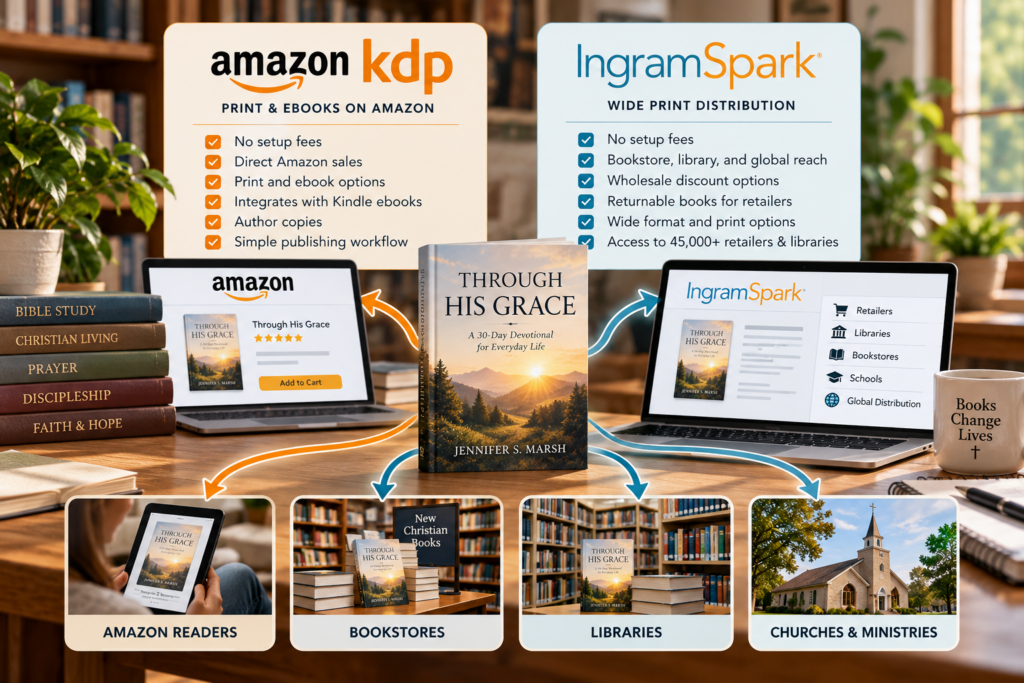
Amazon KDP and IngramSpark both let independent authors publish print books without ordering thousands of copies upfront.
But they serve different strengths.
KDP is tightly connected to Amazon and is simple to use for authors who expect most sales to come through Amazon.
IngramSpark is built around wider wholesale distribution and can make books available to bookstores, libraries, schools, universities, and other retailers through Ingram’s network.
For many Christian authors, the real question is not:
Which platform should I choose?
It is:
Which platform should handle which part of my publishing strategy?
In many cases, the answer may be both.
KDP Is Strongest Inside the Amazon Ecosystem
KDP makes it easy to publish ebooks, paperbacks, and hardcovers directly to Amazon.
There are no upfront title setup fees.
Authors upload their manuscript and cover, set pricing, select distribution options, and publish through the same system used for Kindle books.
For authors whose primary audience shops on Amazon, that simplicity is valuable.
KDP also connects directly with:
- Amazon product pages
- Kindle ebooks
- Kindle Unlimited when enrolled in KDP Select
- Amazon Advertising
- author copies
- Amazon marketplace reporting
If Amazon is likely to generate most of your book sales, KDP is usually difficult to ignore.
IngramSpark Is Designed for Wider Print Distribution
IngramSpark’s advantage is reach beyond Amazon.
Ingram says its distribution network includes more than 45,000 retailers, libraries, universities, educators, and other outlets. IngramSpark
That makes it particularly relevant for authors who want their books available through:
- independent bookstores
- Christian bookstores
- libraries
- schools
- universities
- international retailers
- institutional buyers
This can matter significantly for Christian publishing.
A Bible study workbook may be used by churches.
A Christian children’s book may appeal to schools, libraries, homeschool families, and gift shops.
A Christian nonfiction title may benefit from bookstore and ministry availability.
IngramSpark makes those channels easier to access.
But availability is not the same thing as placement.
Bookstores and libraries still decide whether to order or stock the book.
You Can Use KDP and IngramSpark Together
This is where many authors get confused.
KDP itself does not require print exclusivity.
KDP Select requires exclusivity only for the digital Kindle edition during the enrollment period. Print, audio, and other formats can still be distributed elsewhere. Kindle Direct Publishing
That means an author can use:
KDP for Amazon print sales
and
IngramSpark for wider print distribution
IngramSpark specifically says authors can use both systems when they own the ISBN. It also advises authors not to enable KDP Expanded Distribution when using IngramSpark for that same print edition because it can create distribution conflicts. IngramSpark
For many independent publishers, that combined model makes sense.
ISBN Ownership Matters More When You Use Both
If you plan to use multiple print platforms, owning your ISBN gives you more flexibility.
A free ISBN supplied by a platform is generally tied to that platform’s publishing identity and may not be portable to another service.
IngramSpark’s own guidance explains that platform-issued free ISBNs cannot simply be reused across multiple self-publishing platforms. IngramSpark
If you expect to publish across KDP and IngramSpark, buying and managing your own ISBNs may be the cleaner long-term choice.
That is especially relevant if you are building a publishing imprint rather than releasing only one book.
Setup Costs Have Changed
Older comparisons often say IngramSpark charges around $49 to upload a title.
That is outdated.
IngramSpark’s current rate card lists setup as free. It also currently allows revisions without charge during the first 60 days after the book’s initial production date, with a $25 revision fee applying afterward. IngramSpark
KDP also does not charge a title setup fee.
That means the decision between the two platforms should no longer be framed around a large upfront IngramSpark upload charge.
The more important differences are distribution, wholesale terms, printing costs, workflow, and publishing strategy.
Bookstore Access Is Where IngramSpark Stands Out
Bookstores already work extensively with Ingram.
That makes an Ingram-distributed title easier for many booksellers to locate and order through their normal systems.
IngramSpark also allows publishers to set wholesale discounts and choose whether books are returnable.
Those settings matter because bookstores generally evaluate both margin and returnability when deciding whether to stock unfamiliar titles.
That does not mean every bookstore will order an IngramSpark book.
Professional cover design, pricing, demand, metadata, local interest, and author outreach still matter.
But IngramSpark gives the book a more familiar wholesale path.
KDP Expanded Distribution Is Not the Same Thing
KDP offers Expanded Distribution for eligible paperbacks.
That can make books available beyond Amazon through third-party distributors.
But if you are already using IngramSpark, using KDP Expanded Distribution for the same ISBN can create conflicts.
IngramSpark specifically warns against that setup when authors are using both platforms. IngramSpark
A cleaner strategy is usually:
KDP standard Amazon distribution
plus
IngramSpark wholesale distribution
That keeps the roles clear.
Printing Options Matter by Book Type
Different books have different production needs.
A simple black-and-white paperback may work very well through KDP.
A children’s book, premium devotional, workbook, hardcover gift book, or image-heavy title may require closer comparison of:
- trim sizes
- paper options
- color printing
- binding
- hardcover choices
- print cost
- proof quality
- availability by region
Do not assume one platform always produces better quality.
Order physical proofs from both if the appearance of the book is especially important.
The right platform may depend on the specific format you are publishing.
Christian Children’s Books Often Benefit From Both
Christian children’s books are a good example of why a dual-platform strategy can make sense.
Amazon may be an important sales channel for parents and grandparents.
But bookstores, libraries, Christian schools, homeschool families, churches, and ministry events may also matter.
KDP can serve Amazon well.
IngramSpark can improve wider ordering availability.
The best setup depends on where the author expects readers and buyers to encounter the book.
Bible Studies and Workbooks May Need Wider Channels
Bible study workbooks often sell differently from ordinary trade books.
They may be purchased:
- in bulk by churches
- by small-group leaders
- through conferences
- through ministry websites
- through bookstores
- directly from the author
For these kinds of products, distribution flexibility can matter more than Amazon ranking alone.
An author might still use KDP for Amazon orders while using IngramSpark or direct fulfillment for other channels.
The important point is to design the distribution around how the product will actually be used.
Payment Timing Is Different
KDP currently pays royalties approximately 60 days after the end of the month in which standard sales are reported. Expanded Distribution royalties are generally paid approximately 90 days later. Kindle Direct Publishing
IngramSpark payment timing varies by sales channel, but its direct Share & Sell ecommerce program currently states that publisher compensation is paid 90 days after the end of the month in which the sale occurred. IngramSpark
For authors with modest sales, payment timing may not drive the platform decision.
For publishers managing larger catalogs and cash flow, it becomes more important.
KDP Select Applies Only to Kindle Ebooks
This distinction deserves emphasis because many publishing articles get it wrong.
KDP Select is optional.
If you enroll a Kindle ebook, the digital edition must remain exclusive to Amazon during the 90-day enrollment period. Kindle Direct Publishing
That does not prevent you from distributing the paperback or hardcover elsewhere.
It also does not require every book published through KDP to be exclusive.
An author can publish print through KDP and IngramSpark while deciding separately whether the ebook belongs in KDP Select.
Which Platform Is Easier to Use?
KDP is generally straightforward for authors already familiar with Amazon.
Its publishing workflow is built around guided steps and preview tools.
IngramSpark requires more attention to traditional publishing concepts such as:
- wholesale discounts
- returns
- distribution settings
- print specifications
- ISBN ownership
- territorial pricing
That does not make IngramSpark unnecessarily difficult.
It reflects the fact that the platform serves broader publishing and wholesale channels.
Authors who intend to build a larger catalog usually benefit from learning those concepts anyway.
Which Platform Is Better for Direct Amazon Sales?
KDP is generally the natural choice for print sales taking place directly on Amazon.
The platform controls the Amazon listing and integrates directly into Amazon’s fulfillment infrastructure.
Using KDP for Amazon and IngramSpark for the wider market is therefore a common strategy.
The exact economics still depend on:
- list price
- page count
- trim size
- ink type
- printing cost
- marketplace
- discount settings
Never assume one platform pays more without running the numbers for the actual book.
Which Platform Is Better for Bookstores and Libraries?
For wider wholesale availability, IngramSpark usually has the stronger infrastructure because the title enters Ingram’s established distribution network.
That makes it particularly useful if bookstore and library availability is part of the publishing plan.
But again, distribution does not guarantee sales.
The book still needs professional production and reader demand.
Frequently Asked Questions
Can I use KDP and IngramSpark at the same time?
Yes. If you own the ISBN, you can generally use KDP for Amazon sales and IngramSpark for wider distribution. IngramSpark recommends not enabling KDP Expanded Distribution in that setup. IngramSpark
Does KDP require exclusivity?
Not for ordinary publishing. KDP Select requires digital exclusivity only for the enrolled Kindle ebook during its 90-day term. Print can still be distributed elsewhere. Kindle Direct Publishing
Does IngramSpark still charge a setup fee?
Its current rate card lists title setup as free. Revisions are currently free during the first 60 days after the initial production date and $25 afterward. IngramSpark
Which platform is better for bookstores?
IngramSpark generally offers stronger wholesale bookstore access because of Ingram’s established distribution network. That makes ordering easier, but bookstores still decide whether to stock individual titles.
Which platform is better for Amazon?
KDP is usually the more direct choice for Amazon print sales because it is Amazon’s own publishing platform.
Do I need different ISBNs for KDP and IngramSpark?
Not if you own the ISBN and are distributing the same edition in a compatible way. Platform-provided free ISBNs have more restrictions and generally cannot be transferred between platforms. IngramSpark
Should Christian authors use both?
Often, yes, especially when the audience includes Amazon shoppers as well as churches, bookstores, libraries, schools, or ministry organizations. But the best setup depends on the specific book and reader channels.
Choose Distribution Based on Where Your Readers Are
KDP and IngramSpark are not necessarily competitors in an either-or decision.
They can serve different roles.
KDP gives Christian authors direct access to Amazon’s enormous retail ecosystem.
IngramSpark expands print availability into the broader wholesale publishing market.
For an author focused almost entirely on Amazon, KDP may be enough.
For an author who wants bookstore, library, school, church, or institutional reach, IngramSpark may add meaningful value.
For many authors, the strongest approach is:
KDP for Amazon.
IngramSpark for wider print distribution.
Then build the rest of the publishing strategy around where the actual readers are.