How Christian Authors Can Publish Beyond Amazon KDP
Amazon can remain an important sales channel without becoming your entire publishing strategy. Explore wide ebook distribution, IngramSpark, audiobooks, direct sales, libraries, and other ways Christian authors can reach readers.
Amazon KDP is an important publishing platform.
For many independent authors, it may remain one of the most important places to sell ebooks and print books.
But Amazon does not have to be your entire publishing business.
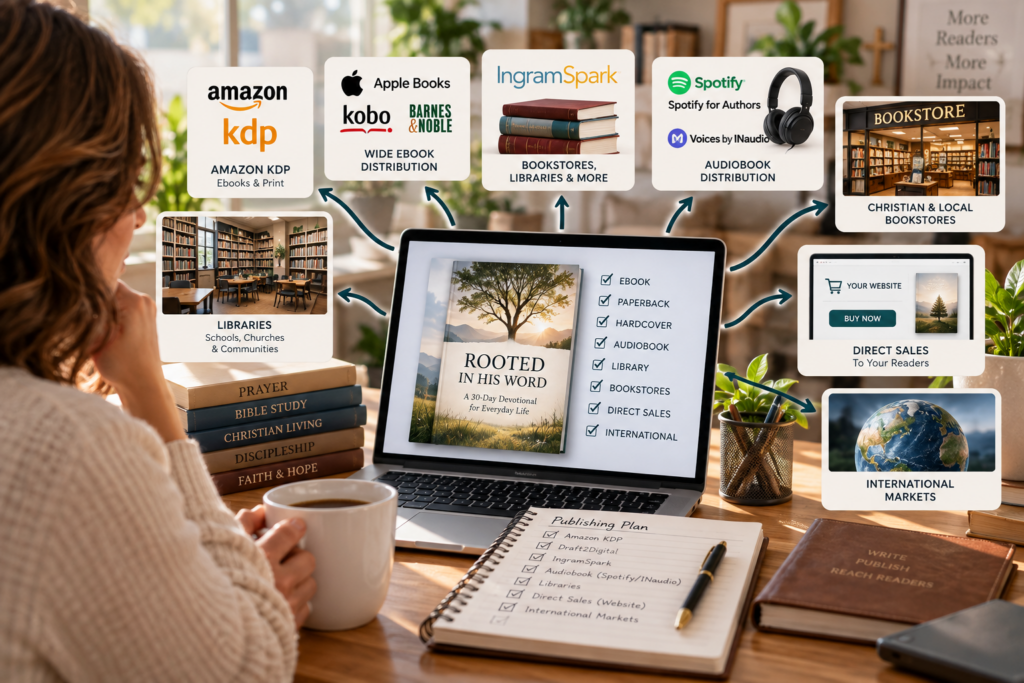
Christian authors may also want to reach readers through bookstores, libraries, churches, ministries, schools, homeschool communities, their own websites, international retailers, and audiobook platforms.
That requires thinking beyond one storefront.
Publishing widely does not mean abandoning Amazon.
It means understanding which channels serve your books, your readers, and your long-term publishing goals.
Start With the Difference Between KDP and KDP Select
One important distinction is often overlooked.
Publishing an ebook through KDP does not automatically make that ebook exclusive to Amazon.
KDP Select does.
KDP Select is Amazon’s optional 90-day program for Kindle ebooks. When an ebook is enrolled, the digital edition must remain exclusive to the Kindle Store during the enrollment period. The ebook is also included in Kindle Unlimited and becomes eligible for certain Amazon promotional programs. Kindle Direct Publishing
Print and audio editions are not subject to that same ebook exclusivity requirement.
That means authors who do not enroll an ebook in KDP Select can generally distribute that ebook through other retailers as well.
Before choosing a wide-distribution strategy, decide whether Kindle Unlimited exclusivity or broader ebook availability better fits the particular book.
There is no universal right answer.
Why Christian Authors May Benefit From Wider Distribution
Christian publishing often includes reader channels that extend beyond Amazon.
A Christian children’s book might fit:
church bookstores
Christian schools
homeschool communities
libraries
family ministries
A Bible study workbook might be useful for:
small groups
churches
retreats
ministry organizations
direct sales
A Christian nonfiction author may reach readers through:
conferences
speaking events
podcasts
church leadership networks
author websites
Wide publishing can make a book easier to order through some of those channels.
It can also reduce dependence on one retailer for discovery, sales, and customer access.
The point is not to put every book everywhere.
The point is to choose channels intentionally.
Draft2Digital Can Simplify Wide Ebook Distribution
Authors who want to distribute ebooks beyond Amazon can upload directly to individual retailers or use an aggregator.
Draft2Digital is one of the better-known aggregation options.
It distributes ebooks and print books to major online retailers and additional storefronts, while allowing authors to choose which stores they want to use. Draft2Digital
That can simplify distribution to retailers such as Apple Books, Kobo, Barnes & Noble, and others without maintaining a separate publishing workflow for every store.
This is especially useful for authors who value convenience over managing every retailer relationship individually.
An aggregator also helps reduce duplicate administrative work.
But authors should still understand the tradeoff.
Direct distribution may provide more direct control or retailer-specific tools, while aggregation offers simplicity.
Choose based on the size of your catalog and how much platform management you want to handle.
IngramSpark Can Expand Print Availability
Amazon KDP is convenient for Amazon print sales.
IngramSpark serves a different role.
It connects print books to Ingram’s global distribution network, which includes bookstores, libraries, schools, universities, online retailers, and other buyers. IngramSpark currently says its network reaches more than 45,000 retail and institutional outlets. IngramSpark
That can matter for Christian authors who want their books to be orderable outside Amazon.
However, one distinction is essential:
Availability does not guarantee placement.
When an IngramSpark title is enabled for wholesale distribution, retailers and libraries can find and order it through Ingram’s systems. Individual buyers still decide whether to stock or purchase the title. IngramSpark
A book still needs demand, appropriate pricing, professional production, strong metadata, and often suitable wholesale terms.
IngramSpark opens a distribution door.
It does not create demand by itself.
IngramSpark and KDP Can Be Used Together
Authors do not always have to choose one print platform.
IngramSpark states that it is non-exclusive, so authors can also use other printers and distributors. It specifically advises authors who publish print directly through KDP not to use KDP Expanded Distribution when using IngramSpark for broader print distribution. IngramSpark
That makes a combined strategy possible:
KDP for Amazon print sales
and
IngramSpark for broader wholesale distribution
The exact setup depends on ISBN ownership, formats, territories, and distribution choices, so authors should plan those details before publishing.
PublishDrive Offers Another Wide-Distribution Model
PublishDrive provides ebook, print, and audiobook distribution through a subscription-based model.
Its current plans use a flat subscription structure rather than taking a percentage of store royalties, with different catalog limits depending on the plan. PublishDrive Help Center
PublishDrive also distributes through a large network of retailers and library channels and allows authors to disable stores where a title is already distributed directly or through another service. PublishDrive Help Center
That makes it more relevant for authors or small publishers managing a growing catalog.
For a Christian author publishing one book, it may be more infrastructure than necessary.
For someone building a larger catalog across multiple formats, it may be worth comparing with percentage-based aggregators.
Libraries Are a Real Distribution Channel
Libraries should not be treated as an afterthought.
Several wide-distribution services can make ebooks or print books available through library channels.
IngramSpark distributes to libraries as part of its broader network. IngramSpark
PublishDrive also distributes digital titles to library services including OverDrive and others. Publish Books Online
Christian authors with books serving families, schools, churches, Bible-study readers, or local communities may find libraries particularly relevant.
Again, being available to a library does not guarantee acquisition.
But wide distribution makes acquisition possible in channels Amazon alone may not serve as effectively.
Audiobook Distribution Has Changed
Audiobooks are another area where older publishing advice becomes outdated quickly.
Spotify now allows self-published authors to upload audiobooks directly through Spotify for Authors. Spotify for Authors
Spotify also works with Voices by INaudio, formerly Findaway Voices by Spotify, for distribution to other audiobook retailers and library platforms. Spotify
That means independent authors now have more audio-distribution options than simply choosing between Audible and an older Findaway workflow.
For Christian authors with devotionals, nonfiction, memoirs, or teaching-oriented books, audio may provide an especially useful additional format.
Readers may listen during commuting, exercise, household work, or devotional time.
The format should fit the book, but it is increasingly worth considering.
Direct Sales Give Authors Something Retailers Cannot
Wide retail distribution is useful.
Direct sales can be even more strategically valuable.
When readers purchase through Amazon or another retailer, the retailer owns most of the customer relationship.
When readers buy directly from the author, the author can build a much stronger connection.
That matters for Christian authors because the book may be only one part of a larger relationship involving:
email newsletters
devotionals
Bible studies
speaking
courses
future books
community
ministry resources
Lulu Direct, for example, currently integrates print-on-demand fulfillment with Shopify, Wix, WooCommerce, and its own direct-buy tools. It handles printing and fulfillment while allowing the author to sell through their own audience channels. Lulu
Direct sales can also allow authors to retain customer information, subject to appropriate consent and privacy practices.
That can be strategically important for building an author platform.
Direct Sales Can Be Especially Useful for Christian Authors
Christian authors sometimes sell books in environments where ordinary retail distribution is not the natural fit.
Examples include:
church events
retreats
conferences
speaking engagements
homeschool conventions
Bible-study groups
ministry workshops
author websites
A direct-sales system allows the author to combine publishing with existing relationships.
That could mean:
a QR code at an event
a buy button in an email newsletter
a book bundled with a study resource
a workbook sold through a ministry website
a signed-book promotion
Direct sales require more planning, but they can also give authors more control over presentation, customer experience, and future communication.
Do Not Confuse Distribution With Marketing
One of the biggest mistakes in wide publishing is assuming more storefronts automatically produce more sales.
They do not.
Distribution answers:
Where can someone buy the book?
Marketing answers:
Why would someone know the book exists and want it?
Adding Apple Books, Kobo, Ingram, libraries, and direct sales increases availability.
It does not replace:
email marketing
content marketing
author platforms
reviews
book descriptions
cover design
podcasts
paid advertising
church relationships
reader communities
Wide distribution works best when the author also has a plan to create demand.
Keep Metadata Consistent Across Platforms
The more places a book appears, the more important consistency becomes.
Track:
title
subtitle
author name
series name
ISBN
book description
categories
keywords
pricing
publication date
cover files
edition information
Inconsistent metadata creates confusion.
It can also create duplicate listings or distribution problems.
Maintain one master publishing record for every title.
That becomes increasingly valuable as your catalog grows.
Understand ISBNs Before Going Wide
An ISBN identifies a specific edition and format of a book.
A paperback and hardcover require different ISBNs.
A new edition may require another ISBN.
But distributing the same edition through two services does not automatically mean you need two separate ISBNs simply because the distributor changed.
That is why owning your ISBNs can make multi-platform print distribution easier to manage.
Platform-provided ISBNs may have restrictions or publishing-identity implications.
Plan your ISBN strategy before uploading the same title to multiple print services.
Avoid Duplicate Distribution
Using multiple aggregators can create conflicts if two services try to send the same edition to the same retailer.
For example, PublishDrive specifically allows authors to disable stores where they already distribute directly or through another service. PublishDrive Help Center
That is the right principle generally.
Keep a distribution map.
For each title, record:
which platform sends the ebook to Amazon
which platform sends it to Apple
which platform sends it to Kobo
which service handles print
which service handles libraries
which platform handles audio
Avoid sending identical editions to the same retailer through multiple distributors unless you clearly understand the consequences.
Publishing Wide Does Not Mean Publishing Everywhere
More is not always better.
A devotional author may discover that direct sales, Amazon, church relationships, and libraries matter much more than maintaining every small international storefront.
A Christian fiction author may benefit from broader ebook retail distribution.
A Bible-study publisher may care more about print, direct fulfillment, and ministry partnerships.
A children’s author may value bookstore, school, and library availability.
Distribution should follow the audience.
Do not add platforms merely because they exist.
Build a Publishing System You Control
The strongest reason to diversify is not fear that Amazon will disappear.
It is control.
When your entire publishing business depends on one marketplace, one account, one source of reader discovery, and one sales channel, you have fewer options.
A more resilient publishing system might include:
Amazon
wide ebook retail
Ingram distribution
direct sales
an email list
an author website
audiobooks
libraries
church or ministry relationships
Not every author needs all of them.
But owning more of your publishing infrastructure gives you more choices.
Frequently Asked Questions
Can I publish the same book on KDP and other platforms?
Yes, generally. The important exception is the digital edition of a book enrolled in KDP Select, which must remain exclusive to Kindle during the 90-day enrollment period. Print and audio can still be distributed elsewhere. Kindle Direct Publishing
Can I use both KDP and IngramSpark for print?
Yes. IngramSpark is non-exclusive. If you use KDP for direct Amazon print distribution and IngramSpark for wider wholesale distribution, IngramSpark recommends not enabling KDP Expanded Distribution. IngramSpark
Is Smashwords still a separate distribution strategy?
Draft2Digital acquired Smashwords, and today Draft2Digital is the more relevant platform to evaluate for wide ebook distribution. Draft2Digital
Can independent authors publish audiobooks directly to Spotify?
Yes. Spotify for Authors now allows self-published authors to publish audiobooks directly to Spotify. Wider audiobook distribution can also be handled through Voices by INaudio. Spotify for Authors
Does IngramSpark guarantee bookstore placement?
No. It makes books available through Ingram’s distribution network, but bookstores and libraries decide what they actually order or stock. IngramSpark
Do I need a new ISBN for every distributor?
Not simply because you use another distributor. ISBNs identify editions and formats rather than distribution companies. A paperback and hardcover need different ISBNs, but the same paperback edition can generally retain its ISBN across compatible distribution arrangements.
Should every Christian author publish wide?
No. Some books may perform well with Amazon-focused distribution. Others benefit substantially from bookstores, libraries, direct sales, church networks, or international retailers. Choose based on your audience and goals.
Build More Than One Path to the Reader
Amazon KDP can remain an important part of an independent Christian publishing strategy.
It simply does not have to be the entire strategy.
Draft2Digital can simplify wide ebook distribution.
IngramSpark can expand print availability.
PublishDrive can help manage wider multi-format catalogs.
Spotify and INaudio can broaden audiobook distribution.
Lulu Direct can support direct-to-reader print sales and fulfillment.
And your own website, email list, churches, ministries, events, and communities can create connections no marketplace can fully replace.
The goal is not to escape Amazon.
It is to build enough publishing flexibility that one platform does not determine whether your readers can find you.