Amazon Ads for Christian Authors: How to Test Keywords Before Spending More
Amazon Ads can get expensive when targeting is based on guesses. Learn how Christian authors can test keywords, match types, product targets, negative targeting, and bids before committing more advertising money.
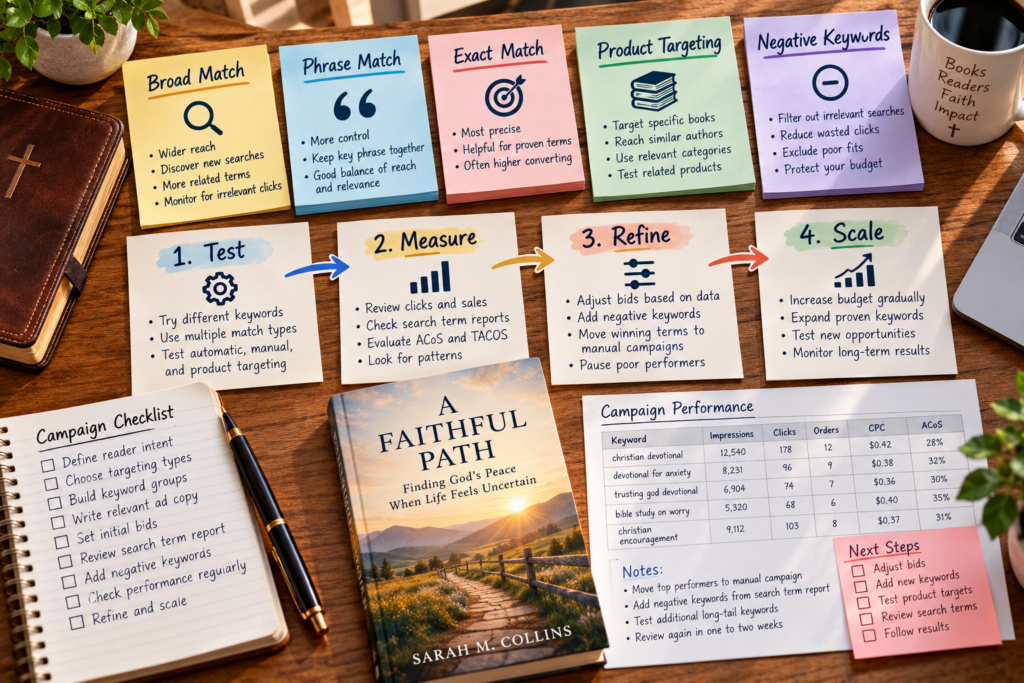
Amazon Ads can help Christian authors put books in front of shoppers who are already browsing for something to read.
But advertising gets expensive quickly when the targeting is too broad, the book page is weak, or the author keeps raising bids without learning which searches actually matter.
The better approach is simple:
Test first. Spend more second.
For Christian authors, that means using Amazon Ads to learn which readers respond to your book before committing larger budgets.
Start With Reader Intent
Before choosing keywords, ask:
What would the right reader type into Amazon to find a book like mine?
A reader looking for a general Christian book may search:
Christian books
But someone with a specific need may search:
Christian devotional for grief
or:
Bible study on trusting God
or:
Christian historical romance
The more clearly the search reflects the book’s actual purpose, the easier it is to understand whether the click is relevant.
Specificity does not automatically guarantee better results.
It gives you a clearer hypothesis to test.
Use Amazon’s Different Targeting Types
Sponsored Products give authors several ways to reach potential readers.
These include:
- automatic targeting
- manual keyword targeting
- product targeting
- negative targeting
Each serves a different purpose.
Automatic targeting can help uncover searches and product relationships you might not have considered.
Manual keyword targeting gives you more control over the terms you want to test.
Product targeting lets you focus on related books, authors, categories, or products.
Negative targeting helps reduce irrelevant traffic.
The goal is not to choose one method forever.
The goal is to learn which methods connect your book with the right readers.
Do Not Use Only Exact Match
Manual keyword targeting includes several match types.
Broad Match
Broad match gives Amazon more freedom to connect your keyword with related searches.
For example:
Christian devotional
may trigger searches that contain related wording.
Broad match can be useful for discovery.
It can also generate irrelevant clicks, so it requires careful monitoring.
Phrase Match
Phrase match provides more control while still allowing additional words around the phrase.
For example:
Christian prayer devotional
may match a search such as:
Christian prayer devotional for women
This gives you a middle ground between reach and precision.
Exact Match
Exact match is the most restrictive option.
It is useful when you already know a particular phrase is relevant to your book.
You do not need to choose one match type permanently.
Testing all three can show you how readers actually search.
Build Keyword Groups Around the Book
Do not start with a massive list of unrelated search terms.
Create smaller groups based on the book itself.
For a Christian devotional about worry, you might test:
Broad theme
Christian devotional
Christian encouragement
faith book
Problem-focused
Christian devotional for anxiety
Christian book about worry
Bible study on fear
Scripture or theme-focused
trusting God devotional
Bible study on peace
Christian book about faith
Audience-focused
Christian devotional for women
Christian devotional for men
devotional for young adults
Only use audience terms if they truly match the book.
Relevance matters more than volume.
Similar Authors and Books Can Be Valid Targets
Advertising works differently from metadata.
You should not insert unrelated author names into your book metadata in an attempt to gain visibility.
Advertising, however, allows you to test relevant books, authors, categories, and products as targets.
If readers who enjoy a particular Christian author are genuinely likely to enjoy your book too, that may be a useful target.
But do not target famous authors simply because they receive traffic.
A Christian romance reader and a reader searching for academic theology may both be interested in faith-based books, but they are not necessarily the same audience.
Automatic Campaigns Can Help You Learn
Automatic campaigns can be valuable research tools.
Amazon may connect your book with:
- close search matches
- looser search matches
- similar books
- related products
That can reveal opportunities you did not identify manually.
If a particular search or product consistently performs well, you can move it into a manual campaign where you have more control.
Think of automatic targeting as a discovery tool.
Product Targeting Deserves Its Own Test
Readers do not always discover books through search terms.
Many find them while browsing other book pages.
Product targeting lets you place ads around relevant titles or categories.
For a Christian historical romance, you might test:
- comparable Christian historical romance titles
- related series
- similar authors
- relevant genre categories
The question is:
What else is my ideal reader already looking at?
That can be just as important as what they type into the search bar.
Suggested Bids Are Information, Not Instructions
Amazon provides suggested bids.
Treat them as useful marketplace information.
Do not treat them as commands.
Your actual bid should consider:
- royalty
- book price
- budget
- competition
- campaign objective
- historical conversion
- cost per click
There is no universal rule that says you should always bid above or below Amazon’s suggestion.
Adjust based on actual performance.
Understand What a Click Is Worth
A click costs money.
That means you need some idea of what an attributed sale is worth to you.
Suppose your paperback royalty is approximately $4.
If your campaign historically takes 12 clicks to generate one sale, your rough break-even cost per click would be:
$4 ÷ 12 = about $0.33 per click
That does not mean you should automatically bid $0.33.
It gives you a reference point.
A Kindle ebook, paperback, hardcover, or series can have very different economics.
Use your own royalty numbers.
Do Not Treat Generic Benchmarks as Rules
You will find plenty of advice online claiming that:
- a certain click-through rate is good
- a particular conversion rate is bad
- a certain ACoS is ideal
- a fixed number of clicks means a keyword has failed
Those benchmarks can provide context.
They should not control your decisions.
Performance varies based on:
- genre
- price
- cover
- reviews
- competition
- book format
- keyword intent
- product page strength
- seasonality
Your most useful benchmark is often your own previous performance.
Use Negative Keywords Carefully
Negative targeting helps prevent your ads from appearing for irrelevant searches.
Suppose you publish clean Christian romance.
If your ad repeatedly appears for searches centered on explicit romance, those clicks may be a poor fit.
A negative keyword can help stop that traffic.
Likewise, an adult devotional may not need to appear for searches related to children’s Bible activity books.
Negative targeting helps protect your budget by eliminating obvious mismatches.
Do Not Add Negative Keywords Too Quickly
Do not react to a handful of clicks.
You need enough information to make a meaningful decision.
A keyword may take time to produce a sale.
A more expensive nonfiction book may convert differently from a low-priced ebook.
A narrow Christian niche may receive fewer searches overall.
Look at the pattern.
Then decide.
The purpose of testing is to reduce guesswork, not replace one kind of guessing with another.
Search Term Reports Are Extremely Useful
The keyword you bid on and the exact phrase the shopper typed are not always identical.
Search term reports can show you what readers actually searched.
Look for:
- unexpected search phrases
- strong-converting terms
- irrelevant traffic
- useful long-tail keywords
- potential negative keywords
- new manual campaign ideas
This is one of the best ways to turn advertising into research.
Keep Automatic and Manual Campaigns Separate
Separating campaign types makes your data easier to understand.
For example:
Campaign 1: Automatic discovery
Campaign 2: Manual keyword testing
Campaign 3: Product targeting
This lets you see which approach is producing results.
If every targeting type is mixed together, learning becomes harder.
Test Match Types Instead of Choosing One Forever
You might test the same idea in several ways.
For example:
Broad: Christian devotional grief
Phrase: Christian devotional grief
Exact: Christian devotional grief
Each version gives Amazon a different level of flexibility.
The point is not to assume which one is best.
The point is to observe how they behave.
Change One Important Variable at a Time
This is one of the most important advertising habits.
Suppose a campaign performs poorly.
If you simultaneously:
- raise bids
- replace keywords
- change the cover
- lower the price
- rewrite the description
and performance improves, you will not know what caused the change.
Make one meaningful adjustment.
Observe.
Then make the next adjustment.
That is how you learn.
Give Tests Enough Time
Do not react to every click.
Advertising data needs time to develop.
A single day can be noisy.
One reader may click today and buy later.
Another keyword may take longer to generate enough traffic to evaluate fairly.
Give campaigns enough time to collect useful information before making major changes.
The exact amount of time will vary by book, genre, budget, and search volume.
Check the Book Page When Clicks Do Not Become Sales
If a keyword consistently attracts relevant traffic but readers do not purchase, the targeting may not be the problem.
Look at the product page.
Check:
- cover
- title
- subtitle
- description
- price
- reviews
- A+ Content
- sample
- positioning
The ad may have done its job.
It brought the reader to the book.
The page may have failed to convince them that the book was worth buying.
Christian Authors Should Watch Audience Fit Closely
Christian publishing contains many different audiences.
Readers may be looking for:
- Christian fiction
- devotionals
- Bible studies
- memoir
- Christian living
- theology
- prayer resources
- marriage books
- children’s faith books
- denominational material
- nondenominational material
You do not need to overcomplicate targeting.
But you should recognize when a search suggests a reader expects something your book does not provide.
Better targeting protects your budget and respects the reader.
Do Not Promise Spiritual Outcomes
Christian advertising should remain truthful.
Avoid claims such as:
End your anxiety with this devotional.
Fix your marriage with this book.
Restore your faith in 30 days.
You cannot guarantee those outcomes.
A stronger approach is:
A 30-day devotional exploring Scripture, prayer, and trust during uncertain seasons.
That communicates what the book offers without making promises you cannot support.
Measure More Than Clicks
Clicks are only one part of the picture.
Useful campaign metrics may include:
- impressions
- clicks
- cost per click
- attributed orders
- attributed sales
- ad spend
- ACoS
- total book sales
- Kindle Unlimited page reads
- series read-through
For series authors especially, the first sale may not tell the whole story.
A reader who discovers Book One through an ad may later buy Books Two, Three, and Four.
That changes the economics.
ACoS and TACOS Tell Different Stories
ACoS compares advertising spend with attributed advertising sales.
It helps you evaluate direct campaign efficiency.
TACOS compares advertising spend with total sales.
It can help show how advertising fits into the broader performance of the book or catalog.
Neither number has one universally correct percentage.
Your royalties, objectives, and catalog structure determine what makes sense.
Scale Slowly
When a keyword, product target, or campaign consistently supports your goals, you may consider increasing investment.
Possible next steps include:
- raising bids
- raising budget
- testing related keywords
- expanding product targets
- testing another match type
Do not move from a small test to a large spend overnight.
Increase gradually.
Then watch whether performance holds.
Frequently Asked Questions
Should I use automatic or manual targeting first?
Both can be useful. Automatic targeting can uncover search behavior and related products, while manual targeting gives you more control.
Which keyword match type should Christian authors use?
Broad, phrase, and exact can all be useful. Broad helps discovery, phrase adds more control, and exact is the most restrictive. Testing is more useful than assuming one is always best.
Should I use Amazon’s suggested bid?
Use it as a reference point. Your actual bid should reflect your royalty, budget, objective, competition, and campaign performance.
When should I add a negative keyword?
Consider it when a search is clearly irrelevant or consistently produces poor-quality traffic. Avoid reacting too quickly to small amounts of data.
How long should I test a keyword?
There is no universal number of days. Give the campaign enough time to collect meaningful data before making decisions.
Should I advertise only Book One in a series?
Book One is often a logical entry point, but the right strategy depends on series structure, pricing, read-through, and your campaign objective.
Is a high click-through rate enough?
No. Clicks show interest, but you also need to consider purchases, advertising cost, royalties, and broader book performance.
Can Amazon Ads fix a weak book page?
No. Ads can increase visibility, but they cannot repair poor positioning, an ineffective cover, unclear description, or weak audience fit.
Test Before You Scale
Amazon Ads do not become efficient because an author discovers one magical keyword.
They improve through disciplined testing.
Start with reader intent.
Use automatic and manual targeting.
Test broad, phrase, and exact match.
Study search terms.
Use negative targeting carefully.
Understand what each click is worth.
Check the product page when traffic does not convert.
Make one meaningful change at a time.
Then increase spending only when the data gives you a reason.
That is how Christian authors can use Amazon Ads as a learning system rather than a guessing game.