How Amazon Helps Readers Discover Your Book: What Christian Authors Should Know
Amazon book discovery is not controlled by a simple ranking formula. Learn how keywords, categories, metadata, sales history, availability, and reader fit help Christian authors improve discoverability.
Publishing a book on Amazon does not guarantee readers will find it.
Amazon has to decide where a title belongs, which searches it may be relevant to, and how it fits among millions of other products.
That process is dynamic.
There is no public three-step formula that authors can manipulate to guarantee higher placement.
Instead, Amazon says search results may be influenced by factors including past sales history, availability, popularity, how long the item has been listed, keywords, book details, and other information associated with the title. Kindle Direct Publishing
For Christian authors, the best strategy is not to chase an algorithm.
It is to make it easier for Amazon and readers to understand exactly what the book is, who it serves, and why it belongs in a particular search or category.
Amazon Search Is Dynamic, Not a Fixed Formula
Search placement can change.
A book that appears prominently today may move tomorrow even if you changed nothing.
Amazon explicitly says search results are determined automatically using multiple factors and are constantly changing. Kindle Direct Publishing
That means claims such as:
“sales velocity determines 40% of rank”
“conversion rate is one of three core signals”
or
“sell X copies per day to reach position Y”
should be treated cautiously unless Amazon itself confirms them.
Amazon does confirm that search can be influenced by:
- past sales history
- availability
- popularity
- length of time listed
- keywords
- book details
That is enough to build a useful publishing strategy without inventing a ranking formula.
Best Sellers Rank Is Not the Same as Search Position
Authors often confuse Best Sellers Rank with search ranking.
They are related concepts, but they are not the same measurement.
Amazon says Best Sellers Rank and Category Rank are based on customer activity relative to other books. Recent activity is weighted more heavily, but historical activity also matters. Kindle Direct Publishing
That rank is relative.
Your rank can move even when your own sales stay the same because other books are gaining or losing activity.
Search placement is different.
Search results are created dynamically based on relevance and other factors.
So a book can have a respectable Best Sellers Rank without appearing first for every relevant keyword.
Likewise, a book may appear in useful searches without having an extraordinary overall sales rank.
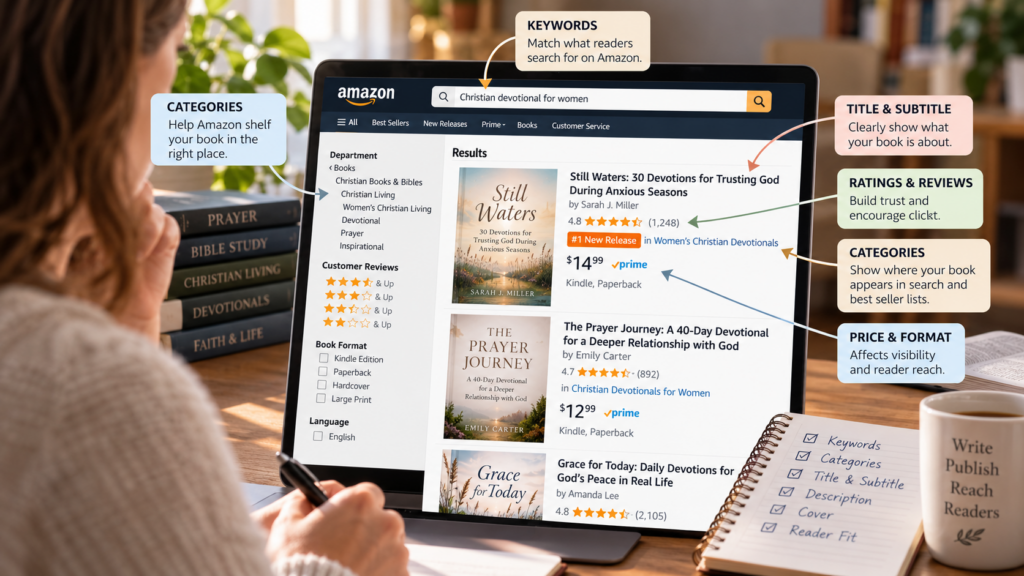
Keywords Help Amazon Understand the Book
Keywords are one of the clearest tools authors can control.
KDP currently lets authors enter up to seven keywords or short phrases. Amazon recommends using terms that accurately describe the book and reflect how customers may search for it. Kindle Direct Publishing
Useful keyword ideas can include:
- setting
- character type
- character role
- plot theme
- tone
- topic
- audience
- problem being addressed
For a Christian book, that might include phrases such as:
Christian grief devotional
Bible study for women
faith after loss
Christian parenting anxiety
small group Bible study
The exact terms should describe the actual book.
Do not insert unrelated keywords simply because they appear popular.
Do Not Stuff Keywords Into the Title
This is one place where older KDP advice can cause trouble.
The old article recommends building titles around exact search phrases and front-loading keywords.
That is too aggressive.
Amazon says the title field should contain only the actual title shown on the book cover. Authors should not add generic search keywords, promotions, unrelated terms, or other metadata simply to gain visibility. Kindle Direct Publishing
The title should first be a legitimate title.
The subtitle can clarify the book’s subject or purpose, but it must also match the published book and follow Amazon’s metadata rules.
For example:
Still Waters
may be the actual title.
A legitimate subtitle might be:
30 Devotions for Trusting God During Anxious Seasons
That clarifies the book for readers without turning the title into a string of search terms.
Think Like a Reader When Choosing Keywords
Amazon specifically advises authors to think like readers.
Ask:
What would someone type if they were looking for this book?
What problem are they trying to solve?
What type of book do they expect?
What subject, life stage, genre, or faith context matters?
Amazon even recommends testing proposed keywords in its own search field and reviewing the suggestions and results. Kindle Direct Publishing
But autocomplete should be treated as research, not as proof of exact search volume.
Amazon does not tell authors that autocomplete phrases represent a specific number of searches.
Use those suggestions to understand language and intent.
Do not build precise sales forecasts from them.
Categories Help Amazon Shelf the Book
Categories act like digital bookstore shelves.
KDP currently allows authors to choose up to three categories when setting up a book. Kindle Direct Publishing
Amazon advises authors to balance:
- relevance
- popularity
- specificity
That is much better guidance than simply chasing the smallest category.
A Christian devotional about grief should not be placed in an unrelated niche just because it appears easier to rank there.
The goal is to place the book where appropriate readers are actually browsing.
If a category is too broad, the book may be difficult to discover.
If it is too narrow or inaccurate, it may reach the wrong readers.
Choose categories based on genuine fit.
Keywords Can Support Category Placement
Amazon also notes that keywords can help determine how a book is shelved when a highly specific category is not available. Kindle Direct Publishing
That means categories and keywords should work together.
Suppose you publish:
A Christian devotional for caregivers of aging parents
Your selected categories may be broader than that exact niche.
Keywords can add specificity around:
Christian caregiving
caregiver devotional
faith for aging parents
Christian encouragement caregivers
Together, those signals help Amazon understand the book more clearly.
Metadata Consistency Matters
Amazon uses book details to create the product page and to help organize titles.
Those details include:
- title
- subtitle
- author
- description
- categories
- keywords
- audience
- language
- edition
- series
Amazon says metadata should accurately represent the book and should remain consistent across formats. Kindle Direct Publishing
If your paperback is titled one way and your ebook another, linking and discoverability can become more difficult.
Likewise, inconsistent subtitles, author names, or series information can create confusion.
Good discoverability starts with clean metadata.
Your Description Helps the Reader Understand the Book
The description is not simply a place to repeat keywords.
Amazon advises authors to focus the description on the content of the book. Kindle Direct Publishing
For Christian nonfiction, that means clearly communicating:
- who the book is for
- what problem it addresses
- what the reader will find inside
For fiction:
- protagonist
- conflict
- stakes
- emotional or spiritual tension
For devotionals:
- audience
- season of life
- structure
- Scripture-centered experience
A good description improves the reader experience.
It also helps align expectations.
That matters because discoverability without reader fit is not especially useful.
Covers Affect Click Decisions Even If They Are Not Search Keywords
A cover does not function like a backend keyword.
But it matters enormously once the book appears in front of a shopper.
Readers make quick judgments at thumbnail size.
A cover should communicate:
- genre
- tone
- professionalism
- intended audience
A Christian suspense novel should not look like a devotional.
A Bible study workbook should not resemble a romance novel.
A children’s Christian book should not look like adult nonfiction.
Discoverability gets the book seen.
The cover helps determine whether someone wants to investigate further.
Search Visibility and Conversion Are Different Problems
This distinction is extremely useful.
If readers rarely see the book, you have primarily a visibility problem.
Look at:
- keywords
- categories
- metadata
- audience demand
- external marketing
- advertising
If people reach the product page but do not buy, you have more of a conversion problem.
Look at:
- cover
- title
- subtitle
- description
- price
- reviews
- sample
- audience fit
Do not try to fix every problem with more keywords.
And do not assume poor sales automatically mean poor search placement.
Diagnose the stage first.
Sales History Does Matter, but Not Through a Simple Formula
Amazon says past sales history can influence search results. Kindle Direct Publishing
Amazon also says recent and historical customer activity contribute to Best Sellers Rank, with recent activity weighted more heavily. Kindle Direct Publishing
That means sales activity matters.
But Amazon does not provide authors with a precise equation such as:
five sales per day = page-one ranking
or
30-day sales velocity determines X percentage of search placement
Those formulas should not be presented as fact.
Instead, focus on the practical takeaway:
Books that consistently attract real reader activity may gain stronger marketplace visibility over time.
Availability Also Matters
Amazon lists availability as one factor that can influence search results. Kindle Direct Publishing
That sounds obvious, but it matters operationally.
Make sure:
- formats are live
- books are not accidentally suppressed
- metadata updates have completed
- titles are properly linked
- pricing is valid
- regional marketplaces are active where intended
Amazon notes that newly published or republished books can take up to 72 hours to appear properly in search. Kindle Direct Publishing
So do not panic immediately after publication if search visibility is still settling.
Search Results Can Change Without Anything Being Wrong
Amazon search is not static.
A book may appear on the first page today and farther down tomorrow.
Amazon explicitly says that is normal behavior. Kindle Direct Publishing
Changes can result from:
- competitor activity
- customer behavior
- new titles
- changes in popularity
- search context
- marketplace differences
- Amazon testing
That means checking your exact search position every few hours is not a useful publishing strategy.
Look for broader trends rather than daily fluctuations.
Amazon Does Not Guarantee Top Search Placement
Another point worth making clearly:
Amazon does not guarantee that a book will appear near the top of results. Kindle Direct Publishing
That remains true even if:
- the metadata is correct
- the keywords are relevant
- the categories fit
- the book sells consistently
Your goal is to improve relevance and reader fit.
Not to obtain a guaranteed position.
Ads Can Increase Visibility, but They Are Not an Organic-Ranking Guarantee
Amazon advertising can help put a book in front of shoppers.
But authors should be cautious about claims that ads automatically create permanent organic-ranking gains.
Ads can generate:
- impressions
- clicks
- purchases
- reader awareness
Sales generated through advertising contribute to real customer activity, but Amazon does not publish a simple rule stating that paid traffic creates a specific organic-search boost.
Treat ads as advertising.
Use them to reach qualified readers and test demand.
Do not rely on them as a secret ranking mechanism.
Best Sellers Rank Should Not Become the Goal
Best Sellers Rank can be useful as a relative indicator of activity.
But it is not the same thing as building a sustainable readership.
For Christian authors especially, stronger long-term goals may include:
- reaching the right readers
- building an email list
- increasing repeat readership
- growing a series
- serving churches or ministries
- building direct sales
- earning genuine reviews
- creating useful books readers recommend
Rank is a snapshot.
Reader relationships are an asset.
Optimize for the Right Reader, Not the Algorithm
It is tempting to think Amazon discoverability is a technical puzzle.
Find the right keywords.
Find the easiest category.
Trigger the right signal.
Climb the rank.
But that mindset can pull authors away from the real objective.
Amazon wants shoppers to find products relevant to what they are looking for.
Authors should want exactly the same thing.
That means:
Choose accurate keywords.
Use appropriate categories.
Keep metadata consistent.
Write a clear description.
Use a professional cover.
Price appropriately.
Serve a defined reader.
Then market the book to people who are genuinely likely to want it.
That strategy is less exciting than a secret ranking formula.
It is also much more durable.
Frequently Asked Questions
Does Amazon use three ranking signals for books?
Amazon does not publish a three-factor ranking formula. It says search results may be influenced by multiple factors including past sales history, availability, popularity, length of time listed, keywords, book details, and other information. Kindle Direct Publishing
How many keywords can I use on KDP?
KDP currently allows up to seven keywords or short phrases. Amazon recommends using relevant terms that reflect how customers might search for the book. Kindle Direct Publishing
How many categories can I select?
KDP currently allows authors to select up to three categories during book setup. Kindle Direct Publishing
Should I put search keywords in my book title?
Only when they are legitimately part of the actual title. Amazon says the title field should match the title shown on the book cover and should not be stuffed with generic search terms or promotional language. Kindle Direct Publishing
Does Best Sellers Rank determine search placement?
Not by itself. Amazon describes Best Sellers Rank as a measure of customer activity relative to other books. Search results are determined dynamically using several factors. Kindle Direct Publishing
How long does it take a new book to appear in Amazon search?
Amazon says newly published or republished books may take up to 72 hours to appear in search results. Kindle Direct Publishing
Should I constantly change my keywords?
No. Amazon allows keywords to be updated, but changes should be based on relevance and improved understanding of the reader, not constant experimentation for its own sake. Kindle Direct Publishing
Help Amazon Understand the Book
You do not need to reverse-engineer Amazon’s search algorithm.
You need to make the book understandable.
Clear title.
Accurate subtitle.
Relevant keywords.
Appropriate categories.
Consistent metadata.
Strong description.
Professional cover.
Defined audience.
Real reader activity.
Those are the things authors can work on responsibly.
Instead of asking:
How do I rank my book?
ask:
How do I make it easier for the right reader to find and understand my book?
That question leads to much better publishing decisions.