Amazon Ads Keyword Strategy for Christian Authors
Amazon Ads can help Christian authors reach readers already searching for related books. Learn how to choose relevant keywords, test targeting, evaluate campaign data, and understand what each click is really worth.
.
Publishing a Christian book on Amazon does not guarantee that the right readers will find it.
A devotional about grief may compete with thousands of other devotionals.
A Christian romance may appear beside books serving very different audiences.
A Bible study on prayer may never reach the reader who is searching for exactly that subject.
Amazon Ads can help place a book in front of readers who are already browsing and searching for books.
But advertising works best when your targeting reflects what your actual reader wants.
For Christian authors, that means going beyond broad keywords such as Christian book or Bible study and building campaigns around reader intent.
How Amazon Ads Work for Authors
One of the primary advertising options for authors is Sponsored Products.
These ads can appear in Amazon shopping results and on product detail pages.
You generally pay when someone clicks the advertisement, not merely when the ad is displayed.
Amazon gives authors several ways to target potential readers.
These include:
- automatic targeting
- keyword targeting
- product targeting
- category targeting
Keyword targeting is especially useful when you know what your potential readers may type into Amazon’s search bar.
The goal is not to generate as many clicks as possible.
The goal is to earn relevant clicks from people who may genuinely want your book.
Start With the Reader, Not the Keyword Tool
Before building a campaign, describe the reader you want to reach.
Suppose you published a devotional about trusting God during uncertain seasons.
Your reader might be searching for:
- devotional about trusting God
- Christian devotional for difficult times
- devotional for anxiety and worry
- Bible devotional about faith
- Christian encouragement book
Those phrases reveal intent.
Compare that with:
Christian
That keyword could describe almost anything.
Broad targeting can have a place in testing, but specificity helps you understand why someone might actually be interested in the book.
Build Keywords From the Book Itself
Your first keyword ideas should come from the actual product.
Look at:
- title
- subtitle
- central theme
- genre
- audience
- problem addressed
- biblical subject
- emotional need
- setting
- book format
- comparable reading interests
For a Christian marriage book, possibilities might include:
Christian marriage book
biblical marriage advice
Christian communication marriage
faith based marriage book
Christian book for couples
For a Bible study on Philippians:
Philippians Bible study
Bible study on joy
Christian study guide Philippians
small group Philippians study
Philippians study workbook
The closer the term is to the reader’s reason for buying the book, the more useful it may be as a test.
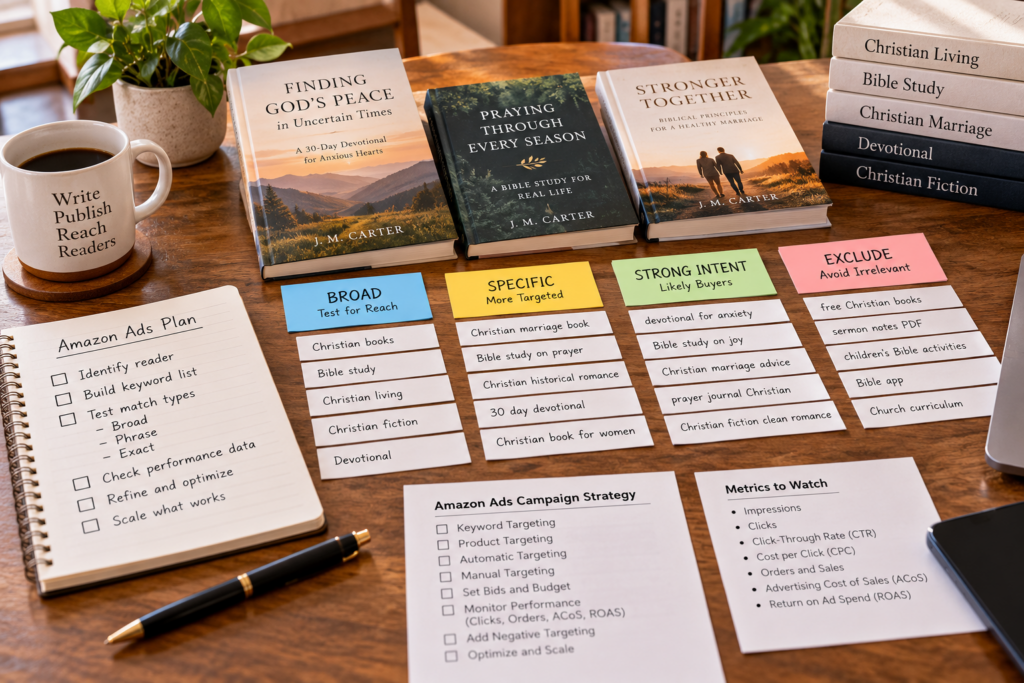
Use a Range From Broad to Specific
Do not assume every keyword needs to be long.
Amazon itself recommends testing a range of terms from broader categories to more specific searches.
Think in layers.
A Christian historical romance might test:
Broad
Christian fiction
Christian romance
historical romance
More specific
Christian historical romance
faith based historical fiction
clean historical romance
Highly specific
Christian historical romance frontier
Christian romance second chance
historical Christian marriage of convenience
You are not declaring in advance which one will perform best.
You are creating groups that can be measured.
Similar Books and Authors Can Also Inform Targeting
Amazon advertising differs from Amazon book metadata in an important way.
You should not stuff another author’s name into your book’s metadata merely to attract their traffic.
Advertising, however, specifically allows authors to target relevant authors, publishers, titles, products, and ASINs.
That can be useful.
If readers who enjoy a particular Christian author are genuinely likely to enjoy your book too, that author may be worth testing as an advertising target.
The key word is relevant.
Do not target every famous Christian author simply because the name receives traffic.
A theological reference book and a Christian romantic suspense novel may both be Christian books, but they serve very different readers.
Consider Product Targeting Alongside Keywords
You are not limited to search phrases.
Sponsored Products can also target relevant products and categories.
That means you may be able to place your book around readers browsing:
- comparable books
- related series
- similar authors
- closely related categories
For some books, product targeting can be easier to conceptualize than keyword targeting.
Instead of asking:
What would my reader type?
you ask:
What else would my reader realistically consider buying?
Both questions are valuable.
Automatic Campaigns Can Help You Learn
Automatic targeting lets Amazon determine relevant placements based on the information it has about your book.
That can be useful for discovery.
You may learn that shoppers are finding your book through searches or products you did not initially consider.
A practical strategy is to use automatic targeting as one source of information, then move promising terms or targets into controlled manual campaigns where you can manage them more deliberately.
Automatic campaigns are not substitutes for strategy.
They can be research tools within the strategy.
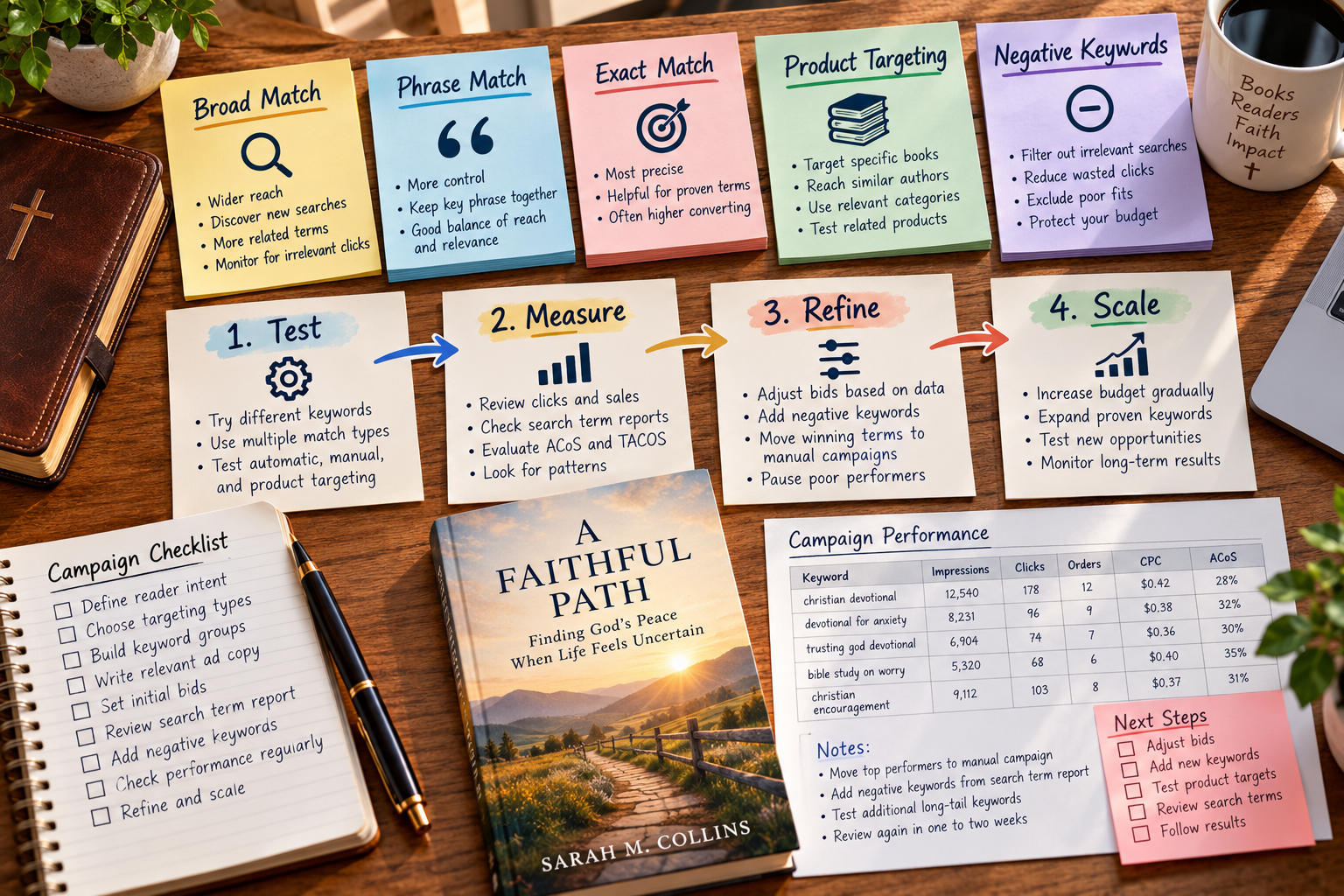
Understand Broad, Phrase, and Exact Matching
Manual keyword campaigns can use different match types.
Broad match gives Amazon more flexibility to match your keyword with related searches.
Phrase match keeps the general phrase together while allowing additional terms around it.
Exact match is more restrictive and focuses on searches closely matching your selected term.
Suppose your keyword is:
Christian prayer devotional
Broad matching may reach a wider range of related searches.
Phrase matching keeps that idea more tightly connected.
Exact matching gives you the most control.
None is automatically best.
They serve different purposes.
A broader match can help discover search behavior.
Exact matching can help you control targeting once you know a term matters.
Do Not Assume a Click Is a Success
Clicks cost money.
A keyword generating a lot of clicks may look exciting until you discover that none of those visitors purchase the book.
Your campaign should be evaluated beyond traffic.
Watch metrics such as:
- impressions
- clicks
- click-through rate
- cost per click
- orders
- attributed sales
- advertising spend
- ACoS
- ROAS
Each tells you something different.
Impressions tell you whether the ad is being shown.
Clicks tell you whether shoppers respond to what they see.
Orders begin to tell you whether the book page fulfills the expectation created by the targeting.
A Keyword Can Be Relevant and Still Perform Poorly
Suppose you advertise a devotional using:
Christian devotional
The term accurately describes your book.
But it may attract too many types of devotional shoppers.
One reader wants devotionals for women.
Another wants a men’s study.
Another wants a one-year devotional.
Another wants a grief devotional.
Your book may satisfy only a small portion of those shoppers.
Now consider:
30 day devotional for grief
The potential audience is smaller.
But the intent may be much closer to your actual product.
This is why advertising decisions should be based on performance rather than assumptions about search volume.
Calculate What a Sale Is Worth to You
This is where the old article oversimplified the math.
Do not calculate profitability using the book’s retail price alone.
What matters to you is the royalty you actually earn.
Suppose your royalty on a particular sale is approximately $4.
If your campaign historically requires ten ad clicks to generate one attributed sale, your rough advertising break-even point would be:
$4 royalty ÷ 10 clicks = $0.40 per click
Spend substantially more than that and the direct sale may not cover the advertising expense.
Spend less and the economics may work better.
But your actual numbers matter.
Do not assume somebody else’s conversion rate applies to your book.
Use your own campaign history.
ACoS Does Not Equal Profit
ACoS means Advertising Cost of Sales.
The formula is:
Advertising spend ÷ attributed sales revenue × 100
If you spend $20 in advertising and Amazon attributes $100 in retail sales to those ads, your ACoS is 20%.
That sounds profitable.
But Amazon’s $100 sales figure is not necessarily the amount you receive.
Your actual income is your royalty after Amazon’s applicable costs and royalty structure.
Therefore, your break-even ACoS depends on your particular book economics.
A hardcover.
A paperback.
A 70% royalty Kindle ebook.
A 35% royalty Kindle ebook.
Those may have very different break-even points.
Know your royalty before deciding whether an ACoS is acceptable.
Separate Discovery From Performance
Early campaigns should teach you something.
You may discover:
- which search terms produce impressions
- which terms produce clicks
- which product targets attract shoppers
- which terms actually produce orders
- which targeting is too broad
Once you identify promising targets, you can give them more deliberate attention.
Do not keep every keyword forever simply because it seemed sensible when you created the campaign.
Campaigns should evolve.
Negative Targeting Can Reduce Waste
Sometimes the search behavior tells you who you do not want.
Imagine you sell a serious adult Bible study, but searches associated with children’s Bible activities repeatedly trigger clicks.
Those clicks may be irrelevant.
Negative targeting can help prevent your ads from appearing for certain unwanted searches or products.
That can make the campaign more focused.
Advertising is partly about finding the right reader.
It is also about declining to pay for the wrong one.
Your Book Page Still Has to Do Its Job
Advertising cannot compensate indefinitely for a weak book page.
If people click but rarely purchase, inspect the destination.
Look at:
- cover
- title
- subtitle
- description
- A+ Content
- price
- reviews
- sample
- positioning
Ask whether the advertisement and product page are making the same promise.
If someone searches:
Christian devotional for grief
and your cover looks like a generic inspirational journal, the reader may not immediately understand that the book serves them.
Targeting creates the opportunity.
The book page still has to communicate the value.
Christian Authors Should Be Especially Careful With Audience Fit
“Christian reader” is not one audience.
Readers vary by:
- denomination
- theological tradition
- age
- life stage
- gender
- genre
- Bible translation preference
- devotional style
- reading purpose
You do not need to target every distinction.
But you should recognize that Christian publishing contains many audiences.
A devotional written for mothers raising young children is not automatically relevant to every person interested in Christianity.
Specificity helps.
Do Not Turn Faith Into Clickbait
There is also a brand consideration for Christian authors.
Avoid targeting or advertising language that makes exaggerated spiritual promises.
Be cautious with claims such as:
This book will transform your life.
Guaranteed to restore your faith.
End anxiety through Scripture.
Advertising should accurately represent what the book contains.
A more credible approach is:
30 Scripture-based readings for Christians navigating worry and uncertainty
That tells readers what they are receiving without promising an outcome you cannot guarantee.
Sponsored Brands Can Matter as Your Catalog Grows
Authors with several eligible books under the same author name may also have access to Sponsored Brands.
These ads can highlight multiple titles and help introduce readers to an author’s broader catalog.
That becomes particularly interesting for:
- Christian fiction series
- devotional collections
- Bible-study series
- children’s book collections
- authors publishing around a consistent theme
A single-book author will usually focus first on Sponsored Products.
A growing catalog creates additional possibilities.
Test Small Enough to Learn Safely
There is no universal daily budget every author should use.
Five dollars may be comfortable for one author and wasteful for another.
Fifty dollars may be entirely reasonable for an established publisher.
Choose a test budget you can afford to spend while learning.
The purpose of an early campaign is not necessarily to scale immediately.
It is to gather enough information to make the next decision intelligently.
Change One Important Variable at a Time
Suppose a campaign performs poorly.
If you simultaneously:
- replace every keyword
- double all bids
- change the cover
- lower the price
- rewrite the description
you will not know what changed the result.
Make deliberate adjustments.
Then observe.
Advertising becomes much more useful when it becomes an experiment rather than a reaction.
Frequently Asked Questions
Do Amazon Ads guarantee book sales?
No. Advertising can increase visibility and bring potential readers to your book page, but it cannot guarantee purchases.
Should Christian authors use broad keywords?
Broad terms can be useful for discovery, but more specific keywords often provide clearer reader intent. A healthy campaign may test both.
Can I target other authors with Amazon Ads?
Amazon advertising allows relevant author, publisher, title, product, and ASIN targeting. The comparison should be genuinely relevant to the audience for your book.
What is the best starting budget?
There is no universal amount. Choose a budget you can afford to use for testing without needing immediate profitability.
Should I use automatic or manual targeting?
Both can be useful. Automatic targeting can uncover potential search terms and product relationships, while manual targeting gives you greater control.
What is a good ACoS for books?
There is no universal percentage. Your acceptable ACoS depends on the royalties you actually earn, your objectives, and whether you are measuring direct profitability or broader reader acquisition.
Should I advertise a book with no reviews?
Reviews are one factor readers may consider, but there is no requirement that a book accumulate a particular number before advertising. Evaluate the strength of the entire book page instead.
Can ads fix a book that is not selling?
Ads can increase visibility. They cannot repair weak positioning, an ineffective cover, unclear description, poor reader fit, or an unsuitable price.
Find the Reader Before You Raise the Budget
Amazon Ads do not succeed because an author discovers a secret keyword.
They improve when the author understands the reader.
Start with the book.
Identify the people it genuinely serves.
Build relevant keywords and product targets.
Watch what shoppers actually do.
Calculate advertising costs against real royalties.
Remove waste.
Strengthen what shows promise.
Then increase spending only when the evidence gives you a reason.
That is a much more durable strategy than searching for keywords that supposedly “always convert.”