Why Your Christian Book Is Not Selling: 6 Problems to Check First
If your Christian book is not selling, diagnose the reader journey before changing everything. Learn how positioning, cover design, metadata, descriptions, pricing, reviews, and audience development affect sales.

Publishing a book does not automatically create demand.
A Christian author can have a well-written manuscript, professional editing, sincere ministry purpose, and still see very few sales.
That does not always mean Amazon is suppressing the book.
It may mean readers are getting lost somewhere between discovery and purchase.
The most useful question is not:
Why is Amazon not selling my book?
It is:
Where does the reader journey break down?
For most independent Christian books, the problem usually falls into one of six areas:
- audience positioning
- cover and title
- metadata and discoverability
- book description and sales page
- pricing and perceived value
- trust and audience development
Diagnose those before spending more money on promotion.
Problem 1: The Book Is Not Positioned for a Specific Reader
Before examining keywords, ads, or categories, ask the most basic question:
Who is this book for?
“Christians” is usually too broad.
So is:
“people who want encouragement”
or
“families who want stronger faith.”
A devotional for widows navigating grief serves a different reader from a devotional for young mothers dealing with anxiety.
A Bible study for new believers serves a different reader from a theological workbook for experienced small-group leaders.
A Christian romance novel serves a different expectation from a Christian suspense novel.
If the audience is unclear, every later publishing decision becomes harder.
Your cover becomes generic.
Your subtitle becomes vague.
Your keywords scatter in too many directions.
Your description tries to speak to everyone.
Your marketing becomes unfocused.
Start by completing this sentence:
This book is for ______ who want or need ______.
If that sentence is difficult to finish, positioning may be the first problem to solve.
Problem 2: The Cover and Title Do Not Communicate the Right Book
Readers often encounter the cover before anything else.
Amazon’s own metadata guidance tells authors to make clear what kind of book they are offering and to give readers a sense of what makes it interesting. Kindle Direct Publishing
That communication begins visually.
A Christian devotional should not accidentally resemble a business manual.
A Bible study workbook should not look like a children’s picture book.
A Christian suspense novel should not resemble inspirational nonfiction.
The question is not whether the cover is attractive.
The question is whether the right reader recognizes the category and promise quickly.
Check your cover at thumbnail size.
Ask:
Can I read the title?
Can I identify the genre?
Does the imagery match the emotional tone?
Does it look professionally produced beside comparable books?
Does the subtitle clarify the reader or benefit?
Then look at the title itself.
A title may be beautiful but unclear.
For nonfiction especially, the subtitle often does important work by explaining the audience, problem, or outcome.
For example:
Still Waters
is evocative.
But:
Still Waters: 30 Devotions for Trusting God During Anxious Seasons
helps the reader understand what the book actually is.
If people see the book but do not click, the title and cover deserve serious examination.
Problem 3: Your Metadata Does Not Help the Right Reader Find You
KDP lets authors choose categories and enter keywords to help readers discover books.
Amazon currently recommends choosing categories that are relevant while balancing popularity and specificity. It also notes that keywords can help determine how books are shelved when a highly specific category is unavailable. Kindle Direct Publishing
The goal is not to find the least competitive category possible.
The goal is to put the book where the right reader would reasonably expect to find it.
Choosing irrelevant categories simply because they appear easier to rank in can create a poor customer experience, and Amazon specifically warns against that. Kindle Direct Publishing
Keywords should also describe the actual book.
Amazon recommends specific, relevant terms and says keywords can capture details such as setting, character, plot, and theme that may not fit naturally in the title or description. Kindle Direct Publishing
For a Christian nonfiction book, those details might include:
- audience
- topic
- problem
- life stage
- faith context
- format
For fiction, they might include:
- genre
- setting
- themes
- character type
- story elements
Avoid keyword stuffing and unrelated terms.
KDP explicitly prohibits misleading metadata, unrelated author names, brands you do not own, and other promotional or manipulative keyword practices. Kindle Direct Publishing
Good metadata helps Amazon understand the book.
It does not compensate for unclear positioning.
Problem 4: The Book Description Does Not Help the Reader Decide
Getting someone to the product page is only part of the job.
Now the reader needs a reason to continue.
Amazon describes the book description as essentially a short pitch that should tell readers what makes the book interesting and what kind of book it is. Kindle Direct Publishing
A weak description often does one of two things:
It summarizes too much.
Or it says almost nothing specific.
Christian books are especially vulnerable to vague copy such as:
An inspiring book that will strengthen your faith and transform your walk with God.
That may sound positive, but it does not tell the reader what the book actually helps with.
Specific is stronger.
For example:
When prayer feels unanswered, these 40 short readings help Christians return to Scripture, honest reflection, and practical trust during seasons of waiting.
For fiction, lead with conflict and stakes.
For a devotional, communicate the season, experience, and structure.
For a Bible study, explain what readers will explore and how the study works.
For Christian nonfiction, identify the problem and what the book provides.
Also remember that Amazon prohibits reviews, testimonials, URLs, requests for reviews, promotional material, and keyword-stuffing in the description field. Kindle Direct Publishing
If readers click but do not buy, the description is one of the first places to inspect.
Problem 5: The Price Does Not Match the Product or Market
Price affects both perceived value and royalty economics.
But there is no universal “correct” price for an independent Christian book.
Compare similar books in the same format and audience.
Look at:
- page count
- trim size
- color versus black-and-white
- hardcover versus paperback
- workbook versus trade book
- established versus unknown author
- comparable reader value
KDP currently lets authors set prices within platform minimum and maximum ranges, and pricing can be changed later. Kindle Direct Publishing
For ebooks, Amazon offers 35% and 70% royalty options subject to eligibility and pricing requirements. In the United States, the current 70% royalty price range extends from $2.99 to $12.99. Kindle Direct Publishing
For paperbacks sold through Amazon, KDP currently uses either a 50% or 60% royalty rate depending on the list price and marketplace, then subtracts printing costs. On Amazon.com, the 60% rate begins at $9.99. Kindle Direct Publishing
That means pricing is not only a marketing decision.
It affects margin too.
Do not price low simply because you are a new author.
Do not price high simply because the book is Christian or personally meaningful.
Price according to format, market expectations, cost, and reader value.
Problem 6: Readers Have No Reason to Trust or Discover You Yet
A good Amazon listing cannot create an audience by itself.
Some books suffer from a simple traffic problem.
Very few qualified readers are seeing them.
That is different from a conversion problem.
If nobody is reaching the product page, changing the description repeatedly may accomplish very little.
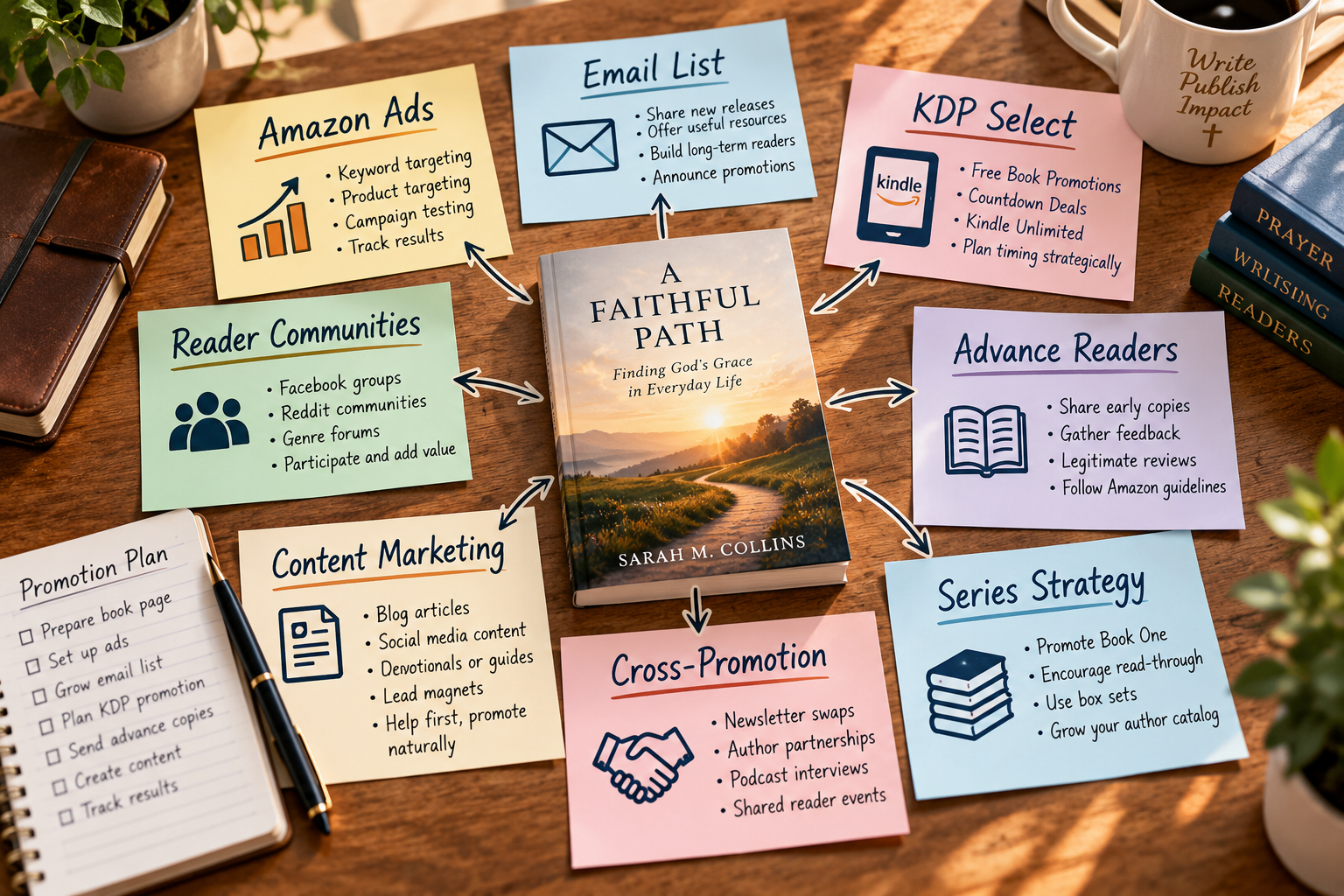
Christian authors can build discovery through:
- email lists
- articles
- devotionals
- podcasts
- church and ministry relationships
- speaking
- social content
- reader communities
- partnerships
- launch teams
- direct recommendations
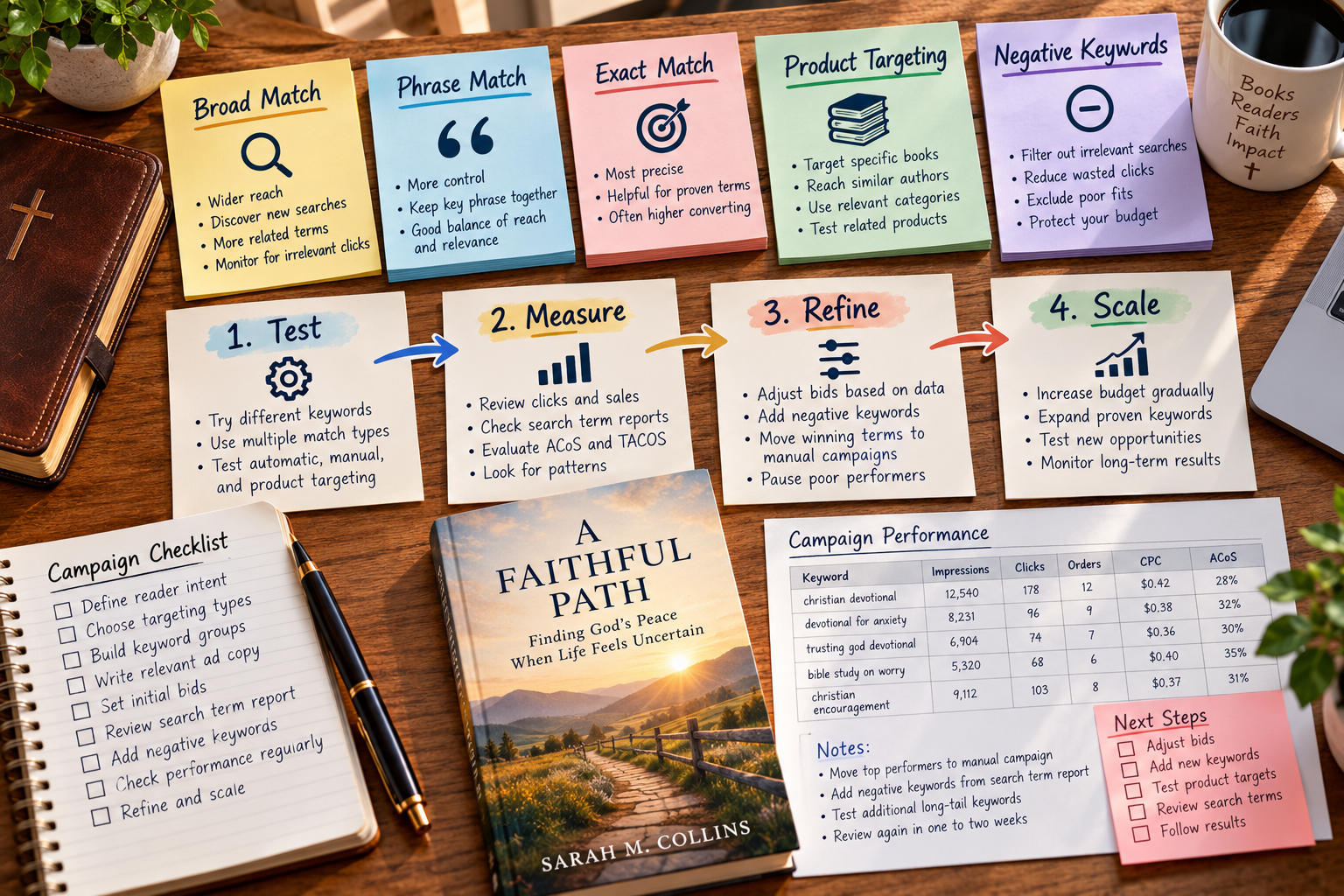
- Amazon Ads when appropriate
Amazon also offers Sponsored Ads designed to help books appear in shopping results and increase discovery. Kindle Direct Publishing
But paid advertising should amplify a strong book page, not compensate for a confusing one.
Sending more traffic to a weak cover, vague description, or poorly positioned book simply helps more people decide not to buy.
Reviews Matter, but There Is No Magic Number
Reviews can help readers feel more confident about an unfamiliar book.
But there is no universal threshold where ten reviews suddenly make a book trustworthy.
The original version of this article implied that moving from a few reviews to ten changes buying behavior dramatically. Pasted markdown
I would remove that claim.
What matters more is authentic social proof accumulated over time.
Encourage legitimate readers to leave honest reviews where platform rules allow.
Do not buy reviews.
Do not manipulate them.
Do not treat a review count as the only explanation for poor sales.
A book with few reviews can still sell when positioning, topic, audience, cover, and visibility are strong.
Diagnose Traffic and Conversion Separately
This is one of the most useful distinctions an author can make.
If the book gets very little exposure, you have a discovery problem.
Possible causes include:
- weak audience platform
- poor keyword alignment
- inappropriate categories
- little marketing
- limited advertising
- low search demand
If readers reach the page but do not purchase, you have more of a conversion problem.
Possible causes include:
- cover
- title
- subtitle
- description
- price
- reviews
- unclear reader fit
- weak sample pages
Do not solve a traffic problem with endless cover changes.
Do not solve a conversion problem by buying more traffic.
Find the broken stage first.
Look at the Entire Product Page as One Message
A book listing should feel coherent.
The cover says one thing.
The title says the same thing.
The subtitle clarifies it.
The description expands it.
The categories and keywords reinforce it.
The sample confirms it.
The price feels appropriate for it.
If those elements point in different directions, readers become uncertain.
For example:
A cover suggests gentle devotional encouragement.
The title sounds academic.
The subtitle promises marriage advice.
The description discusses general Christian living.
The keywords target prayer.
That book may be excellent.
But the buying experience is confused.
Alignment is one of the most underrated sales improvements an author can make.
Compare Your Book to the Right Competitors
Competitive research is useful when it is used responsibly.
Do not simply copy bestseller covers, descriptions, or metadata.
Instead, compare how successful books communicate with the same reader.
Study:
- cover conventions
- title styles
- subtitles
- description structure
- pricing
- length
- formats
- reader expectations
The goal is not imitation.
It is understanding the market language your readers already recognize.
Your book should fit the category well enough to be understood while still having a clear reason to exist.
Do Not Change Everything at Once
If sales are weak, authors sometimes change:
- cover
- price
- keywords
- categories
- description
- ads
all at the same time.
Then sales improve slightly.
What fixed the problem?
You have no idea.
Make changes deliberately.
Start with the biggest suspected barrier.
If the cover is obviously wrong for the genre, fix that first.
If the positioning is vague, address title, subtitle, and description together because they belong to the same strategic issue.
If the listing appears strong but traffic is nearly nonexistent, work on discovery.
KDP allows authors to update keywords and descriptions, and pricing can also be changed after publication. Kindle Direct Publishing
Use that flexibility carefully rather than constantly tinkering.
When Ads Make Sense
Amazon Ads can help a book reach more shoppers.
They are most useful when the underlying product page is ready to convert.
Before spending heavily, ask:
Does the cover fit?
Is the reader clear?
Does the description work?
Is the price reasonable?
Does the sample support the promise?
If the answer is no, fix those first.
Advertising cannot create reader-product fit.
It can only increase exposure.
Frequently Asked Questions
Why is my KDP book getting no sales?
Start by separating discovery from conversion. If few qualified readers see the book, investigate positioning, keywords, categories, and marketing. If readers reach the listing but do not buy, examine the cover, title, description, price, reviews, and overall audience fit.
Should I change my keywords if my book is not selling?
Possibly, but only if the current keywords do not accurately describe how readers might search for the book. Amazon allows keywords to be updated and recommends specific, relevant terms rather than broad or misleading ones. Kindle Direct Publishing
Should I choose very small Amazon categories so I can rank higher?
No. Category relevance matters more than chasing an easy rank. Amazon specifically advises authors to balance relevance, popularity, and specificity rather than choosing categories merely because they seem easier. Kindle Direct Publishing
How do I know whether my cover is hurting sales?
Compare it with professionally produced books serving the same reader. Test it at thumbnail size and ask people unfamiliar with the manuscript what kind of book they think it is. If their answer is consistently wrong, the cover may be communicating the wrong category.
Will lowering the price fix poor sales?
Not necessarily. Price is only one part of the decision. A lower price cannot fix unclear positioning, a weak cover, little traffic, or a description that does not connect with the reader.
Should I run Amazon Ads if I have no organic sales?
You can test ads, but first make sure the listing is strong. Advertising increases traffic. It does not automatically repair a conversion problem.
How many reviews do I need before my book will sell?
There is no universal number. Reviews can build confidence, but positioning, demand, cover quality, description, price, and visibility all contribute to sales.
Fix the Broken Step, Not Everything
When a Christian book is not selling, the answer is rarely one secret Amazon trick.
It is usually a breakdown somewhere in the path between:
the right reader
and
the decision to buy.
Start with the audience.
Then inspect the cover and title.
Review the metadata.
Strengthen the description.
Check the price.
Evaluate trust and traffic.
When you know where the reader journey breaks, you can make a focused improvement instead of endlessly changing things and hoping something works.
That is a much better publishing strategy than blaming the platform or chasing another algorithm trick.