How to Publish a Christian Children’s Book: From Story Idea to Finished Book
Learn how to publish a Christian children’s book from manuscript and illustration through editing, production, distribution, and marketing while keeping the child reader at the center.
Publishing a Christian children’s book involves more than writing a faith-based story and adding illustrations.
You are creating a book for two audiences at the same time.
The child needs a story that is engaging, understandable, emotionally appropriate, and enjoyable to experience.
The adult buying or recommending the book needs confidence that the story is age-appropriate, thoughtfully produced, and consistent with the values or biblical message it presents.
That combination makes Christian children’s publishing a distinctive challenge.
The strongest books begin by getting the story right, then build the publishing process around the child who will actually read or hear it.
Define the Child Before You Define the Book
“Children” is far too broad an audience.
A board book for a toddler, a picture book for an early elementary reader, an illustrated devotional, an early chapter book, and a middle-grade Christian novel require very different approaches.
Before writing or revising, identify:
- the approximate age of the reader
- whether the book will be read aloud or independently
- the reader’s likely vocabulary and attention span
- the emotional maturity required by the subject
- whether the book is primarily story, teaching, devotional, activity, or a combination
- who is most likely to purchase it
That last point matters because young children rarely buy their own books.
Parents, grandparents, teachers, churches, schools, homeschool families, librarians, and ministry leaders may all influence purchasing decisions.
A clear audience helps shape the manuscript, artwork, format, cover, description, and marketing.
Tell a Story Before Delivering a Lesson
A Christian children’s book can carry a meaningful biblical message without reading like a sermon rewritten for children.
Story comes first.
Characters need something they want.
Something needs to happen.
There should be curiosity, emotion, discovery, tension, humor, wonder, or another reason for a child to keep turning pages.
The faith element should belong naturally inside that experience.
A story about kindness becomes stronger when a child sees a character struggle with whether to include someone who feels left out.
A story about prayer becomes more meaningful when the character faces a situation that makes prayer personally relevant.
A story about courage becomes memorable when the reader cares whether the character finds that courage.
The lesson should emerge from the story rather than interrupting it.
Children often understand more than writers give them credit for. You do not need to explain the moral after every scene.
Trust the story to carry part of the message.
Handle Scripture and Theology With Care
Christian children’s books can shape a child’s earliest understanding of God, Scripture, prayer, faith, and Christian life.
That deserves careful attention.
If you retell a biblical story, distinguish between what Scripture actually says and details you are adding for narrative purposes.
Imagined dialogue, emotions, settings, or minor characters may make a story more vivid, but they should not quietly become presented as biblical fact.
If you quote Scripture directly, verify the wording and reference against the translation you intend to use.
Also check the current copyright and permissions policy for that translation before publication.
If your book teaches a theological concept, consider having it reviewed by someone knowledgeable in Scripture and appropriate to the theological tradition the book represents.
A children’s book may use simple language.
That does not mean its theology should be careless.
Write for the Ear as Well as the Eye
Many children’s books are experienced aloud.
That means rhythm matters.
Read the manuscript aloud repeatedly during revision.
Listen for sentences that are difficult to say, repeated words that become distracting, dialogue that sounds unnatural, and passages that take too long to reach the next interesting moment.
Children may hear a favorite book dozens of times.
Parents notice clumsy language quickly when they have to read it aloud again and again.
Concise writing is especially valuable in illustrated books because the artwork is carrying part of the storytelling.
You do not need to describe everything the illustration already shows.
Let words and pictures work together.
Do Not Choose the Illustrator Too Early
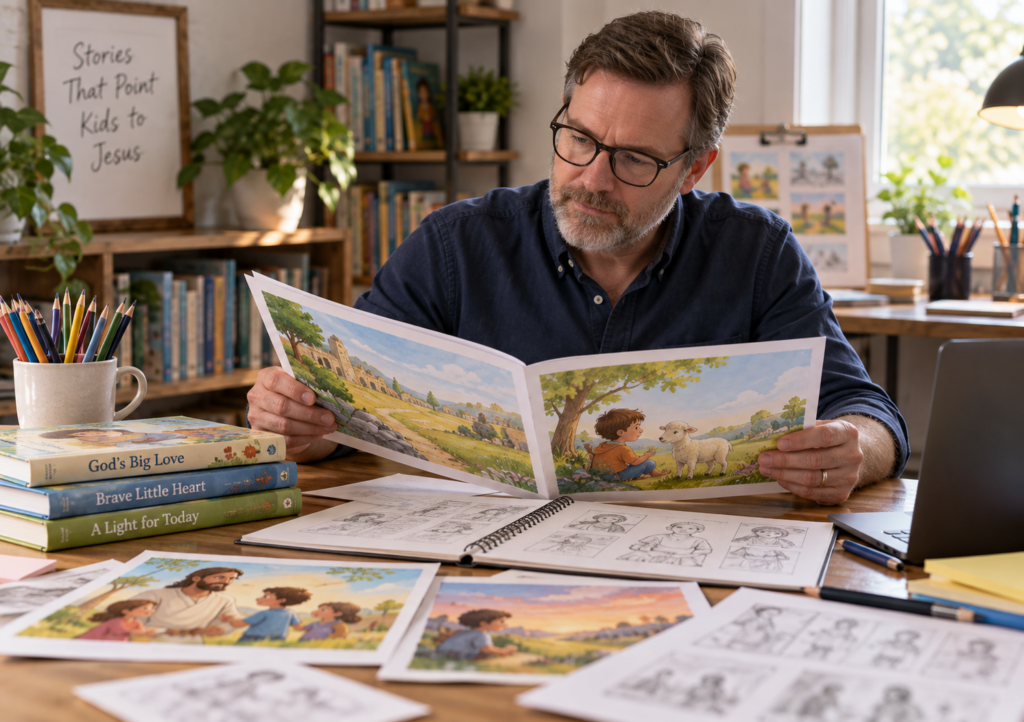
Illustration is one of the largest creative decisions in many children’s books, but the manuscript should be sufficiently developed before major illustration work begins.
Otherwise, revisions can become expensive.
First determine the book’s format and illustration needs.
Does every spread require a full scene?
Will there be spot illustrations?
Are the same characters appearing throughout the book?
Does the story require historically accurate biblical settings?
Are animals, fantasy elements, diverse families, churches, or specific cultural settings important?
Once the visual requirements are clear, look for an illustrator whose style fits the actual project.
A technically skilled illustrator can still be wrong for your book if the style does not suit the age range, tone, or story.
Review complete portfolio examples when possible, not simply individual attractive images.
Use a Written Illustration Agreement
Do not begin a major illustration project based only on messages or verbal understanding.
Use a written agreement.
It should clarify matters such as:
- what illustrations are being created
- final dimensions and file specifications
- project schedule
- payment structure
- revision process
- delivery format
- ownership and licensing rights
- whether the illustrator can display the work in a portfolio
- whether the artwork can be reused elsewhere
- what happens if the project ends early
Copyright ownership deserves particular attention.
Paying an illustrator does not automatically mean every possible right to the artwork transfers to you.
Understand exactly what rights you are purchasing or licensing before production begins.
For a commercially important project, professional contract guidance may be worthwhile.
Decide Between Traditional and Self-Publishing
Christian children’s authors can pursue traditional publishing or publish independently.
Each path has advantages.
Traditional publishing may provide editorial development, art direction, illustration, design, production, distribution, and an established publishing identity.
The publisher typically controls many decisions about the final book.
Submission requirements vary considerably. Some publishers consider agented projects, some have limited submission opportunities, and others periodically change what they accept.
Always check the current guidelines of the specific publisher before submitting.
Self-publishing gives the author greater control over the manuscript, illustration, schedule, pricing, production, and marketing.
It also places responsibility for those decisions on the author.
That means assembling a capable team where necessary rather than treating self-publishing as simply uploading a PDF.
Budget From the Project Requirements
There is no universal cost for publishing a children’s book.
Illustrated books can be especially difficult to price because artwork varies enormously in complexity, quantity, experience level, licensing terms, and revision requirements.
Other potential expenses include:
editing
proofreading
cover and interior design
illustration
ISBNs
proof copies
website or marketing materials
advertising
author copies
Build the budget from the actual project rather than starting with an arbitrary number.
Get written estimates.
Know what each service includes.
Separate essential production costs from optional promotional spending.
And be particularly cautious about expensive packages promising guaranteed bestseller status, guaranteed bookstore placement, or guaranteed sales.
Understand ISBN Choices
Print books generally require an ISBN.
Self-publishing platforms may offer free ISBNs, while authors can also obtain their own.
Those choices affect the publishing identity displayed with the book.
For example, Amazon KDP currently states that books using its free ISBN are assigned the imprint “Independently published,” while authors using their own registered ISBN supply the associated imprint information. Kindle Direct Publishing
For an author planning a larger publishing catalog or a separate publishing imprint, owning ISBNs may be worth considering.
For someone publishing a single project, the convenience of a platform-provided ISBN may be sufficient.
The important thing is to understand the difference before choosing.
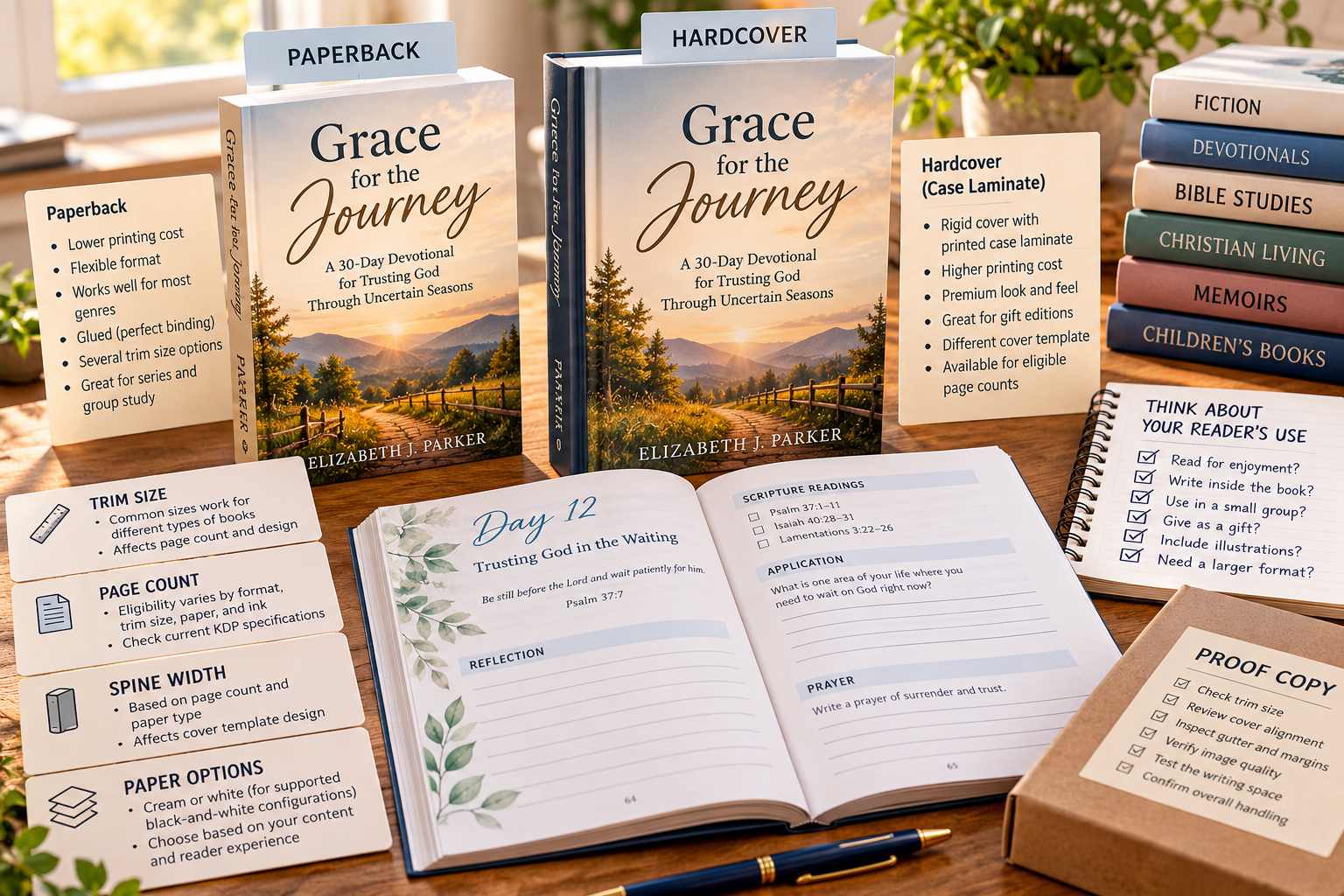
Order a Physical Proof
Never evaluate an illustrated children’s book only on a monitor.
Order a physical proof.
Check:
- illustration brightness
- skin tones
- shadows
- text size
- page margins
- gutters
- cropping
- bleed
- page order
- image resolution
- cover alignment
- spine placement when applicable
- readability under ordinary lighting
Read the physical book aloud too.
A problem that was invisible while editing individual pages may become obvious when you experience the book from beginning to end.
Do not rush this stage.
A proof copy exists so you can discover mistakes before customers do.
Think About Distribution Before Launch
Amazon may be one sales channel, but Christian children’s books can have other potential audiences.
Depending on the book, those may include:
churches
Christian schools
homeschool families
children’s ministries
Bible study programs
retreats and conferences
independent bookstores
libraries
author events
direct website sales
Print-on-demand distribution services can make independently published titles available for retailers, libraries, schools, and bookstores to order. IngramSpark, for example, currently distributes title information through a large global network of retailers and libraries. IngramSpark
But availability is not placement.
A bookstore being able to order your book does not mean it will automatically stock it.
Authors still need professional production, appropriate metadata, reasonable retail terms, and reader demand.
Market to the Adults Who Choose the Book
Children may be the readers, but adults are often the buyers.
That changes the marketing strategy.
A parent may ask:
Is this appropriate for my child?
What does it teach?
Will my child enjoy hearing it again?
Does it reflect the values I want reinforced?
A homeschool parent may look for educational usefulness.
A children’s ministry leader may care about group application.
A teacher may consider whether the book supports a classroom discussion.
Your book description and marketing should answer those adult questions without forgetting the child.
Do not market only the lesson.
Show why the book is enjoyable to read.
Consider Churches and Ministry Settings Naturally
Some Christian children’s books fit naturally into ministry settings.
A book about Easter may complement seasonal children’s programming.
A story about prayer could support a church family resource.
A book about kindness or friendship might fit a children’s ministry or Christian school discussion.
But avoid treating churches as automatic buyers.
A ministry needs a reason the book fits what it is doing.
Approach churches, schools, and ministries with a clear explanation of who the book serves and how it might be useful.
Relationship-based outreach works best when the resource genuinely fits the audience.
Protect the Child Reader From Adult Marketing Language
One common weakness in Christian children’s publishing is writing a book for children while describing it entirely in adult religious terminology.
A child may not care that a book offers “transformational biblical principles for developing Christ-centered resilience.”
A parent might appreciate the purpose behind that phrase, but the story itself still needs warmth, imagination, clarity, and emotional relevance.
Keep the theological purpose.
Translate it into an experience a child can understand.
The book should feel written for children rather than written about what adults want children to become.
Frequently Asked Questions
How long should a Christian children’s book be?
There is no single correct length. The appropriate word count depends on age, format, reading level, illustration style, and whether the book is designed for reading aloud or independent reading. Study recently published books serving the same age group and format.
Do I need an illustrator before approaching a traditional publisher?
Not necessarily. Traditional publishers often manage illustration and art direction themselves. Follow the submission requirements of the publisher or literary agent you are approaching rather than commissioning a complete illustrated book automatically.
How much does it cost to self-publish a Christian children’s book?
There is no reliable universal figure. Illustration is often a major expense, but editing, design, formatting, proofing, ISBNs, marketing, and printing choices can also affect the budget. Get estimates based on your actual book.
Do I need permission to quote Bible verses?
Possibly. Many modern Bible translations allow limited quotation under specified conditions, but each translation has its own copyright and attribution requirements. Check the current permissions policy for the translation you intend to use.
Can a self-published children’s book reach bookstores and libraries?
Yes. Distribution services can make independent titles available for booksellers and libraries to order, but availability does not guarantee that any retailer or library will stock the book. IngramSpark
Should the Christian lesson be stated directly?
Sometimes, but not automatically. The appropriate approach depends on the book. In many stories, allowing the theme to emerge naturally through character, conflict, and resolution creates a stronger reading experience than repeatedly explaining the lesson.
Build the Book for the Child
Publishing a Christian children’s book requires decisions about theology, storytelling, illustration, design, production, distribution, and marketing.
But all of those decisions point back to one question:
Will this work for the child it was created to serve?
Begin there.
Know the reader.
Tell a genuine story.
Handle Scripture and theology carefully.
Choose illustrations that strengthen the experience.
Produce the book professionally.