How to Write Christian Book Descriptions That Help Readers Say Yes
Learn how to write Christian book descriptions that clearly communicate audience, purpose, conflict, and value without relying on vague promises, keyword stuffing, or generic sales language.
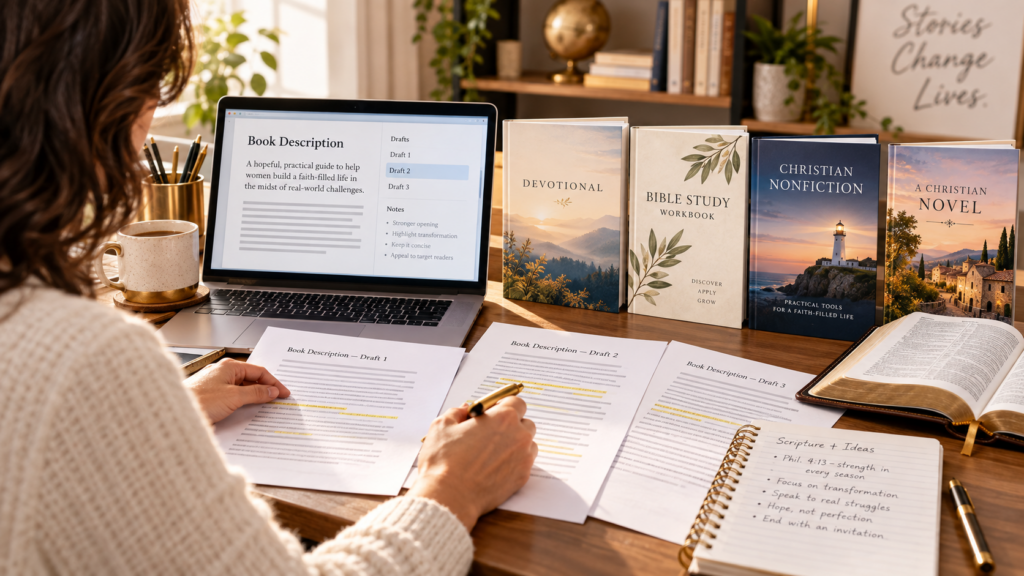
A book description has one job:
Help the right reader understand why this book may be worth their time.
On Amazon and other online bookstores, the description sits between curiosity and commitment.
The cover may earn the click.
The description helps the reader decide whether to keep going.
For Christian authors, that means doing more than summarizing the manuscript or adding phrases such as “inspiring,” “faith-filled,” or “life-changing.”
A strong description makes the book’s audience, purpose, conflict, promise, or emotional experience clear.
It should sound like the book.
And it should help the reader recognize whether the book is meant for them.
Start With the Reader’s Reason for Caring
Do not begin by telling readers everything about the book.
Begin with the reason they might care.
For Christian nonfiction, that might be a problem, need, question, or desired change.
For a devotional, it might be the season of life the reader is walking through.
For fiction, it might be the central conflict, emotional tension, or impossible choice.
For a Bible study, it might be the biblical question readers want help exploring.
Compare:
This 30-day devotional contains Scripture, reflections, prayers, and application.
with:
When uncertainty makes it difficult to trust God, these 30 short readings offer a quiet place to return to Scripture, prayer, and hope.
The first describes contents.
The second helps the reader understand why those contents might matter.
Both kinds of information are useful, but the reason to care usually belongs first.
Do Not Turn the Description Into a Table of Contents
Authors often know too much about their books.
That makes it tempting to explain every section, theme, character, feature, and lesson.
Readers do not need all of that before purchasing.
Amazon currently recommends focusing on the main plot, theme, or idea and avoiding details that may overwhelm someone making a quick decision. Kindle Direct Publishing
Choose the information that helps readers answer:
What is this book?
Who is it for?
Why might I want it?
Everything else can wait.
Christian Nonfiction Should Lead With the Need and Promise
Christian nonfiction descriptions work best when they clearly identify the reader and the problem or question the book addresses.
Suppose the book helps Christian parents navigate childhood anxiety.
A weak opening might say:
This practical Christian parenting book explores anxiety, prayer, faith, communication, and biblical principles.
A stronger version might say:
When your child is anxious, telling them simply to “trust God” may not be enough. This practical guide helps Christian parents respond with compassion, biblical perspective, and concrete ways to build confidence at home.
The second version gives the reader a reason to continue.
Then the description can explain what the book includes.
Devotional Descriptions Should Communicate the Season and Experience
A devotional description does not need to summarize 30 or 90 individual readings.
Instead, communicate:
- who the devotional serves
- what season or need it addresses
- what kind of daily experience readers can expect
- how Scripture fits into the book
- what makes the devotional distinct
For example:
For the days when prayer feels difficult and answers seem far away, this 40-day devotional offers short Scripture-centered reflections, honest encouragement, and simple prayers for staying close to God through uncertainty.
That tells the reader much more than:
Includes 40 devotionals with Bible verses and prayers.
Features matter.
Experience usually matters more.
Bible Study Descriptions Should Explain What Readers Will Explore
A Bible study description should give readers enough information to understand the study without turning into a theological abstract.
Tell them:
- the biblical book or theme
- the intended audience
- the study approach
- whether it is individual or group-friendly
- the kind of questions or activities included
- the intended outcome
For example:
Explore Philippians as more than a collection of encouraging verses. This six-session study helps readers examine joy, perseverance, humility, and faithful living in context through Scripture observation, reflection questions, prayer, and practical application.
That gives a group leader or individual reader a clear picture of the resource.
Christian Fiction Needs Conflict, Not Explanation
Fiction descriptions should create tension.
Readers usually do not need extensive world-building, character biography, or backstory before they understand what makes the story compelling.
Focus on:
- protagonist
- disruption
- central conflict
- stakes
- emotional or spiritual tension
For example:
After returning home to settle her father’s estate, Mara expects grief. She does not expect to uncover letters suggesting the man who raised her hid a secret that could change everything she believes about her family and her faith.
That gives the reader enough to understand the story without explaining the entire plot.
Christian fiction does not need to advertise its theology in every sentence.
Let the faith dimension emerge naturally from the book’s actual conflict and positioning.
Memoir Descriptions Should Establish the Journey
Christian memoir descriptions often become vague because authors try to summarize an entire life.
Instead, identify the central journey.
What changed?
What was lost?
What was discovered?
What question carries the story?
For example:
After years of building a life around certainty, one unexpected diagnosis forced Daniel to confront what faith meant when prayer did not produce the answer he wanted.
That gives the memoir a narrative center.
The description can then explain the broader themes without trying to cover every event in the book.
Children’s Book Descriptions Need to Speak to the Buyer
Children may be the readers, but adults are often the purchasers.
A Christian children’s book description should help parents, grandparents, teachers, or ministry leaders understand:
- appropriate age
- story concept
- faith theme
- emotional tone
- whether it is suited for reading aloud, independent reading, or group use
Do not describe only the lesson.
Describe the story too.
Instead of:
A Christian picture book teaching children about kindness.
Try:
When Eli notices a new boy sitting alone, one small invitation begins a friendship neither child expected. This warm picture book helps children explore kindness, belonging, and what it means to love your neighbor.
The story earns attention.
The faith theme clarifies the purpose.
Workbooks and Guides Should Make the Use Case Obvious
A workbook description should tell readers what they will actually do.
Consider including:
- who it is for
- how it is organized
- types of exercises
- whether answers or leader notes are included
- print or writing features
- intended use
For example:
Designed for individual or small-group study, this Bible study workbook includes guided Scripture observation, reflection questions, prayer prompts, and generous writing space to help readers slow down and engage with the text.
That is far more useful than calling it simply “interactive.”
Use Specific Language Instead of Generic Praise
Avoid relying on phrases such as:
powerful
inspiring
transformational
life-changing
must-read
Those words may be appropriate occasionally, but they are weak substitutes for concrete information.
Show the reader what makes the book useful or interesting.
Instead of:
A powerful devotional for difficult times
try:
Thirty Scripture-centered readings for Christians navigating grief, uncertainty, and unanswered prayer.
Specificity creates trust.
Avoid Claims the Book Cannot Prove
Christian publishing sometimes uses language that promises more than a book can responsibly deliver.
Be careful with statements such as:
This book will transform your marriage.
These prayers will heal your anxiety.
Follow this plan and restore your faith in 30 days.
Those claims may overpromise both practically and spiritually.
Better language describes what the book provides:
Explore biblical principles and practical conversations designed to help couples strengthen communication and approach conflict with greater patience and understanding.
The description can be persuasive without making guarantees.
Make the First Lines Work Hard
Readers may initially see only the opening portion of the description.
That means the first lines deserve special attention.
Do not spend them on publication history, author credentials, or a long setup.
Lead with the book.
A clear first line might identify:
the reader
the problem
the central conflict
the emotional question
the core promise
The best opening depends on the type of book.
There is no universal formula.
But there should be a reason to keep reading.
Use Short Paragraphs for Online Reading
Descriptions are read on screens.
Dense blocks of text create friction.
Use shorter paragraphs and deliberate white space so the reader can scan the page easily.
For nonfiction, bullets may help when you are listing clearly distinct benefits or features.
For fiction, excessive bullets usually interrupt the emotional flow.
Match the format to the book.
Amazon currently allows basic formatting including bold, italics, lists, paragraph tags, line breaks, and certain heading tags in book descriptions. Kindle Direct Publishing
Use formatting to improve readability, not to turn the description into an advertisement full of visual gimmicks.
Know What Amazon Does Not Allow
KDP currently restricts certain material in book descriptions.
Examples include:
- reviews, quotes, or testimonials
- requests for customer reviews
- URLs
- price or availability information
- promotional material
- time-sensitive information
- spoilers
- keyword-stuffing or book-tag phrases
- Unicode emojis
Those restrictions matter because some older book-marketing advice recommends putting testimonial quotes, promotional claims, or outside links directly into the description. Amazon’s current metadata guidelines prohibit those practices. Kindle Direct Publishing
Always check current KDP guidance before publishing.
Do Not Stuff SEO Keywords Into the Description
Your description should sound natural.
Do not force phrases repeatedly into the copy simply because you want Amazon to associate them with the book.
KDP has separate keyword fields for discovery, and Amazon advises authors to keep descriptions focused on the content of the book. Kindle Direct Publishing
If important terms fit naturally, use them.
If they make the description sound robotic, leave them out.
The description is primarily for the reader.
Match the Description to the Cover and Subtitle
The cover earns attention.
The subtitle clarifies positioning.
The description should continue the same promise.
If the cover says:
Peace for the Waiting Season
and the subtitle says:
30 Devotions for Trusting God When Answers Take Time
the description should not suddenly become a broad discussion of general Christian living.
Everything should point toward the same reader and need.
That consistency makes the book easier to understand.
Back Cover Copy and Amazon Descriptions Can Be Related
You do not necessarily need two completely different pieces of copy.
The core message can often remain the same.
But online descriptions may benefit from shorter paragraphs, clearer formatting, and a stronger emphasis on what the reader sees first.
A print reader holding the physical book has already made a different kind of commitment than someone scrolling through search results.
Adapt the presentation accordingly.
Test Whether the Description Creates the Right Expectation
Before publishing, show the description to someone who has not read the manuscript.
Ask:
What kind of book do you think this is?
Who do you think it is for?
What do you expect to get from it?
What makes you curious?
What is unclear?
Those answers are more useful than asking whether they “like” the description.
The goal is accurate expectation.
If the description attracts readers looking for a different book, even strong copy can create disappointment.
Frequently Asked Questions
How long should a KDP book description be?
There is no ideal universal word count. Use enough space to communicate the book’s purpose, audience, and appeal without unnecessary detail. Amazon emphasizes simplicity and clarity rather than a prescribed number of words. Kindle Direct Publishing
Can I use bold and italics in a KDP description?
Yes. Amazon currently supports basic HTML and editor formatting, including bold, italics, paragraph breaks, lists, and some heading tags. Kindle Direct Publishing
Can I include reader reviews in my Amazon description?
Amazon’s current metadata guidelines say reviews, quotes, and testimonials should not be included in the book-description field. Kindle Direct Publishing
Should fiction and nonfiction descriptions use the same structure?
No. Fiction generally depends more on conflict, stakes, character, and emotional tension. Nonfiction usually benefits from clearly identifying the reader’s need and the value the book provides.
Can I use my back cover copy as my Amazon description?
Often, yes, as a starting point. You may still want to adjust paragraph length, formatting, and opening emphasis for online reading.
Should I add keywords to my description?
Use relevant language naturally, but do not keyword-stuff the description. KDP provides separate keyword fields for discoverability. Kindle Direct Publishing
Help the Reader Recognize the Right Book
A strong book description does not pressure the reader into buying.
It helps the right reader understand the book quickly enough to decide whether it belongs in their hands.
Lead with what matters.
Be specific.
Match the genre.
Keep the language natural.
Make the audience clear.
Avoid exaggerated promises.
And make sure the description accurately represents the experience inside the book.
The goal is not simply more clicks.
It is better alignment between the book you wrote and the reader it was written to serve.