How to Create a Bible Study Workbook Readers Can Actually Use
Create a Bible study workbook that helps readers engage deeply with Scripture through clear structure, thoughtful questions, practical reflection, theological care, and usable page design.

Creating a Bible study workbook takes more than writing a list of questions beneath a Scripture passage.
A useful workbook helps readers slow down, observe the text carefully, understand what it means, reflect on why it matters, and respond thoughtfully.
That requires structure.
Before writing dozens of questions or designing pages, decide what the study is meant to accomplish, who it is for, and how each lesson will move the reader forward.
A well-designed Bible study workbook should make the study process clearer, not more complicated.
Define the Purpose Before Building the Lessons
Start with one simple question:
What should the reader understand or experience by the end of this study?
That answer becomes the foundation for everything else.
A study of Philippians might focus on joy and faithfulness in difficult circumstances.
A study of Ruth might explore loyalty, providence, loss, belonging, and redemption.
A thematic study on prayer might draw from several biblical books while helping readers understand different dimensions of prayer.
The subject can be broad or narrow, but the purpose should be clear.
If you cannot explain the study in one or two sentences, the scope may still need refinement.
A focused purpose helps you decide what belongs in the workbook and what should be saved for another project.
Know Who the Workbook Is For
A Bible study workbook for new believers will look different from one written for experienced small-group leaders.
A women’s ministry study may have different needs from a teen study, homeschool resource, men’s group, church-wide study, or personal devotional workbook.
Think about:
- biblical familiarity
- age
- reading level
- individual versus group use
- denominational context
- available study time
- whether the reader will have access to additional resources
- whether a leader will guide the discussion
Those decisions affect vocabulary, question complexity, lesson length, instructions, and layout.
Do not assume every reader knows how to locate cross-references, identify literary context, or understand theological terminology.
Explain what the reader genuinely needs.
Choose the Study Structure Before Writing Every Question
Once the purpose and audience are clear, map the study.
You might organize it by:
- chapters of one biblical book
- major passages
- themes
- people
- events
- doctrines
- stages in a spiritual journey
The number of lessons should come from the material and the intended use rather than an arbitrary rule.
A short study may contain only a few sessions.
A deeper book study may require considerably more.
What matters is progression.
Each lesson should contribute something distinct while building toward the overall purpose.
Before drafting full lessons, write a simple outline showing:
Lesson title
Primary passage
Main idea
Key learning goal
Possible application
That outline can reveal repetition or gaps before you spend hours writing pages that later need to be removed.
Let Scripture Determine the Lesson
A Bible study workbook should not begin with the conclusion you want readers to reach and then search for verses that seem to support it.
Begin with the biblical text.
Read the passage in context.
Consider:
Who is speaking?
Who is being addressed?
What is happening around the passage?
What literary form is being used?
What themes appear repeatedly?
How does this passage relate to the larger biblical context?
If your workbook includes teaching notes, distinguish clearly between what the text says and your interpretation of it.
A workbook can guide readers without pretending every passage has only one simple question or application.
Build Questions That Encourage Careful Study
One useful way to organize Bible study questions is to move through several kinds of engagement.
Observation
Observation questions help the reader notice what is actually present in the passage.
Examples:
What words or ideas are repeated?
Who is present?
What changes during the passage?
What command, promise, question, or contrast do you notice?
Interpretation
Interpretation asks what the passage means in its context.
Examples:
Why might this statement matter in the surrounding passage?
How does this verse connect with what comes before it?
What does this passage reveal about God, people, faith, or obedience?
What other Scripture might help clarify this idea?
Reflection and Application
Application helps the reader consider how biblical truth intersects with life.
Examples:
What does this passage challenge you to reconsider?
Where do you see this truth becoming relevant in your current circumstances?
What response might this passage invite?
What would obedience or trust look like here?
Application questions should grow naturally from the passage.
Avoid forcing every lesson into an action step when reflection, prayer, repentance, remembering, or deeper understanding may be the more appropriate response.
Avoid Turning the Workbook Into a Trivia Test
Factual questions can be useful.
Readers may need to identify people, places, events, commands, or repeated words.
But if every question has one short factual answer, the workbook can begin to feel more like a quiz than a study.
Use factual questions to support understanding.
Then give readers opportunities to think, compare, interpret, reflect, and respond.
The goal is not merely to prove that someone read the passage.
It is to help them engage with it carefully.
Design Pages for Actual Use
Workbook design should reflect how people will interact with the pages.
If you ask a reflective question, provide enough room for a meaningful response.
If you include charts or comparison exercises, make them large enough to use comfortably.
If the workbook may be printed at home, avoid layouts that waste large amounts of ink.
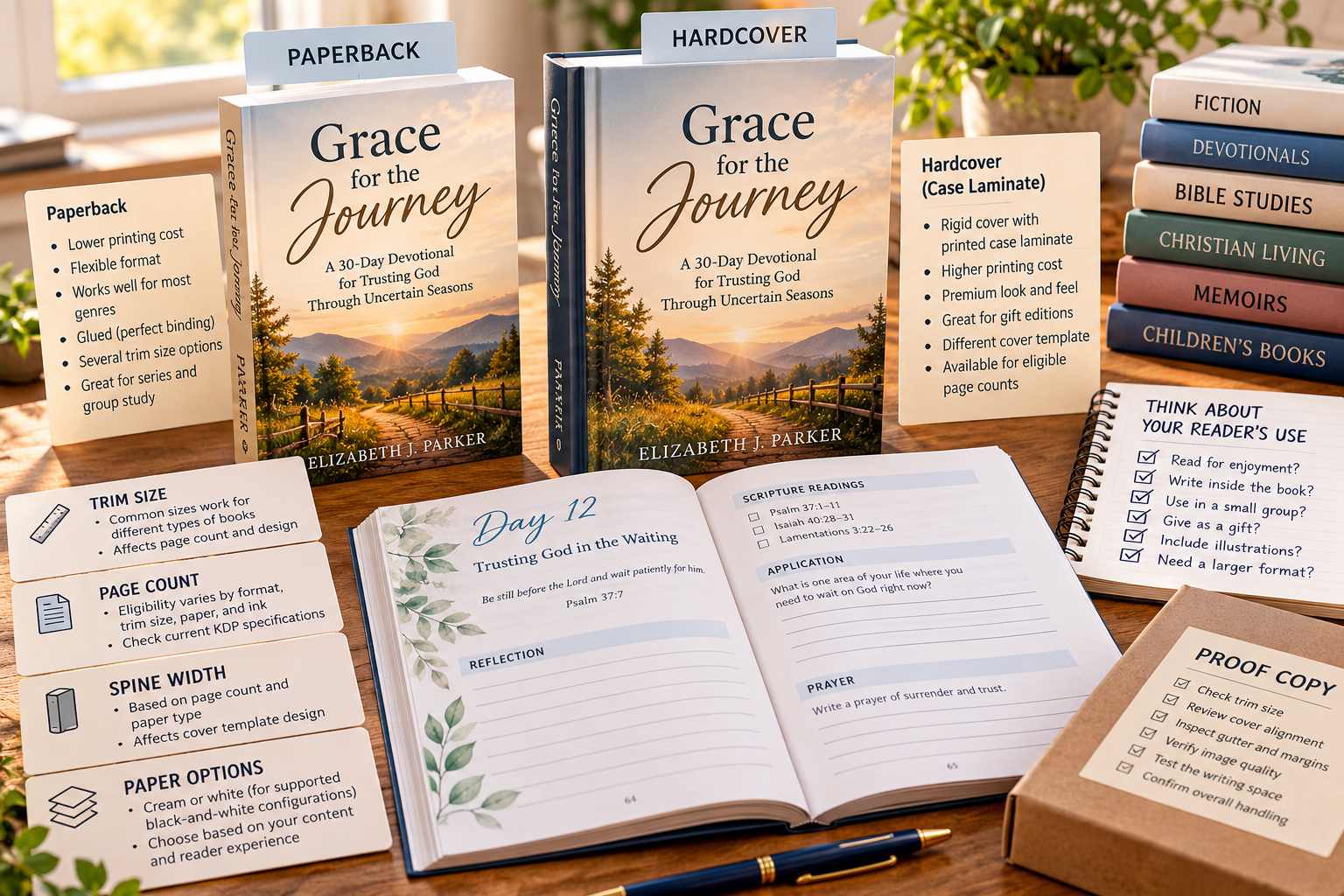
If it will be professionally printed, consider margins, binding, page size, and whether the book can remain open comfortably while someone writes.
Useful design elements may include:
- clear lesson headings
- readable Scripture references
- consistent question numbering
- adequate writing space
- note sections
- prayer prompts
- summary boxes
- key-word definitions
- optional leader notes
- simple visual distinctions between teaching and questions
Do not decorate every page simply because space exists.
White space is functional.
It gives readers room to think.
Decide Whether Readers Need the Scripture Printed in the Workbook
Some Bible study workbooks print the full passage.
Others provide references and expect readers to use their own Bible.
Both approaches can work.
Printing Scripture inside the workbook may make the study easier to use, especially for short passages.
But it also introduces copyright and permissions considerations when using modern Bible translations.
If you quote Scripture directly, verify:
- translation
- wording
- reference
- attribution
- permissions requirements
For a workbook using many passages, track Scripture quotation throughout the manuscript rather than waiting until the end.
This is also a natural place to internally link to your Faith Author Hub article on Bible Translation Copyright for Authors.
Use Theological Review When the Study Requires It
Grammar editing and theological review are not the same thing.
A Bible study workbook may make interpretive claims, explain doctrine, summarize biblical history, or guide readers toward application.
Those areas deserve careful review.
Depending on the depth and subject of the study, consider asking a pastor, Bible teacher, theologian, ministry leader, or other qualified reader to evaluate the material.
The goal is not to eliminate every denominational distinction.
It is to catch:
- inaccurate references
- unsupported interpretations
- misleading simplifications
- unclear theological assumptions
- applications that do not follow naturally from the text
The more heavily the workbook teaches Scripture, the more important this review becomes.
Include Leader Material Only When It Adds Value
Not every Bible study workbook needs a separate leader guide.
But if the study is designed for groups, leader material can help.
This might include:
- lesson objectives
- background notes
- discussion guidance
- suggested timing
- optional follow-up questions
- clarification for difficult passages
- prayer suggestions
Leader material should not simply repeat what appears on the participant page.
It should make facilitation easier.
You can include leader notes in the same book or create a separate leader edition depending on the complexity of the study.
Decide Whether You Need Answer Keys
Reflection questions do not need answer keys.
Interpretive questions may not always have one exact response either.
An answer key is most useful when a question has a clear factual answer or when the author wants to provide guidance about the intended interpretation.
If you include answers, consider calling the section something like:
Suggested Responses
Leader Notes
Discussion Guidance
rather than implying that every spiritual reflection has one correct response.
Bible study should encourage careful thought, not turn every page into a test.
Test the Workbook With Real Readers
Before publishing, give the workbook to people who resemble the intended audience.
Ask them to actually use it rather than simply skim it.
You are looking for practical problems.
Were the instructions clear?
Did they understand what each question was asking?
Was there enough writing space?
Did any section feel repetitive?
Were any questions too vague?
Did a lesson assume knowledge the reader did not have?
Did the pacing feel uneven?
The exact number of testers matters less than getting meaningful feedback from people who genuinely represent the audience.
A workbook can look excellent to its author and still create friction for a first-time user.
Testing exposes that friction.
Choose Print and Digital Formats Intentionally
Print and digital workbooks create different experiences.
A printed workbook can be useful when readers will write extensively, participate in groups, or carry the material through a multi-session study.
A digital PDF can work well for downloadable resources, online groups, lead magnets, or users who prefer printing selected pages.
A fillable digital version may suit readers who work primarily on tablets or computers.
You can also offer more than one format.
What matters is designing for the format rather than creating one layout and assuming it will function equally well everywhere.
Prepare the Workbook for Publishing
Before release, complete a final production review.
Check:
- Scripture references
- theological consistency
- spelling and grammar
- page numbers
- contents
- lesson order
- question numbering
- writing space
- margins
- print quality
- image resolution
- copyright information
- Bible translation attribution
- permissions
- front matter
- back matter
- links and QR codes, if used
Order a physical proof if the workbook will be printed.
Write in it.
Turn pages.
Check whether the binding interferes with response areas.
Look at the workbook as a reader, not just as the person who created it.
Frequently Asked Questions
How long should a Bible study workbook be?
There is no required length. It depends on the audience, topic, number of lessons, depth of study, page size, and amount of writing space. Build the workbook around what the study actually requires.
Does every Bible study need observation, interpretation, and application questions?
No, but that progression can be a useful framework. The questions should fit the passage and the purpose of the lesson rather than following a formula mechanically.
Do I need to be a pastor to create a Bible study workbook?
No. But authors teaching Scripture should approach interpretation carefully and seek appropriate theological review when needed.
Should the workbook include an answer key?
Use answer keys for factual questions when they help. Reflection and application questions usually do not need one fixed answer.
Should I print the Scripture passages in the workbook?
You can, but copyrighted translations have quotation and attribution requirements. Check the permissions policy for the translation you use.
What software should I use?
Use software capable of producing a clean, consistent layout suitable for your intended format. Word processors, design platforms, and professional page-layout applications can all work depending on the complexity of the workbook and your production skills.
Should I create a leader guide too?
If the study is intended for groups and leaders need additional context or facilitation support, a leader guide can be valuable. It is not necessary for every workbook.
Build for the Person Doing the Study
A Bible study workbook succeeds when it helps readers engage with Scripture more thoughtfully.
That means good workbook design begins long before fonts and page layouts.
Define the purpose.
Know the reader.
Build a clear progression.
Let Scripture lead.
Write questions that encourage thought rather than simply filling blanks.
Give readers room to respond.
Test the material before publishing.
Then produce the workbook professionally.
The finished resource should not call attention to how cleverly it was designed.
It should make studying Scripture easier.