ACX for Christian Authors: How to Set Up and Publish an Audiobook
ACX gives Christian authors a path from finished book to professionally distributed audiobook. Learn how rights, narrators, Royalty Share, production costs, royalties, exclusivity, and quality review work.
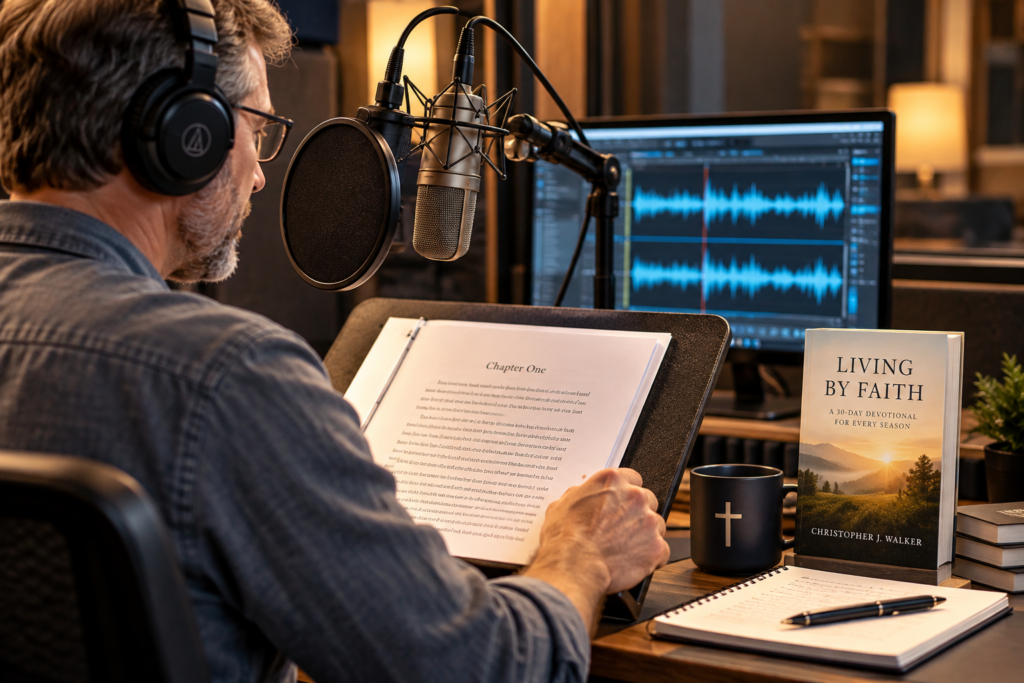
Turning a Christian book into an audiobook can open the door to readers who prefer listening while driving, exercising, commuting, or managing busy family schedules.
But publishing an audiobook is not simply a matter of uploading your KDP manuscript.
Amazon KDP and ACX serve different purposes.
KDP handles Kindle ebooks and print books.
ACX is Amazon’s audiobook production and distribution platform for titles sold through Audible, Amazon, and Apple Books. ACX Help
For Christian authors, ACX can be especially useful for:
- devotionals
- Christian living books
- memoirs
- Bible studies
- Christian fiction
- inspirational nonfiction
The process becomes much easier once you understand the production choices before you begin.
Start With Your Audio Rights
Before creating an ACX project, confirm that you control the audiobook rights.
You need the legal authority to produce and distribute the audiobook.
That matters if:
- you previously signed with a publisher
- another company owns audio rights
- you licensed translation rights separately
- the book contains substantial third-party material
- you collaborated with another author
Owning the ebook or paperback rights does not automatically prove that you control audio rights.
Check your contracts first.
ACX Is Separate From KDP
Publishing a book on KDP does not automatically create an audiobook.
You create an ACX account separately.
Then you claim the book title you want to produce.
Your print and ebook editions may already appear in Amazon’s catalog, which helps ACX identify the title, but audiobook production is a separate workflow.
Think of ACX as a new edition of the same intellectual property rather than an automatic KDP add-on.
Decide How the Audiobook Will Be Produced
ACX gives rights holders several production approaches.
The main options are:
- Pay for Production
- Royalty Share
- Royalty Share Plus
- DIY
Each creates a different financial relationship.
Pay for Production
With Pay for Production, you pay the narrator or producer an agreed amount, usually based on the finished length of the audiobook.
This is commonly expressed as per finished hour.
If the finished audiobook is seven hours long and the agreed rate is $250 per finished hour, production would cost:
7 × $250 = $1,750
Once the agreed production cost is paid, you do not continue sharing royalties with the narrator under that production arrangement.
This approach requires more money upfront but gives the rights holder greater control over future royalty income.
Royalty Share
Royalty Share reduces the upfront production cost.
Instead of paying the narrator a full production fee, you and the producer share royalties.
Under ACX’s current royalty model, an exclusive title earns a 50% royalty rate. In a Royalty Share arrangement, that royalty is divided equally between the rights holder and producer, which results in 25% each. ACX Help
This can make audiobook production more accessible for authors who do not want to fund the entire project upfront.
But it also means sharing future earnings with the producer.
Royalty Share Plus
Royalty Share Plus combines the two approaches.
You pay a reduced upfront production amount and also share royalties with the narrator.
That can make the project more attractive to experienced narrators while reducing the author’s initial cash requirement.
For some independent authors, this becomes a useful middle ground.
DIY Production
If you already have professionally produced audio files, or you are capable of creating them yourself, ACX also supports DIY production.
In that model, you upload finished audio and ACX handles distribution and royalty payments.
DIY does not necessarily mean narrating in a bedroom with a basic microphone.
The final files still need to satisfy ACX’s audio requirements.
If you do not have recording and editing experience, hiring professional production support may save considerable time and frustration.
Exclusive vs Non-Exclusive Distribution
This is one of the most important decisions.
Under ACX’s current royalty model:
Exclusive distribution: 50%
Non-exclusive distribution: 30% ACX Help
Exclusive distribution means ACX controls distribution of that audiobook through Audible, Amazon, and Apple Books.
You cannot distribute the same audiobook independently through other audiobook retailers while that exclusive agreement applies. ACX Help
Non-exclusive distribution allows you to make separate arrangements with other audiobook services.
The lower royalty rate buys you greater distribution flexibility.
Do Not Choose Exclusivity Based Only on the Percentage
A 50% royalty rate looks more attractive than 30%.
But the distribution decision should consider your broader publishing strategy.
Exclusive distribution may make sense when:
- Audible is your primary audiobook market
- simplicity matters
- you do not intend to distribute elsewhere
- you want the higher ACX royalty rate
Non-exclusive distribution may make more sense when:
- you want wider audiobook distribution
- you want libraries included through other services
- you want more control over retail channels
- you already use another audiobook distributor
The higher percentage is only one variable.
Distribution reach matters too.
ACX’s Royalty Model Changed in 2026
This is important because many older articles still quote the previous 40% and 25% rates.
Starting in May 2026, ACX introduced a new royalty model.
New titles under that model earn:
- 50% for exclusive distribution
- 30% for non-exclusive distribution
Existing legacy titles are being transitioned to the new model by the end of 2026. ACX
Any older tutorial still presenting 40% and 25% as the standard rates is now outdated.
Audible Now Uses a Broader Membership Royalty Model
Another major 2026 change is how Audible membership listening contributes to royalties.
The new model allows ACX creators to earn across more types of Audible membership listening, including eligible all-you-can-listen activity.
Creators under the new model also gain:
- higher royalty rates
- suggested pricing tools
- additional earnings insights
- eligibility options for broader membership listening ACX
That makes older audiobook royalty explanations increasingly unreliable.
You Can Suggest a Price, But Audible Still Controls Final Pricing
Under the new model, ACX creators can suggest a retail price.
However, Audible retains control of the actual selling price and may adjust it. ACX Help
That means you should not build your audiobook strategy around exact fixed retail-price assumptions.
Your royalty depends on Audible’s royalty model and the type of customer transaction or listening activity.
Finding a Narrator
If you are not narrating the book yourself, narrator selection becomes one of the most important creative decisions.
Do not choose a narrator simply because the voice sounds pleasant.
Ask whether the narrator fits:
- genre
- tone
- audience
- theological content
- emotional range
- character needs
- pacing
- pronunciation requirements
A devotional narrator needs a different delivery from a Christian suspense narrator.
A memoir may require warmth and authenticity.
A Bible study may need clarity and confidence more than theatrical performance.
Use the Audition to Test the Hard Parts
Do not automatically use the easiest paragraph in the book as the audition script.
Choose a section that reveals what the narrator actually needs to handle.
For fiction, include:
- dialogue
- emotional shifts
- character voices
For Christian nonfiction, include:
- Scripture
- theological terminology
- quotations
- names
- reflective passages
For memoir, include emotionally significant material.
A narrator can sound excellent reading generic prose and still struggle with the actual demands of the book.
Create a Pronunciation Guide
Christian books often contain names and terms that deserve special attention.
Examples include:
- biblical names
- Greek terms
- Hebrew terms
- theologians
- historical figures
- church names
- geographic locations
Do not assume every pronunciation is obvious.
Prepare a pronunciation guide before recording begins.
You may even include audio examples for difficult names.
This is much easier than correcting repeated pronunciation errors across several hours of finished audio.
Review the Production as It Develops
Do not wait until the entire audiobook is finished before listening.
ACX’s production workflow gives authors opportunities to review early material.
Use them.
Check:
- narrator tone
- pacing
- pronunciation
- Scripture references
- character voices
- pauses
- emphasis
Once you approve the direction, the narrator can continue with greater confidence.
Early feedback is cheaper and easier than large-scale re-recording later.
Christian Authors Should Review Scripture Carefully
Audio creates a unique Scripture challenge.
A typo in print is visible.
A spoken error may be harder to catch unless someone listens carefully.
Check:
- book names
- chapter numbers
- verse numbers
- translation wording
- pronunciation
- quotation transitions
If the audiobook uses abbreviated Scripture references in print, you may also need to decide whether they should be spoken more naturally.
For example:
Romans 8:28
might be read as:
Romans chapter eight, verse twenty-eight
Think about the listener experience, not simply the printed page.
Audio Requires Adaptation
Some print elements do not translate naturally into audio.
Examples include:
- charts
- tables
- footnotes
- URLs
- Scripture reference lists
- illustrations
- workbook exercises
- appendices
You may need to adapt those sections.
A narrator should not simply read a complicated table cell by cell if the result becomes impossible to follow.
For an audiobook edition, clarity matters more than rigid duplication of the print layout.
The Audio Files Must Meet Technical Standards
ACX reviews completed audiobooks for technical compliance before distribution.
Their quality review currently can take up to 10 business days. If corrections are required and the audiobook is resubmitted, the review period begins again. ACX Help
That means your production schedule should include time for quality review.
Do not schedule a major launch campaign assuming the audiobook will become available immediately after upload.
Production Takes Longer Than Reading the Book Aloud
Audiobook production includes much more than narration.
The producer may need to:
- record
- edit
- remove errors
- correct breaths and noise
- master the audio
- re-record mistakes
- perform quality control
ACX estimates that producing one finished hour of audio can require several hours of work, especially for newer producers. ACX Help
A six-hour audiobook is not simply a six-hour project.
Build Realistic Production Time Into the Schedule
ACX currently notes that audiobook production often takes roughly 3 to 8 weeks depending on the book’s length and the producer’s schedule. ACX Help
Then allow additional time for ACX’s quality review.
If you want the audiobook available alongside a print or ebook launch, begin audio production well in advance.
Otherwise, treat the audiobook as a later edition rather than forcing an unrealistic simultaneous release.
Consider Whether You Should Narrate Your Own Book
Some authors assume the author should automatically narrate.
Not necessarily.
Author narration can work especially well for:
- memoir
- personal testimony
- devotionals
- teaching based on personal experience
- ministry stories
Readers may value hearing the author’s own voice.
But professional narration may be stronger when the book requires:
- multiple character voices
- dramatic storytelling
- complex accents
- sustained vocal performance
- professional audio engineering
The best narrator is the one who serves the listener.
Christian Fiction Usually Benefits From Professional Narration
Fiction places heavier demands on narration.
The producer may need to handle:
- multiple characters
- dialogue
- emotion
- pacing
- tension
- different ages
- regional voices
A Christian suspense novel read flatly by the author may lose much of its impact.
An experienced narrator can turn the audiobook into a distinct reading experience rather than merely an audio copy of the text.
Devotionals Need the Right Pace
Devotional narration should usually feel measured without becoming sleepy.
The listener needs time to absorb:
- Scripture
- reflection
- prayer
- questions
A narrator who rushes can undermine the entire purpose of the book.
You may want intentional pauses between sections.
For example:
Scripture.
Pause.
Reflection.
Pause.
Prayer.
That rhythm can make the audiobook much more useful.
Think About Distribution Before Signing the Production Deal
Do not wait until the audiobook is finished to think about exclusivity.
Your distribution decision affects your agreement and royalty structure.
Before entering the production arrangement, decide whether your broader plan is:
Audible-focused
or
wide audiobook distribution
That choice can influence narrator compensation and long-term strategy.
Frequently Asked Questions
Do I publish audiobooks through KDP?
No. KDP handles Kindle ebooks and print books. ACX is a separate audiobook production and distribution platform.
Does KDP automatically create an ACX audiobook listing?
No. You need to use ACX separately and claim the eligible title you want to produce.
What royalties does ACX currently pay?
Under the 2026 royalty model, eligible titles earn 50% with exclusive distribution and 30% with non-exclusive distribution.
What is Royalty Share?
Royalty Share allows the rights holder and producer to split audiobook royalties instead of the author paying the entire production cost upfront.
What is Royalty Share Plus?
Royalty Share Plus combines a reduced upfront production payment with ongoing royalty sharing.
Can I distribute my audiobook elsewhere?
Yes, if you choose non-exclusive distribution. Exclusive ACX distribution restricts you from independently selling or distributing that audiobook elsewhere.
Can I choose my audiobook price?
Under the new ACX royalty model, creators can suggest a price, but Audible determines the final selling price.
How long does ACX quality review take?
ACX currently states that quality review can take up to 10 business days. If corrections are required, the review period starts again after resubmission.
Do I need a professional narrator?
Not always. Some authors are strong narrators, particularly for memoir, testimony, or personal devotional material. Fiction and performance-heavy books often benefit from experienced professional narration.
Should I produce an audiobook for every Christian book?
No. Consider audience demand, book type, production cost, expected listening experience, and whether audio genuinely improves access to the content.
Build the Audiobook as Its Own Edition
An audiobook should not be treated as an afterthought attached to your Kindle book.
It is its own publishing format.
Confirm your rights.
Choose the production model.
Decide on exclusive or non-exclusive distribution.
Select the right narrator.
Prepare pronunciation guidance.
Review Scripture carefully.
Adapt print-only elements.
Allow time for production and quality review.
Then publish an audiobook that sounds as professional as your book looks.
For Christian authors, that matters.
The listener may spend six, eight, or twelve hours hearing your words.
Make those hours worth listening to.