Publishing Under a Pen Name on Amazon KDP: What Authors Should Know
Learn how pen names work on Amazon KDP, including account setup, legal identity, Author Central, copyright, privacy, multiple author brands, and what happens if you change names after publishing.
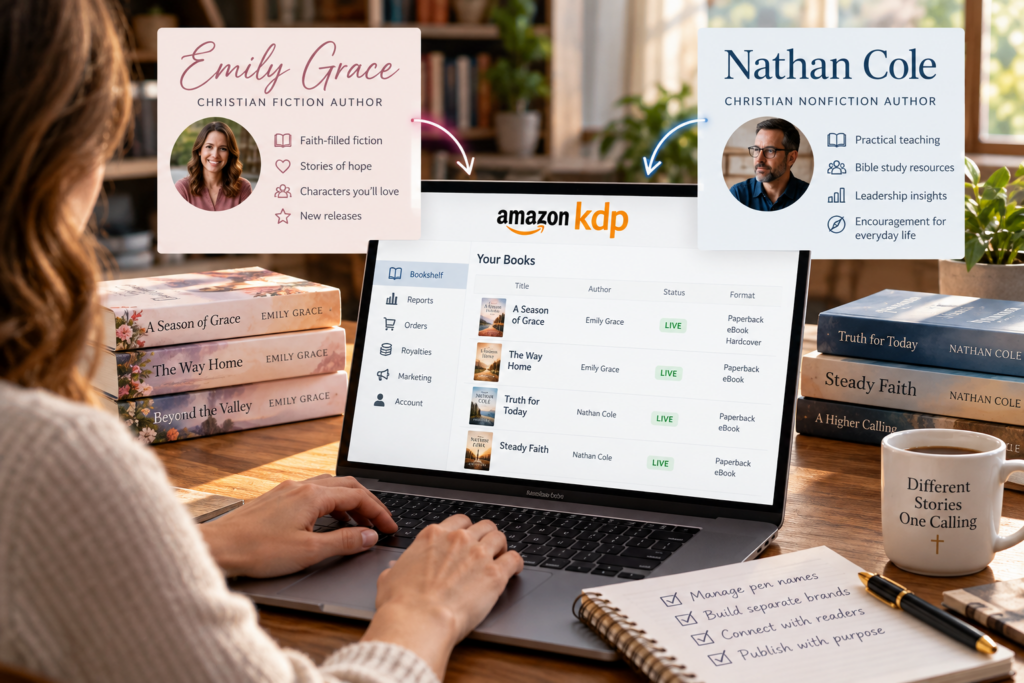
A pen name can help an author separate genres, protect privacy, build a distinct brand, or publish work that does not fit comfortably under an existing public identity.
Amazon KDP allows authors to publish under pseudonyms.
The important distinction is that your public author name can be different from the legal identity attached to your KDP account.
KDP says authors may use pen names for their books, while their real legal name should remain in the account information used for identity verification, payments, banking, and tax reporting. Kindle Direct Publishing
For Christian authors, the decision may involve more than branding.
A pastor writing fiction, a ministry leader publishing memoir, a devotional author entering a different genre, or a writer discussing sensitive personal experiences may all have legitimate reasons to consider a pen name.
The key is to make the decision before publication and manage it consistently.
Why Authors Use Pen Names
Authors use pseudonyms for many reasons.
Some want to separate very different genres.
A Christian romance author may not want the same byline on a technical business guide.
A children’s author may want a different identity from the one used for adult suspense fiction.
Other authors want professional distance from their day jobs.
Teachers, pastors, counselors, attorneys, executives, or ministry leaders may prefer some separation between professional responsibilities and certain kinds of creative work.
Privacy may also matter.
A memoir author discussing family conflict or painful personal history may decide that a pseudonym provides some public separation, even though it does not create complete legal anonymity.
The best reason to use a pen name is not that it sounds more marketable.
It is that the separate identity serves a clear publishing purpose.
Your KDP Account Still Uses Your Legal Identity
A pen name changes what readers see.
It does not replace the legal information Amazon needs from you.
KDP currently requires the account holder’s real legal identity for account verification. Tax information should reflect the legal name used for tax purposes, and bank information should match the actual bank account. Kindle Direct Publishing
When creating a book, you enter the pen name in the author field.
KDP specifically states that a pen name is allowed, provided it is appropriate and used consistently. Kindle Direct Publishing
That means readers can see:
Grace Morgan
while Amazon internally knows the verified account belongs to:
Jane Smith
Those identities serve different purposes.
Choose the Pen Name Before Publishing
This is one of the most important practical rules.
Do not treat the author name as an easily editable marketing field.
KDP says the primary author name is generally locked after publication. For print books, there is a limited 72-hour window after initial publication when some title, subtitle, and primary-author changes may still be possible. After that, changing the author name usually requires creating a new edition. Kindle Direct Publishing
KDP also distinguishes between correcting a typo and changing the identity itself.
A misspelling may be eligible for correction through KDP Support.
Changing:
Sarah Bloom
to
Emily Hart
is not simply a typo correction.
That generally means republishing the book as a new edition. Kindle Direct Publishing
Choose carefully before the first book goes live.
Keep the Name Consistent
Consistency matters across:
- book metadata
- cover
- copyright page
- Author Central
- author website
- newsletter
- social profiles
- book descriptions
- series branding
- promotional materials
KDP warns that consistency in author naming affects search, Author Pages, Series Pages, and format linking. Kindle Direct Publishing
Even small differences can create confusion.
For example:
Rachel M. Stone
and
Rachel Stone
may be treated differently across systems.
Decide on the exact form of the name and use it consistently.
One KDP Account Can Publish Multiple Pen Names
You do not need a separate KDP account for every pseudonym.
A single KDP account can be used to publish books under different author names while payments and tax reporting remain tied to the verified account holder. KDP’s own documentation explicitly supports using pen names in the author field while keeping the legal identity in the account information. Kindle Direct Publishing
That is much simpler than creating separate publishing accounts.
It also avoids potential account problems caused by maintaining multiple KDP accounts unnecessarily.
Author Central Needs Separate Brand Management
Each pen name should be treated as its own public author identity.
Amazon Author Central allows authors to claim books associated with a pen name, and Amazon may verify that the person claiming a new pen name is the rights holder. Kindle Direct Publishing
That means each identity may need its own:
- author bio
- author photo or branded image
- book list
- website link
- public positioning
The backend publishing account can remain unified.
The reader-facing identity can remain distinct.
Decide How Separate You Want the Identities to Be
Not every pen name requires complete separation.
Some authors openly say:
Grace Morgan is the fiction pen name of Jane Smith.
Others keep the connection private.
Both approaches can work.
The level of separation affects how much infrastructure you need.
A lightly separated pen name may share:
- one website
- one newsletter
- one social account
A fully separated brand may need:
- separate website
- separate mailing list
- separate social profiles
- separate visual identity
- separate content strategy
Before creating the pen name, decide how much separation you actually need.
More separation means more management.
Christian Authors May Have Additional Reasons to Use a Pen Name
Christian publishing creates a few special considerations.
A pastor may want to publish fiction without confusing readers who know the author primarily through ministry.
A Christian nonfiction writer may use one name for theological writing and another for mainstream fiction.
A memoir author may want some distance from sensitive personal material.
A devotional writer may eventually expand into a genre with a very different audience.
The decision should not be based on fear of reader reaction alone.
It should be based on whether a separate identity improves clarity, privacy, or positioning.
A Pen Name Is Not Complete Anonymity
A pseudonym can create public separation.
It does not guarantee total anonymity.
Amazon still has your real account information.
Payment processors have your legal information.
Tax authorities receive legal taxpayer information.
Contracts may identify the real party.
Copyright registration can become part of the public record depending on how you file.
If true anonymity is important, a pen name alone should not be treated as a complete privacy solution.
Copyright Can Be Registered Pseudonymously
The U.S. Copyright Office allows works to be registered as pseudonymous.
Its guidance says there is no requirement that the author’s legal name appear on the application. If a work is registered pseudonymously, the author may provide the pseudonym without disclosing the legal name. U.S. Copyright Office
However, copyright registration creates a public record.
If you include your legal name in the application, that information becomes public. U.S. Copyright Office
There is another important distinction.
Under U.S. copyright law, the duration of protection for a pseudonymous work can differ depending on whether the author’s legal identity is disclosed in Copyright Office records. The Copyright Office explains that pseudonymous works may use a term based on publication or creation dates unless the author’s identity is disclosed in the official record. U.S. Copyright Office
That is an area where authors may want legal advice if privacy and long-term rights planning are important.
Check the Name Before You Build the Brand
A pen name should not be chosen in isolation.
Before committing, search:
- Amazon
- major social platforms
- domain names
- trademark databases
- Goodreads
- bookstore listings
You do not want to discover after publication that another author already has the same name in the same genre.
KDP itself recommends considering a pen name, middle name, or initial if the author name is similar to a popular author’s name. Kindle Direct Publishing
The goal is clarity.
Readers should be able to find the correct books without confusing you with someone else.
Do Not Impersonate Another Author or Brand
A pen name is not a license to create confusion.
KDP’s metadata guidelines allow pseudonyms as long as they do not interfere with customers making good buying decisions. Kindle Direct Publishing
Avoid names that appear designed to imitate:
- famous authors
- established brands
- celebrities
- publishers
- public figures
Even if a name is technically available, choosing something confusingly close to a known author can create legal and marketplace problems.
Think About Genre Before Splitting Your Audience
A second author identity creates a second brand.
That means starting again with:
- readership
- reviews
- newsletter recognition
- social following
- author-page visibility
- launch momentum
Sometimes that separation is worth it.
Sometimes it creates unnecessary fragmentation.
If the books serve substantially the same audience, keeping one author identity may be simpler.
If the audiences are very different, separate names can make positioning clearer.
Think in terms of reader expectations rather than simply genre labels.
Build the Pen Name Like a Real Author Brand
If you decide to use a pseudonym, treat it seriously.
Create a consistent visual identity.
Use the same author name everywhere.
Write a clear author biography.
Build an email list around that readership.
Establish an appropriate website or author page.
Make the books visually recognizable as belonging to the same author or series.
A pen name should not feel like a disposable alias.
If readers connect with the books, the name becomes a publishing asset.
Decide What the Author Biography Should Reveal
You do not have to invent an elaborate fictional life story.
A pseudonymous biography can remain truthful while protecting personal details.
For example:
Grace Morgan writes contemporary Christian fiction about family, forgiveness, and second chances. When she is not writing, she enjoys old bookstores, strong coffee, and quiet mornings with a good novel.
That biography communicates the brand without disclosing legal identity.
Avoid fabricating professional credentials or life experiences.
A pen name can protect identity without requiring deception.
Manage Email Carefully
A separate reader-facing email address can help preserve the identity.
For example:
hello@gracemorganauthor.com
may be better than responding from an address containing the author’s legal name.
You can forward that email into your main inbox if you do not want to manage multiple inboxes.
The same principle applies to newsletter sender names.
Readers should see the identity they recognize from the books.
Think About Contracts and Business Records
A pen name does not replace your legal identity in contracts.
Publishing contracts, design agreements, editing agreements, banking relationships, tax documents, and other business arrangements may still need the legal party identified.
A contract might state something like:
Jane Smith, writing as Grace Morgan
depending on the circumstances.
If rights ownership, licensing, anonymity, or business entities are involved, get appropriate professional advice.
Estate Planning Matters Too
If a pen name becomes valuable, make sure the people responsible for your estate know it exists.
Document:
- pen names
- domains
- publishing accounts
- intellectual property
- royalty accounts
- passwords or secure-access instructions
- contracts
- manuscripts
- copyrights
The books remain assets even if readers never knew the author’s legal name.
Good records make those assets easier to manage later.
Frequently Asked Questions
Can I publish under a pen name on Amazon KDP?
Yes. KDP allows authors to publish under a pen name while keeping their legal identity in the account information used for verification, taxes, and payments. Kindle Direct Publishing
Do I need a separate KDP account for each pen name?
No. Different pen names can be published through the same verified KDP account.
Can I change my author name after publishing?
Usually not freely. The primary-author field becomes locked after publication. Small typos may be corrected, but changing to a different pen name generally requires publishing a new edition. Kindle Direct Publishing
Will Amazon publish my legal name on the book page?
KDP says that when using a pen name, the legal name in the KDP account remains separate from the public author name and is not published on the Amazon book listing. Kindle Direct Publishing
Can I register copyright under a pen name?
Yes. The U.S. Copyright Office allows pseudonymous registration. Whether you disclose your legal identity in the public copyright record is a separate decision with possible legal implications. U.S. Copyright Office
Should Christian authors use pen names?
Sometimes. A pen name may help separate genres, preserve privacy, distinguish ministry work from fiction, or create clearer reader expectations. It is not necessary simply because the book is faith-based.
Choose the Name With the Long Term in Mind
A pen name can be useful.
But it is not merely a label typed into KDP.
It can become:
a reader identity
a brand
a website
a newsletter
a series
a body of work
and eventually a valuable publishing asset.
Choose it before publication.
Check that the name is distinctive.
Use it consistently.
Keep your legal identity correct in the systems that require it.
Then build the author identity with the same care you would give your real name.