Amazon KDP Content Guidelines: What Authors Need to Avoid
Amazon KDP content guidelines cover much more than your manuscript. Learn what Christian authors should check for copyright, AI disclosure, public-domain content, metadata, Scripture permissions, and reader quality before publishing.

Amazon KDP gives independent authors remarkable freedom to publish.
That freedom comes with responsibility.
A book can be professionally written and beautifully designed and still run into problems if it violates Amazon’s content, rights, metadata, or customer-experience standards.
For Christian authors, the issues are often less dramatic than people imagine. The most common risks are usually practical:
Using material you do not have rights to.
Publishing undifferentiated public-domain content.
Entering misleading metadata.
Using copyrighted Scripture or other material without checking permissions.
Publishing poor-quality or misleading content.
Failing to disclose AI-generated material when required.
Understanding those areas before upload is much easier than trying to fix a rejected book afterward.
KDP Content Rules Apply to More Than the Manuscript
When authors hear “content guidelines,” they often think Amazon is reviewing only the words inside the book.
The rules apply more broadly.
KDP evaluates material associated with the book, including:
- manuscript content
- title
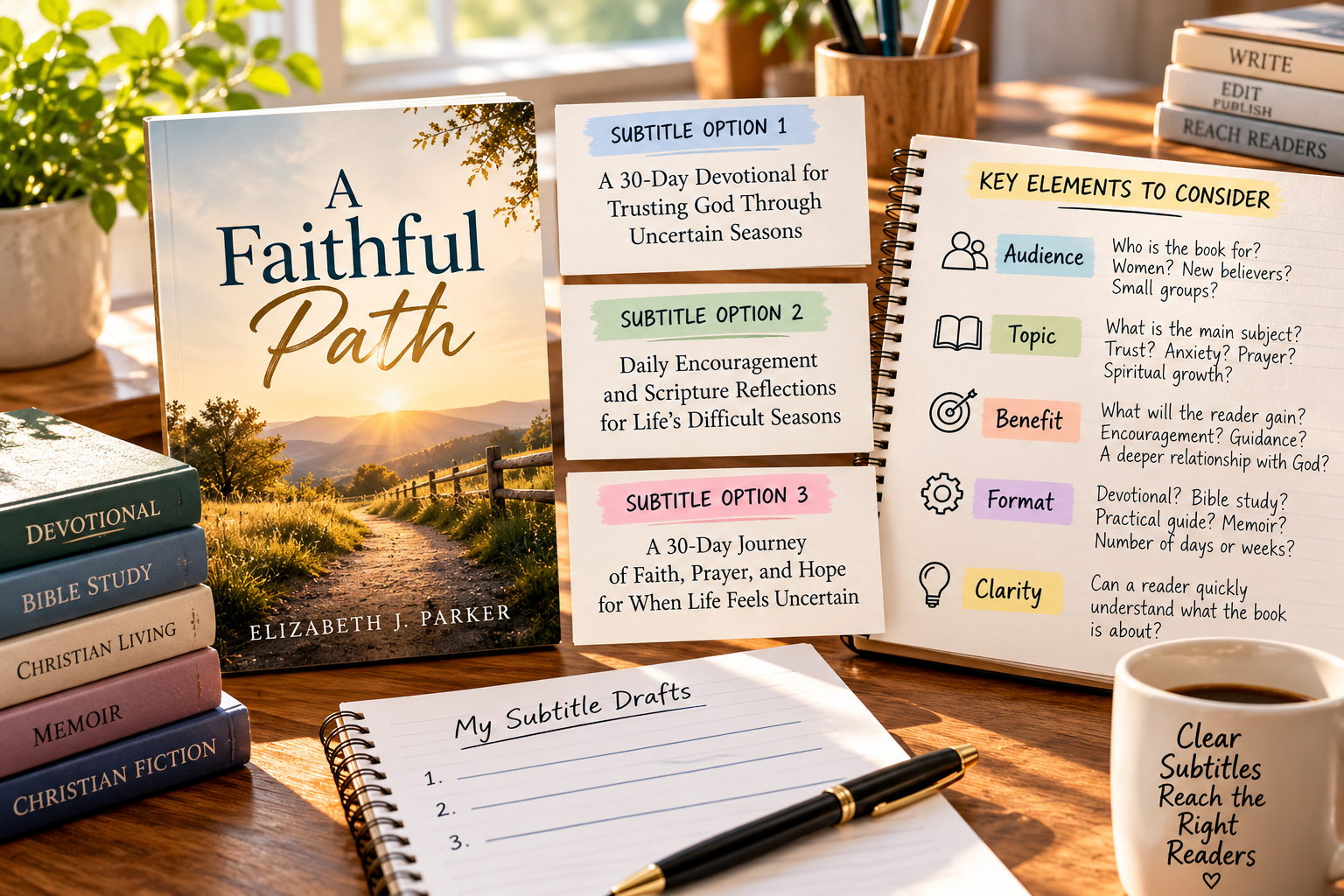
- subtitle
- cover
- description
- author and contributor information
- keywords
- categories
- other book metadata
That means a compliant manuscript can still encounter problems if its cover, title, description, or metadata misrepresents what the reader is buying.
Think of the entire Amazon listing as part of the publication.
You Must Have the Right to Publish the Material
This is one of the most important rules.
You are responsible for ensuring that your book does not violate copyright, trademark, privacy, publicity, or other proprietary rights.
That applies to:
- text
- photographs
- illustrations
- quotations
- translations
- cover graphics
- logos
- supplemental material
Do not assume something is usable simply because you found it online.
Availability is not permission.
If another person created the material, determine whether:
- you own it
- you licensed it
- you have written permission
- it is legitimately in the public domain
- your use is otherwise legally permitted
Keep documentation for important permissions and licenses.
Christian Authors Need to Check Scripture Permissions
This deserves special attention for Faith Author Hub readers.
Modern Bible translations are generally copyrighted.
Each translation publisher establishes its own rules governing quotation limits, attribution, copyright notices, and situations requiring permission.
That matters when publishing:
- devotionals
- Bible studies
- Christian nonfiction
- children’s books
- prayer books
- sermon collections
- theological resources
Do not assume that Scripture can be reproduced without restriction simply because it is biblical text.
Check the specific translation you are quoting.
Public-domain translations are different, but even then, verify the legal status for the market where you intend to publish.
Your Scripture permissions process should happen before the book reaches KDP.
Public Domain Does Not Mean Upload Anything You Find
Public-domain publishing is allowed on KDP.
But Amazon does not necessarily want another identical edition of a public-domain book already available free in its store.
When a free version exists, Amazon expects a differentiated edition.
Meaningful differentiation can include:
- original translation
- original annotations
- original historical context
- original study material
- original illustrations
Simply downloading an old text, changing the cover, and uploading it as a new product is not a strong publishing strategy.
This is especially relevant to Christian publishing because enormous amounts of older faith material are in the public domain.
Sermons.
Devotionals.
Christian classics.
Prayer collections.
Theological works.
Bible commentaries.
Those resources can become excellent new products, but the publisher should add genuine value rather than merely reproduce the original file.
Translation Rights Need Separate Attention
Translation creates another rights issue.
A book being written in another language does not make it available for you to translate and publish.
If the original work remains under copyright, translation rights usually belong to the rights holder unless permission has been granted.
That means you should not take a contemporary foreign-language Christian book, translate it yourself, and publish the translation without obtaining the appropriate rights.
Even when the underlying work is public domain, an existing modern translation may have its own copyright.
The original work and the translation should be evaluated separately.
KDP also requires translated works to identify the original author and translator appropriately in the contributor information.
Covers and Images Must Be Legitimately Usable
Every visual element needs the same rights attention as your manuscript.
That includes:
- stock photography
- illustrations
- generated artwork
- photographs
- icons
- textures
- background graphics
- logos
If you use stock imagery, review the license.
Different image providers have different rules about commercial use, print quantities, derivative works, merchandise, and book covers.
Do not assume that paying for access automatically grants every possible use.
Keep copies of licenses for important cover and interior assets.
AI-Generated Content Has Its Own Disclosure Rule
KDP currently distinguishes between AI-generated and AI-assisted content.
If an AI system actually creates text, images, or translations that appear in the finished book, KDP requires that AI-generated content to be disclosed during publication or when editing and republishing the title.
This includes AI-generated:
- manuscript text
- cover images
- interior artwork
- illustrations
- translations
AI-assisted work is treated differently.
If you create the content yourself and use AI to:
- edit
- refine
- critique
- error-check
- brainstorm
- improve wording
KDP currently does not require disclosure of that assistance.
The important question is who created the actual content that appears in the book.
AI Disclosure Does Not Replace Editorial Responsibility
Disclosing AI-generated content does not make accuracy or quality concerns disappear.
You remain responsible for the final publication.
That is particularly important for Christian authors.
AI can produce:
- incorrect Scripture references
- invented quotations
- mixed Bible translations
- inaccurate theological claims
- nonexistent historical sources
- incorrect copyright information
Every important claim still needs human review.
AI can be part of the production process.
It should not become the final authority.
Metadata Must Accurately Represent the Book
Metadata is the information that tells Amazon and readers what the book actually is.
It includes elements such as:
- title
- subtitle
- author
- contributors
- description
- keywords
- categories
- series information
- audience
KDP expects this information to describe the book accurately.
Do not treat metadata fields as places to stuff promotional language.
Your title should be the actual title appearing on the book.
Your author name should accurately identify the author or legitimate pen name.
Your series information should represent an actual series.
Your description should describe the book readers will receive.
Consistency matters.
Avoid Misleading Keywords
KDP allows authors to enter keywords that help readers discover relevant books.
Those keywords should describe the actual content.
Avoid using:
- unrelated topics
- another author’s name
- another book’s title
- claims such as “bestseller”
- promotional phrases such as “free”
- brand names you are not authorized to use
- misleading search terms
The purpose of keywords is relevance.
Trying to appear in unrelated searches creates a poor customer experience.
For a Christian devotional about grief, terms connected to grief, faith, hope, loss, prayer, or devotional reading may be relevant.
A popular unrelated Christian author’s name is not.
Categories Should Fit the Actual Book
Categories are another place where accuracy matters.
Do not select an unrelated category simply because it appears easier to rank in.
A children’s devotional should be categorized as something appropriate to its actual audience and subject.
A Christian romance should not be placed into unrelated nonfiction categories merely to avoid competition.
A Bible study should not pretend to be something else to gain visibility.
Categories help readers browse.
Use them accordingly.
Descriptions Should Explain, Not Manipulate
Your Amazon description should help readers understand what they are considering.
It should not become a dumping ground for promotional claims, keyword lists, or unrelated information.
Focus on:
- what the book is about
- who it is for
- what readers will find inside
- what problem it addresses
- what kind of experience it provides
Do not add material that has little connection to the book merely because you think it may improve search visibility.
Clear communication serves both Amazon and the reader.
Poor Customer Experience Can Cause Problems Even Without Copyright Issues
A book can be entirely original and still fail readers.
KDP pays attention to customer experience.
Problems can include content that is:
- misleading
- incomplete
- excessively repetitive
- poorly translated
- difficult to read
- substantially duplicated elsewhere
- primarily promotional
- significantly different from what the listing promises
This is especially relevant now that publishing tools make it possible to produce books very quickly.
Speed does not replace usefulness.
A book should offer enough value to justify the reader’s purchase.
Recycled Content Can Create Problems
Republishing nearly identical material repeatedly under different titles is not a sustainable strategy.
That includes taking one book and making superficial changes such as:
- changing the title
- changing the cover
- rearranging sections
- replacing a few words
- republishing substantially the same content
Amazon wants customers to understand what they are buying.
A catalog filled with highly repetitive books can create confusion and disappointment.
If you develop a related series, each book should have a legitimate purpose of its own.
Low-Value Books Deserve Extra Scrutiny Before Upload
Ask a basic question:
Why should someone buy this book?
If the only answer is:
“It was easy to create,”
the product probably needs more work.
For Christian publishers, meaningful value might come from:
- original devotional reflection
- carefully developed Bible-study questions
- original research
- practical application
- historical context
- strong illustrations
- thoughtful teaching
- a distinctive audience focus
- high-quality organization
The goal is not merely to fill pages.
The goal is to produce something worth reading.
Christian Books Need Theological Quality Control Too
Amazon is not your theological editor.
A book can technically satisfy platform rules and still contain serious biblical errors.
Before publication, Christian content should be reviewed for:
- Scripture accuracy
- verse references
- translation attribution
- theological consistency
- historical claims
- denominational terminology
- quotations attributed to Christian figures
- potentially misleading biblical interpretations
Platform compliance and editorial quality are separate responsibilities.
You need both.
Do Not Impersonate Other Authors
Pen names are allowed.
Impersonation is not.
Your author identity should not be deliberately designed to confuse readers into believing you are another established writer.
Do not:
- copy a recognizable author’s branding
- use another author’s identity
- imply a relationship that does not exist
- insert another author’s name into metadata for visibility
Build your own author brand.
It is slower, but it belongs to you.
Series Information Must Be Genuine
Series metadata should help readers understand reading order and related titles.
Do not claim that an unrelated book is part of a successful series merely to attract attention.
If you are building a Christian series, make the relationship clear.
For example:
Faith Through the Seasons Series
could legitimately contain related devotional books addressing:
- grief
- waiting
- prayer
- family
- hope
A coherent series helps readers.
Artificial series labeling confuses them.
Children’s Content Requires Particular Care
Christian children’s books deserve additional review because the intended reader is a child.
Check:
- age appropriateness
- illustrations
- reading level
- themes
- cover imagery
- metadata
- audience settings
The book’s presentation should accurately reflect its intended age group.
Do not market an adult-oriented work as children’s content simply because religious material is involved.
Audience fit matters.
Do Not Guess About Amazon’s Enforcement Systems
There is a great deal of speculation online about exactly how Amazon detects violations.
Authors hear claims about:
- hidden AI detectors
- secret strike systems
- device tracking
- manuscript pattern analysis
- automatic bans
- specific warning thresholds
Amazon does use automated systems, machine learning, and human review as part of enforcing its rules.
But authors do not need to reverse-engineer the detection system.
The safer strategy is much simpler:
Follow the rules.
Keep rights documentation.
Describe the book accurately.
Publish worthwhile content.
Respond carefully if Amazon requests information.
What Happens If Amazon Finds a Problem?
Amazon can reject or remove content that does not comply with its guidelines.
It may also request additional information before making a book available for sale.
If a title is removed, Amazon generally notifies the author or publisher.
There is also an appeal process for decisions you believe are incorrect.
Do not assume every problem means permanent account termination.
Likewise, do not assume repeated or serious violations are harmless.
Treat every compliance notice seriously.
Read the message carefully.
Identify the actual issue.
Correct what can legitimately be corrected.
Provide requested documentation when appropriate.
Keep a Rights and Compliance Folder
This is one simple habit that can save enormous frustration.
For every book, maintain a folder containing:
- manuscript source files
- cover licenses
- stock image licenses
- illustration agreements
- translation permissions
- Scripture permissions
- public-domain research
- contributor agreements
- AI-generation records when relevant
- copyright information
- ISBN information
- final metadata
You may never need most of it again.
But if a question arises two years later, you will know exactly where the documentation lives.
Run a Final Compliance Check Before Publishing
Before clicking Publish, ask:
Rights
Do I have the right to publish every significant element?
Scripture
Have I followed the translation’s quotation and attribution requirements?
AI
Did AI generate any finished text, images, or translations that require disclosure?
Public domain
If applicable, is the work legitimately public domain and sufficiently differentiated?
Metadata
Does the title, subtitle, description, author, series, keywords, and categories accurately represent the book?
Quality
Does this book provide a reasonable reader experience?
Audience
Is the content appropriate for the audience I selected?
Documentation
Could I demonstrate my rights if Amazon asked?
That checklist is far more useful than worrying about secret enforcement formulas.
Frequently Asked Questions
What kinds of content can Amazon KDP reject?
KDP can reject or remove material that violates laws or intellectual-property rights, contains prohibited offensive material, creates a poor customer experience, fails public-domain requirements, or otherwise violates its publishing guidelines.
Can I publish public-domain books on KDP?
Yes, but Amazon may require proof of public-domain status. When a free edition is already available through Amazon, KDP generally expects a differentiated version containing meaningful original material.
Can I publish AI-generated books on KDP?
KDP currently allows AI-generated content, but AI-generated text, images, and translations must be disclosed during the publishing process. The book must still satisfy all other content and quality rules.
Do I have to disclose AI-assisted editing?
No. KDP currently distinguishes AI-assisted work from AI-generated content. Editing, refining, checking, or brainstorming assistance does not itself require disclosure when you created the actual finished content.
Can I use a pen name?
Yes. Pen names are allowed. The author identity should not impersonate another author or mislead readers about who created the book.
Can I use copyrighted Bible translations?
Often, within the specific quotation and attribution allowances established by the translation publisher. Those rules vary by translation. Check the applicable permissions before publishing.
Can Amazon remove a book after it has already been published?
Yes. Approval at publication does not guarantee that a book can never be reviewed again. Rights complaints, customer reports, or other compliance concerns may lead to later review.
Can I appeal a KDP content decision?
Amazon provides an appeal process for removed content. If you believe a decision is incorrect, respond with clear information and supporting documentation rather than speculation or emotional arguments.
Compliance Begins Before You Upload
The best time to think about Amazon’s content guidelines is not after a rejection.
It is while you are building the book.
Verify rights.
Check Scripture permissions.
Review AI use.
Confirm public-domain status.
Keep metadata accurate.
Proof the content.
Document licenses.
Make sure the reader is receiving what the product page promises.
That is not merely Amazon compliance.
It is good publishing.