How Christian Authors Should Use Facebook and Instagram Ads in 2026
Facebook and Instagram advertising has changed. Learn how Christian authors can use clear messaging, strong creative, AI-assisted targeting, testing, and realistic performance measures to reach the right readers.

Facebook and Instagram ads can help Christian authors reach readers, but the strategy has changed.
Older advertising advice often focused heavily on manually choosing detailed interests and trying to identify the perfect audience inside Meta’s targeting controls.
That approach is much less useful than it once was.
Meta removed many targeting options connected to sensitive categories, including religion, and its advertising systems increasingly rely on AI to determine which people are most likely to respond to an ad. About Facebook
For Christian authors, that means the message and creative matter more than simply trying to select “Christian readers” from a targeting menu.
The goal is not to trick the algorithm into finding Christians.
It is to create an ad that clearly communicates who the book is for, what it offers, and why the right reader should care.
Start With the Book, Not the Ad Platform
Before spending money, make sure the book itself is ready to advertise.
Ask:
Who is this book for?
What problem, need, desire, or interest does it address?
Why would that reader choose this book instead of another one?
Where will the ad send them?
What happens after they click?
A devotional for women dealing with grief needs a very different message from a Christian suspense novel, Bible study workbook, parenting book, or children’s devotional.
The more clearly you understand the reader, the easier it becomes to create effective advertising.
Do not begin with the question:
What Facebook audience should I target?
Begin with:
What does the right reader need to recognize immediately in this ad?
Creative Helps Meta Understand Who May Respond
One of the most useful ideas in the Faith-Scale Framework you shared is:
Your creative is part of your targeting.
The guide argues that advertisers should spend less energy trying to construct complicated religious audiences and more energy creating messages that clearly identify who the product is for. The_Faith-Scale_Framework
That idea fits Meta’s current direction.
Meta says its advertising systems increasingly use AI models to understand which ads resonate with different people and determine which ads to show. About Facebook
For an author, that means the opening line, image, video, headline, description, and offer all contribute signals.
Compare:
Discover an inspiring new Christian book.
with:
For Christian parents trying to help an anxious child trust God during uncertain seasons.
The second message is much clearer.
It tells both the reader and the advertising system more about the audience and purpose of the book.
Do Not Build Your Strategy Around Religious Interest Targeting
Meta removed targeting options connected to sensitive subjects such as religious practices and groups beginning in 2022. About Facebook
That makes advice such as:
“Target Baptist authors, Christian worship leaders, and denominations”
unreliable as a general strategy.
Some interests may still exist in the platform, but Christian authors should not build their entire paid advertising plan around the assumption that they can reconstruct a precise religious profile through detailed targeting.
A better approach is to start reasonably broad and let the ad itself communicate who the book serves.
Meta’s Advantage+ Audience is designed to use advertiser inputs together with AI to find relevant audiences and expand beyond initial suggestions when the system predicts better performance elsewhere. About Facebook
That does not mean targeting no longer matters.
Location, age when appropriate, existing customer audiences, and other available controls can still be useful.
But the old model of stacking dozens of interests deserves much less attention than strong creative and clear positioning.
Test Different Messages, Not Just Different Images
A common advertising mistake is creating one ad and then changing only the photo.
That is not a meaningful test.
Christian authors can test different reasons someone might care about the same book.
Suppose you wrote a devotional about difficult seasons.
Possible angles might include:
Hope during uncertainty
Finding peace when prayers seem unanswered
A short morning devotional for overwhelming days
Encouragement for Christians walking through grief
Each angle speaks to a different reader need.
The underlying book remains the same, but the message changes.
The Faith-Scale Framework recommends producing substantial creative variation rather than relying on one supposed winner. The_Faith-Scale_Framework
That principle is useful even if you do not follow the guide’s exact campaign counts or budget recommendations.
Use Plain Language
Christian publishing sometimes defaults to phrases that sound meaningful inside church culture but may be vague in advertising.
Examples include:
walk in victory
step into your calling
experience breakthrough
deepen your spiritual journey
Those phrases may fit some audiences, but they often say very little about the actual book.
Clear language usually works better.
Instead of:
A powerful devotional to transform your walk.
Try:
Thirty short readings for Christians struggling to trust God during uncertain seasons.
The second version tells readers what they are getting.
The Faith-Scale Framework makes a similar argument, encouraging advertisers to use direct, recognizable language rather than overly abstract phrasing. The_Faith-Scale_Framework
Decide What You Want the Ad to Accomplish
Not every author ad should do the same job.
You may want to:
sell a book directly
grow an email list
offer a free devotional
promote a Bible study
register readers for an event
build awareness for a new author brand
drive readers to an article
promote a launch
The campaign objective and landing experience should match the goal.
A reader downloading a free five-day devotional is taking a different action from someone purchasing a $19.99 workbook.
Do not judge both campaigns by the same metric.
Direct Book Sales Can Work, but They Are Not the Only Funnel
The generator said authors should never send cold traffic directly to a book sales page.
That is too absolute.
Direct-to-book advertising can work.
So can lead-generation funnels.
The right approach depends on the book, price, audience, brand familiarity, landing page, reviews, offer, and advertising economics.
A lead magnet can be especially useful when an author wants to build a long-term audience rather than generate only one immediate purchase.
For example:
Ad → free devotional → email sequence → full devotional book
or:
Ad → free Bible study sample → email list → complete workbook
That structure lets the author continue communicating with interested readers.
But do not add extra funnel steps simply because marketing advice says you should.
Every additional step introduces another place for readers to leave.
Test what fits your publishing goal.
Make the Landing Page Match the Ad
A strong ad can still fail if the destination does not deliver what the ad promised.
The transition should feel natural.
If your ad says:
A practical Bible study for Christian women rebuilding confidence after divorce
the landing page should immediately reinforce that same message.
Do not send readers to a generic homepage and expect them to search for the book.
Make the next step obvious.
The page should clearly communicate:
what the book is
who it is for
what it helps with
what format it comes in
what it costs
what the reader should do next
Consistency reduces confusion.
Measure the Result That Matches the Goal
Clicks alone do not tell you whether an ad is working.
A campaign designed to build an email list should be evaluated differently from a campaign designed to sell books.
Useful metrics may include:
cost per landing-page view
cost per email subscriber
cost per purchase
conversion rate
total purchases
revenue
return on ad spend
email engagement after signup
The exact metric depends on the goal.
Meta itself encourages advertisers to evaluate performance holistically rather than relying on one engagement measure. Facebook
If an ad receives many clicks but produces no subscriptions or sales, the problem may be the landing page, offer, audience-message fit, or expectation created by the ad.
Do not automatically assume the targeting is wrong.
Change One Major Variable at a Time
Testing becomes difficult when everything changes simultaneously.
If you change the audience, image, headline, offer, landing page, and price at the same time, you cannot tell what caused the result.
Instead, test deliberately.
For example:
same audience, different message
same message, different creative
same creative, different landing-page headline
same offer, different audience approach
Meta supports A/B testing as a way to compare variables rather than relying only on intuition. Facebook
You do not need a complicated laboratory.
You need enough discipline to know what you actually changed.
Avoid Universal Budget Rules
There is no single correct starting budget for every author.
The generator recommended $5 per day per audience.
The PDF you shared recommends much higher testing budgets tied to product price. The_Faith-Scale_Framework
Those recommendations illustrate an important point:
Different advertisers use very different testing models.
Budget depends on:
book price
profit margin
campaign objective
conversion rate
audience size
creative volume
available cash
how quickly you need useful data
A $4.99 ebook and a $49 Bible-study bundle cannot necessarily support the same advertising economics.
Start with a budget you can afford to test without needing immediate success.
Then base expansion on actual results rather than an arbitrary formula.
Do Not Treat One ROAS Number as Universal
The Faith-Scale guide uses specific ROAS thresholds to identify winners. The_Faith-Scale_Framework
That may be useful within that advertiser’s business model.
It is not a universal rule for authors.
A profitable return depends on your actual economics.
If you sell a $14.99 paperback through a retailer, your royalty may be only a fraction of the retail price.
If you sell a digital workbook directly from your own website, your margin may be much higher.
If your goal is to acquire an email subscriber who may eventually buy several books, immediate ROAS may not even tell the entire story.
Know what one customer is worth before deciding what performance qualifies as good.
Creative Fatigue Is Real, but There Is No Fixed Expiration Date
The generator claimed that ads should be replaced every two weeks.
That is too rigid.
Creative performance can decline as an audience sees the same message repeatedly, but there is no universal expiration date.
The Faith-Scale Framework recommends an ongoing creative-production cycle because successful creatives can lose effectiveness as spend increases. The_Faith-Scale_Framework
The useful principle is:
Keep developing new creative before you desperately need it.
Do not turn that into a rule that every ad must be replaced on a calendar.
Let performance data guide the decision.
Consider Multiple Creative Formats
Do not assume every author ad should be a static book-cover graphic.
Test formats that fit the book.
Possibilities include:
author video
book-cover image
reader testimonial
short quotation
page-flip video
devotional excerpt
illustrated scene
carousel
Reel
behind-the-scenes publishing content
Meta recommends creative testing and supports ad delivery across multiple placements, including Facebook and Instagram Reels. Facebook
The strongest format depends on the book and audience.
Use AI to Multiply Ideas, Not Replace Judgment
AI can help authors create:
headline variations
different hooks
alternative descriptions
video scripts
audience angles
CTA ideas
creative briefs
The Faith-Scale Framework specifically recommends using AI to create variations from winning concepts while having the human advertiser add real-world texture and spiritual nuance. The_Faith-Scale_Framework
That is a sensible division of labor.
Use AI for speed.
Keep the author’s judgment for message, theology, reader sensitivity, and final voice.
Frequently Asked Questions
Can I target Christians directly on Facebook?
Meta removed many detailed targeting options related to religion and other sensitive categories. Christian authors should not rely on direct religious-interest targeting as the foundation of their strategy. About Facebook
Should I use broad targeting?
Broad or AI-assisted targeting can be worth testing, particularly when your creative clearly communicates who the book is for. Meta continues investing heavily in AI-driven ad ranking and audience systems. About Facebook
Should I advertise directly to Amazon?
You can. Direct book-sale campaigns and lead-generation funnels are both legitimate strategies. Test the approach that matches your margins, audience, and long-term publishing goals.
How much should I spend?
There is no universal starting amount. Set a test budget based on your available funds, book economics, objective, and the amount of data you need to make a useful decision.
What should I test first?
Start with different message angles and creative concepts. A beautiful ad aimed at the wrong reader need usually performs worse than a clear message that immediately makes the right reader recognize themselves.
Do Christian authors need Facebook ads?
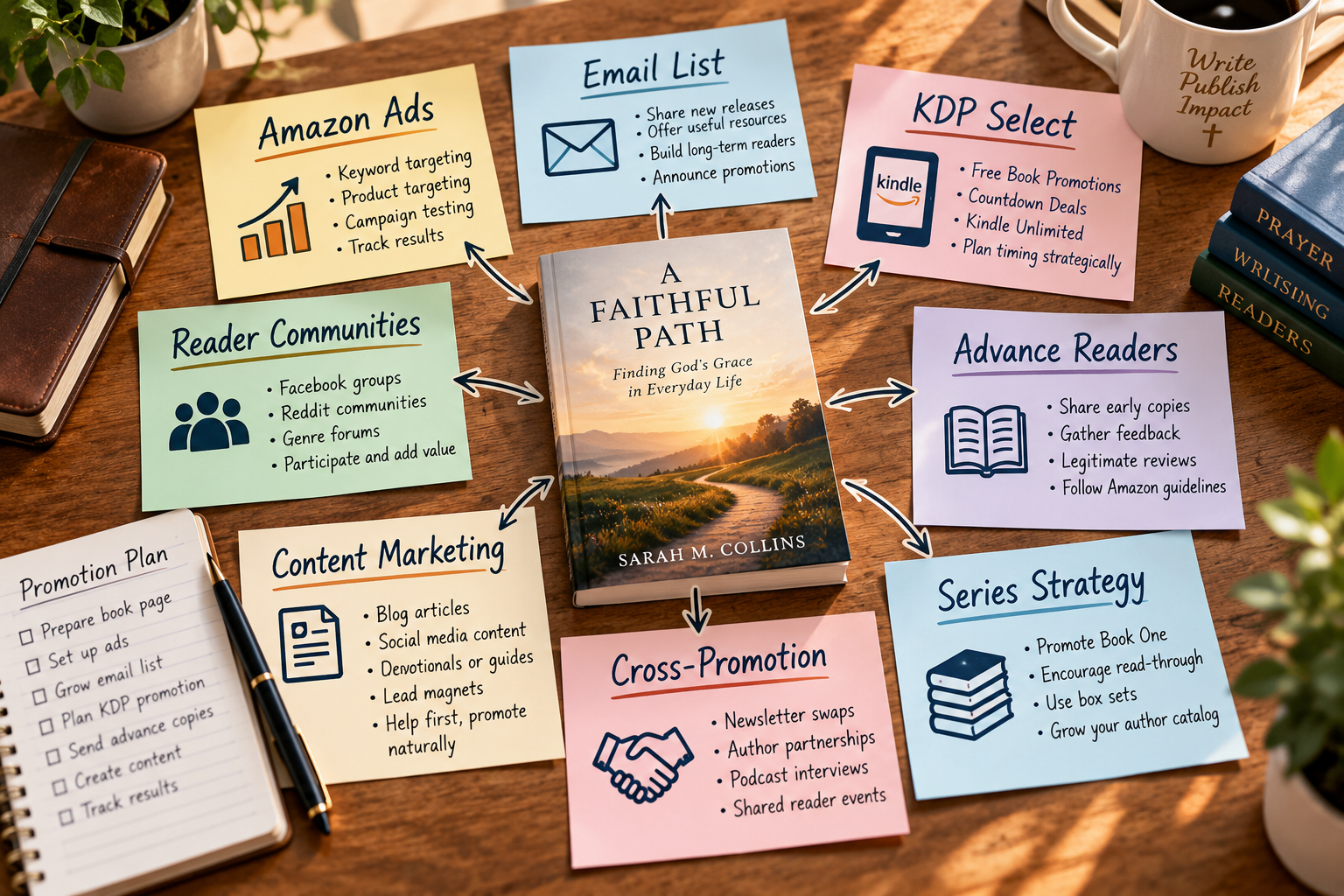
No. Paid advertising is one marketing option among many. Email, content marketing, podcasts, churches, ministries, reader communities, partnerships, and organic social media can all contribute to an author platform.
Let the Message Do More of the Targeting
The biggest shift in Meta advertising is not a secret audience setting.
It is the growing importance of giving the system strong signals through your offer, creative, and message.
Christian authors no longer need to spend all their energy trying to construct the perfect religious-interest audience.
Know the reader.
Make the message unmistakable.
Test different creative angles.
Measure the action that actually matters.
Learn from the results.
Then put more resources behind what proves it can work.