How To Write A Devotional That Readers Actually Finish
Learn how to write a devotional that stays grounded in Scripture, focuses on one clear truth, connects naturally with everyday life, and gives readers something meaningful to carry forward.

Writing a devotional can feel deceptively simple. Choose a Bible verse, add a short reflection, finish with a prayer, and you are done.
In practice, strong devotional writing requires more discipline than that.
A devotional has limited space to help a reader encounter Scripture, understand one meaningful idea, connect that truth to everyday life, and leave with something worth carrying into the day.
The goal is not to say everything about a passage.
It is to say one useful thing clearly, faithfully, and memorably.
Start With a Clear Purpose
Before writing the first sentence, decide what this devotional is meant to help the reader see, understand, remember, or practice.
That purpose should be narrow enough to handle in one short reading.
For example, a devotional built around Psalm 23 might focus on rest, guidance, fear, provision, or God’s presence. Trying to address all of those ideas in one entry usually creates a scattered piece.
Choose one central truth.
Then ask:
What does this passage reveal?
Why might this matter to the reader today?
What response does it invite?
Those questions give the devotional direction before you begin drafting.
Let Scripture Lead the Devotional
A Christian devotional should not begin with a personal idea and then search for a Bible verse that seems to support it.
Start with the biblical text itself.
Read the passage in context. Pay attention to what comes before and after it. Consider who is speaking, who is being addressed, and what the passage is actually communicating.
Then build the reflection from that foundation.
A personal story, illustration, question, or everyday scene can make the devotional more relatable, but it should serve the biblical message rather than replace it.
That distinction matters.
The strongest devotionals do more than mention Scripture. They help readers understand how Scripture speaks into real life.
Choose an Opening That Fits the Message
There is no single correct way to begin a devotional.
Some pieces work beautifully with a Bible verse first.
Others begin with a question:
What do you do when the answer you prayed for does not come?
Others begin with an ordinary moment, a memory, an observation, or a problem the reader recognizes immediately.
The opening has one job: invite the reader into the devotional.
Do not force every entry into the same pattern.
If the Scripture itself is striking, begin there. If a personal moment helps illuminate the passage, begin with the moment. If the reader’s struggle is the natural starting point, begin with the struggle.
The form should serve the message.
Keep the Devotional Focused on One Main Idea
Short devotional writing becomes stronger when every paragraph supports the same central truth.
If the devotional is about God’s presence during uncertainty, avoid wandering into separate lessons about forgiveness, generosity, patience, and prayer simply because they are also important.
Save those ideas for another day.
A useful editing question is:
Does this paragraph strengthen the central message, or is it introducing another message?
If it introduces another one, consider cutting it.
That discipline is especially important when writing a series. One focused idea per entry gives readers room to absorb what they have read and gives the writer more material for future devotionals.
Connect Biblical Truth to Real Life
Application is where a devotional moves from explanation to personal reflection.
But application does not always need to be a task.
Sometimes the most appropriate response is to remember something.
Sometimes it is to reconsider an assumption.
Sometimes it is to pray.
Sometimes it is to make a practical change.
For example, instead of ending a devotional on worry with a broad instruction such as “trust God more,” you might invite the reader to name one concern they have been carrying and bring that specific concern to God in prayer.
The goal is not to manufacture activity.
It is to help the reader respond meaningfully to the biblical truth they have just considered.
Use Personal Stories Carefully
Personal experience can make a devotional warm and memorable.
It can also overwhelm the piece if the story becomes more important than the Scripture.
Use personal stories when they genuinely illuminate the message.
You do not need a dramatic testimony in every devotional. A small moment can be enough: an unanswered text, a difficult conversation, a quiet morning, a mistake, a delayed plan, or an unexpected kindness.
The story should create recognition, not admiration for the writer.
Readers should finish thinking about the truth of the devotional, not simply about the author’s experience.
And not every devotional needs a personal story at all.
Biblical narratives, observations from daily life, historical examples, questions, or simple exposition can also provide effective openings and illustrations.
Write at the Length the Message Needs
There is no universal devotional word count.
Some daily devotionals are intentionally brief. Others allow more space for Scripture explanation, reflection, prayer, and application.
The right length depends on the audience, format, publication, and purpose.
A short email devotional may need to be concise. A printed 365-day collection may follow a consistent length for design reasons. A Bible study devotional may require more room.
The better question is not:
How many words should this be?
Ask:
Have I said what the reader needs without repeating myself?
Once the main idea is clear, remove sentences that merely restate it.
Devotional writing benefits from restraint.
Avoid Sounding Like a Lecture
Christian writers naturally care about the message they are communicating. That passion can sometimes turn into an overly instructional tone.
Watch for language that repeatedly tells readers what they “must,” “should,” or “need to” do.
There are times when direct instruction is appropriate, but devotional writing often becomes more inviting when it creates space for reflection.
Instead of:
You must stop worrying and trust God.
You might write:
What would it look like to place one specific worry into God’s hands today?
The second version does not weaken the message. It gives the reader room to engage with it personally.
Encouragement and conviction can coexist.
Include Prayer When It Serves the Format
Many devotionals close with prayer, and that structure can be effective because it helps the reader respond directly to what they have just read.
The prayer should reflect the devotional’s central idea.
Keep it natural.
Avoid introducing new theological concepts or turning the prayer into another sermon.
For example:
Lord, help me recognize where fear is controlling my thoughts today. Remind me of Your presence and give me the courage to trust You with what I cannot control. Amen.
A simple prayer can provide a meaningful close without repeating the entire devotional.
Build a Consistent Structure for a Devotional Series
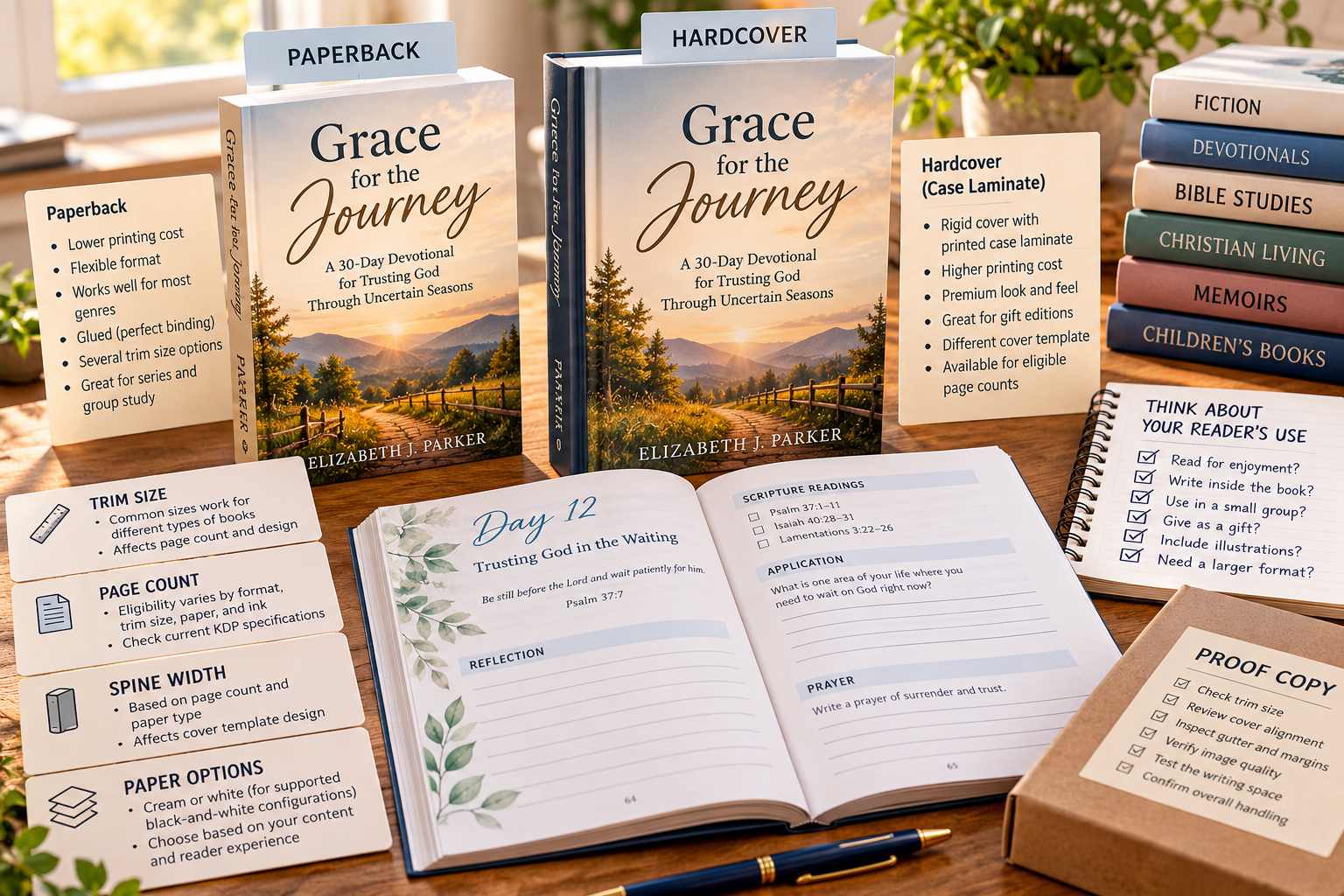
When creating a 30-day, 40-day, 90-day, or year-long devotional, consistency becomes important.
Readers should know generally what to expect from each entry.
A simple structure might include:
Scripture
A primary verse or short passage.
Opening
A question, observation, story, or thought that draws the reader in.
Reflection
The main devotional message.
Application or Reflection Question
A practical way to engage with the message.
Prayer
A brief closing response.
You do not have to use every element in every project.
The purpose of a structure is not to make the writing mechanical. It is to create enough consistency that the reader can focus on the message rather than figuring out how each day’s entry works.
Plan the Series Before Writing Every Entry
A devotional collection becomes much easier to manage when you establish the theme before drafting dozens of individual pieces.
Suppose the series is about hope during difficult seasons.
You might first create a list of possible themes:
waiting
uncertainty
grief
disappointment
God’s presence
renewal
perseverance
answered and unanswered prayer
encouragement from others
hope in Scripture
Then assign a passage and central idea to each entry.
This helps prevent repetition.
It also lets you see whether several devotionals are making essentially the same point before you spend time writing them.
A simple planning document or spreadsheet can save significant revision later.
Verify Every Scripture Reference
Devotional writers carry a particular responsibility because readers may trust the biblical material presented to them.
Check every Scripture reference.
Confirm the book, chapter, verse, wording, and Bible translation.
If you paraphrase rather than quote directly, make that distinction clear.
Also review the copyright and permissions requirements for the Bible translation you intend to use, especially when creating a book-length devotional collection.
Do not rely on memory, a search snippet, or an AI tool for final Scripture verification.
Accuracy matters.
Edit for Clarity, Faithfulness, and Repetition
After drafting, read the devotional once for meaning and once for language.
On the first pass, ask:
Is the biblical point accurate?
Is the passage being used in context?
Does the application follow naturally from the Scripture?
On the second pass, ask:
Am I repeating myself?
Does this sound like something I would actually say?
Are there clichés I can replace with clearer language?
Is any paragraph more about me than about the reader or the Scripture?
If you are creating a series, review the collection as a whole.
Repeated phrases, illustrations, themes, and applications are much easier to notice when several entries are read together.
Give the Reader Something Worth Carrying Forward
A successful devotional does not need to answer every question.
It needs to give the reader one meaningful truth to carry into the day.
That might be a verse to remember.
A question to consider.
A prayer to return to.
A new way of seeing a familiar passage.
Or a practical response to something God has already been showing them.
The devotional may only take a few minutes to read.
Its value comes from what remains after those minutes are over.
Frequently Asked Questions
How long should a devotional be?
There is no single correct length. The appropriate word count depends on the audience, format, publication, and purpose. The devotional should be long enough to develop one meaningful idea without unnecessary repetition.
Should every devotional include Scripture?
For a Christian devotional, Scripture should normally be central to the piece rather than simply added as decoration. The exact format may vary, but the biblical foundation should be clear.
Does a devotional need a personal story?
No. Personal stories can be effective, but they are only one option. A devotional can also begin with Scripture, a question, an observation, a biblical narrative, or another relevant illustration.
Should every devotional include a prayer?
Not necessarily, although prayer is a common and useful closing element. The structure should fit the purpose and expectations of the devotional series.
How do I keep a devotional series from becoming repetitive?
Plan the series before drafting every entry. Track themes, Scripture passages, illustrations, applications, and key ideas so you can identify repetition early.
What is the most important part of writing a devotional?
Faithful focus. Choose one central biblical truth, communicate it clearly, and help the reader understand why it matters in everyday life.
Start With Scripture and One Clear Truth
You do not need a complicated formula to write a meaningful devotional.
Begin with Scripture.
Understand what the passage is saying.
Choose one truth worth exploring.
Connect it honestly to life.
Give the reader space to respond.
Then stop when the message is complete.
A devotional does not have to say everything.
It only needs to say something worth remembering.