How Christian Authors Can Republish Public Domain Books the Right Way
Public-domain publishing is more than uploading old text. Learn how Christian authors can verify copyright status, meet Amazon KDP differentiation rules, add annotations or illustrations, and create valuable new editions of Christian classics.
Public-domain publishing can look deceptively simple.
Find an old book.
Download the text.
Create a cover.
Upload it to Amazon.
But that approach can fail quickly.
Amazon KDP allows public-domain content, but it may reject or refuse editions that do not add meaningful original value, especially when free versions of the same work already exist. Kindle Direct Publishing
For Christian publishers, this matters because the public domain contains an enormous library of sermons, devotionals, theological works, missionary accounts, hymns, biographies, spiritual classics, and historical Christian writing.
The opportunity is real.
But the best opportunity is not simply republishing old text.
It is creating a useful new edition for a modern reader.
Start With Copyright Status, Not the Book Idea
Before designing a cover or writing an introduction, confirm that the source material is actually in the public domain.
In the United States, the U.S. Copyright Office states that all works published before January 1, 1931 are now in the public domain. U.S. Copyright Office
That means many books originally published in 1930 or earlier can generally be used without obtaining permission from the original copyright owner.
But that rule does not answer every question.
You still need to consider:
- where the work was originally published
- whether the edition contains later copyrighted material
- whether the translation has its own copyright
- whether illustrations were added later
- whether annotations or introductions belong to another editor
- whether you plan to sell internationally
Copyright duration varies across countries, and KDP itself warns publishers to make sure they actually hold the rights for the territories they select. Kindle Direct Publishing
If the rights status is uncertain, research it before publication rather than after receiving a complaint.
Public Domain Does Not Mean Every Edition Is Free to Copy
This distinction is crucial.
The underlying book may be public domain.
A modern edition may not be.
Suppose you want to republish a nineteenth-century devotional.
The original text may be free to use.
But a recent publisher may have added:
- a new introduction
- study questions
- footnotes
- modernized language
- new illustrations
- a new translation
- commentary
Those additions can be separately protected.
Use the underlying public-domain work.
Do not copy someone else’s modern editorial contribution.
The same issue arises with Bible translations.
An old theological book may quote a translation that is public domain, while a modern edited version may substitute copyrighted Scripture.
Always evaluate the actual source you are using.
Amazon Requires Meaningful Differentiation
This is where many older public-domain publishing guides are now misleading.
KDP says public-domain books may be sold, but Amazon may refuse a title if substantially the same public-domain content is already available.
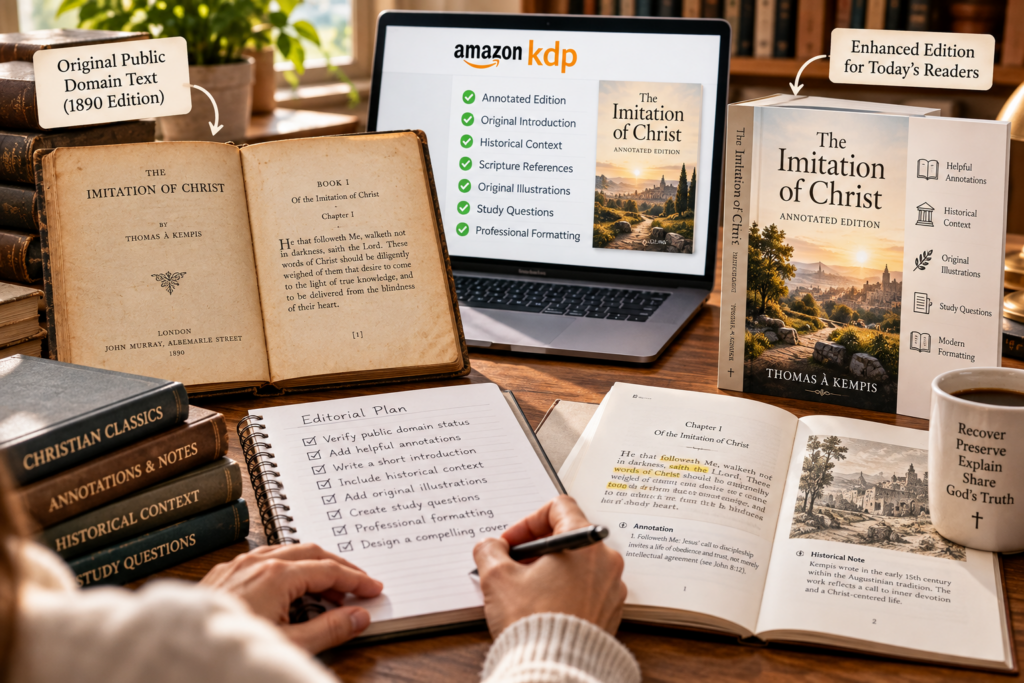
When a free edition exists, Amazon says a differentiated version must qualify through one or more of these categories:
- original translation
- original annotation
- at least 10 original illustrations relevant to the book
Amazon specifically says that the following do not count as sufficient differentiation:
- formatting improvements
- a linked table of contents
- collections
- sales rank
- price
- freely available Internet content Kindle Direct Publishing
That changes the entire publishing strategy.
A prettier cover is not enough.
Cleaner formatting is not enough.
Combining several old texts into one collection may not be enough.
You need to add genuine editorial or creative value.
Annotation Creates One of the Best Opportunities
For Christian publishing, annotation may be especially useful.
A thoughtful annotated edition can help modern readers understand older language, historical context, theological debates, cultural assumptions, or references that are no longer familiar.
Useful annotations might explain:
- archaic terms
- historical events
- denominational references
- people mentioned in the text
- geographical locations
- older theological vocabulary
- historical Bible translation wording
- cultural practices
- quotations from other writers
The key is that the annotation should be original and genuinely useful.
Do not add superficial notes merely to satisfy a requirement.
The added material should make the book better.
Christian Classics Are Especially Well Suited to Contextual Editions
Faith Author Hub has a natural opportunity here because Christian public-domain books often benefit from editorial context.
A nineteenth-century devotional may be spiritually rich but difficult for a modern reader because of:
- older sentence structure
- unfamiliar historical references
- theological terminology
- assumptions about church life
- references to people no longer widely known
A new edition can help readers enter that world.
For example, an edition might include:
- a short introduction to the author
- historical setting
- explanatory notes
- Scripture reference verification
- a reading plan
- reflection questions
- topical index
- glossary
- chronology
- discussion prompts
Not every addition automatically satisfies Amazon’s differentiation rules, so the strongest path is still to ensure the edition genuinely qualifies as annotated, illustrated, or newly translated. Kindle Direct Publishing
Original Illustrations Can Create a Distinct Edition
Amazon also recognizes illustrated public-domain editions when they contain at least 10 original illustrations relevant to the book. Kindle Direct Publishing
That creates interesting possibilities for:
- Christian children’s classics
- missionary accounts
- historical biographies
- allegories
- travel narratives
- hymn histories
- devotional gift books
The illustrations need to be original to your edition.
Do not simply collect old public-domain artwork and assume that qualifies as Amazon’s “original illustrated” differentiation.
If the project relies on the illustration path, create or commission artwork specifically for the edition.
New Translations Can Be Valuable but Require Real Expertise
A new translation is another recognized way to differentiate a public-domain work. Kindle Direct Publishing
That might apply to older Christian texts originally written in:
- Greek
- Latin
- German
- French
- Dutch
- other languages
But translation is not simply replacing words mechanically.
A serious translation requires understanding:
- language
- historical context
- theological terminology
- idiom
- authorial voice
Poor translations can create both quality and credibility problems.
KDP’s content-quality guidance also warns against poorly translated content. Kindle Direct Publishing
If you cannot produce a reliable translation, annotation may be the stronger route.
Project Gutenberg Is Useful, but Understand Its Terms
Project Gutenberg is an excellent research source for older texts.
Most of its ebooks are unrestricted by U.S. copyright law, and Project Gutenberg says those texts may generally be reused commercially in the United States. Project Gutenberg
But the Project Gutenberg trademark and license language are separate from the underlying public-domain text.
Project Gutenberg says that if you remove its license and references to Project Gutenberg, the underlying unrestricted text can generally be reused without the trademark-license obligations. If you keep the Project Gutenberg name associated with the work, additional license requirements apply. Project Gutenberg
So do not simply download a Gutenberg file and upload it unchanged.
Clean the source carefully.
Remove Gutenberg-specific license material when appropriate.
Verify the text.
Then build your own edition.
Verify the Text Before Publishing
Public-domain source files are not automatically error-free.
Older digitized books may contain:
- OCR mistakes
- missing punctuation
- broken words
- inconsistent spelling
- page artifacts
- missing illustrations
- transcription errors
Compare the digital text against a reliable scan or original edition when possible.
For Christian works, also verify:
- Scripture quotations
- Bible references
- author names
- dates
- hymn titles
- theological quotations
A public-domain edition should not be treated as a quick upload.
Editorial quality still matters.
Scripture Requires Extra Attention
Christian public-domain works often contain extensive Bible quotations.
That creates a special issue.
The book itself may be public domain, but a modern Bible translation may not be.
If you modernize or replace Scripture quotations, you may introduce new copyright considerations.
You may decide to preserve the original translation used by the author.
Or you may use another public-domain translation.
If you use a copyrighted modern translation, check its permissions policy.
This is a natural internal-link opportunity to your Faith Author Hub article on Bible Translation Copyright for Authors.
Modernizing Spelling Is Not the Same as Creating a Differentiated Edition
You can modernize spelling or clean punctuation in a public-domain text.
But do not assume that alone will make the edition sufficiently distinct for Amazon.
Amazon specifically says formatting improvements do not qualify as differentiation. Kindle Direct Publishing
The same principle applies to minor editorial cleanup.
Cleaning errors improves quality.
It does not necessarily create enough original value to satisfy KDP’s public-domain differentiation requirements.
Treat proofreading as necessary production work, not as the main selling point.
Collections Are Not Automatically Differentiated
Older publishing advice often recommends bundling several public-domain works together.
That may still create a useful reading experience.
But KDP specifically lists collections among the features it does not consider enough to differentiate a public-domain edition. Kindle Direct Publishing
So if you publish:
Five Classic Christian Devotionals
do not assume the collection itself is enough.
You may still need meaningful original annotation, illustration, or translation.
The collection should have a clear editorial purpose and added value.
Cover Design Still Matters
Even though a new cover does not satisfy Amazon’s public-domain differentiation requirement by itself, it still matters commercially.
A poorly designed edition may look like a low-effort reprint.
A strong cover can communicate:
- historical significance
- devotional tone
- theological seriousness
- intended audience
- gift appeal
- series identity
For Christian classics, avoid making every cover look antique simply because the text is old.
Some books benefit from heritage design.
Others may reach contemporary readers better with clean modern typography and restrained historical cues.
Design for the reader you want today.
Create a Series Identity When Appropriate
Public-domain publishing can become much stronger when individual titles belong to a recognizable editorial series.
For example:
Faith Author Hub Christian Classics
or
Morning Grace Classics
A series might establish consistent standards for:
- typography
- introductions
- annotations
- Scripture references
- cover style
- indexes
- reflection material
The series itself does not satisfy Amazon’s differentiation rule.
But it can help readers recognize a trusted publishing standard.
That becomes valuable across multiple titles.
Do Not Assume Every Famous Classic Is a Good Opportunity
Popularity alone does not make a good public-domain publishing project.
A book with hundreds of competent editions may be difficult to differentiate.
Instead, look for works where your editorial contribution solves a real reader problem.
Ask:
Is the existing text difficult to understand?
Are available editions poorly annotated?
Is the author important but largely forgotten?
Does the book serve a current Christian topic?
Could a modern reader benefit from historical context?
Could the work fit a devotional or study format?
Does it connect naturally with an audience you already serve?
That is a better opportunity than simply choosing the most famous title available.
Public Domain Can Support a Christian Content Ecosystem
A strong edition can lead to more than one product.
A public-domain Christian classic might support:
- annotated edition
- reading guide
- study questions
- newsletter series
- podcast discussion
- article series
- devotional companion
- historical background article
- book-club guide
The key is that each derivative product should add genuine value.
Faith Author Hub could also use these projects to teach Christian authors how historical publishing, rights, annotation, and editorial development work.
Public-Domain Books Have Distribution Limits on KDP
One detail many publishers miss is that public-domain content is not eligible for every KDP program.
Amazon says public-domain content is not eligible for all ebook royalty options or KDP Select. Kindle Direct Publishing
KDP also says public-domain paperbacks are not eligible for Expanded Distribution. Kindle Direct Publishing
That matters if your strategy depends on bookstore or library distribution.
You may need to consider other print-distribution options depending on your goals.
Keep Documentation Showing Why the Work Is Public Domain
Amazon may ask you to prove that the content is public domain. Kindle Direct Publishing
Maintain a simple rights file for every project.
Include:
- original publication date
- original publisher
- author
- source scans
- copyright research
- copyright-renewal research if relevant
- source URLs
- notes about translations
- notes about illustrations
- documentation of your original annotations or illustrations
Do this before publication.
It is much easier than trying to reconstruct the evidence after Amazon asks for it.
Frequently Asked Questions
Can I publish public-domain books on Amazon KDP?
Yes, but Amazon may refuse editions that are already freely available unless your version is meaningfully differentiated. KDP currently recognizes original translations, original annotations, or at least 10 original relevant illustrations as qualifying forms of differentiation. Kindle Direct Publishing
Are books published in 1930 public domain in the United States?
Generally, yes. The U.S. Copyright Office states that all works published in the United States before January 1, 1931 are now in the public domain. Individual rights questions can still require more investigation. U.S. Copyright Office
Is better formatting enough to publish a public-domain book on KDP?
Not by itself. KDP specifically says formatting improvements and linked tables of contents do not count as sufficient differentiation. Kindle Direct Publishing
Can I use Project Gutenberg text?
Often, yes for works unrestricted by U.S. copyright law, but you should understand Project Gutenberg’s trademark and license terms. Removing Project Gutenberg references and license text leaves the underlying unrestricted text available for reuse in the United States. Project Gutenberg
Can I create a collection of several public-domain books?
You can create collections, but KDP says collections alone do not qualify as sufficient differentiation for public-domain content. Kindle Direct Publishing
Can I create an audiobook from a public-domain book?
The underlying public-domain text can generally be recorded without permission in the United States, assuming the text itself is actually public domain. Your original narration is a separate creative work. Platform-specific audiobook requirements should still be checked before publishing.
Can I sell a public-domain book outside the United States?
Possibly, but copyright duration differs by country. Public-domain status in the United States does not automatically mean the work is public domain everywhere. Kindle Direct Publishing
Republish With a Reason
The weakest public-domain publishing strategy is:
This book is free, so I can sell it.
A better strategy is:
This book deserves a better edition for a specific modern reader.
That may mean adding historical context.
Explaining difficult language.
Creating original illustrations.
Building study material.
Producing a reliable new translation.
Correcting errors.
Verifying Scripture.
Designing a professional edition.
The public domain gives you access to the underlying work.
Your value comes from what you responsibly add to it.