Amazon KDP Book Promotion Options: What Authors Can Actually Use
Amazon Ads are only one way to promote a KDP book. Learn how authors can use advertising, KDP Select promotions, email, advance readers, content marketing, communities, and cross-promotion to reach relevant readers.
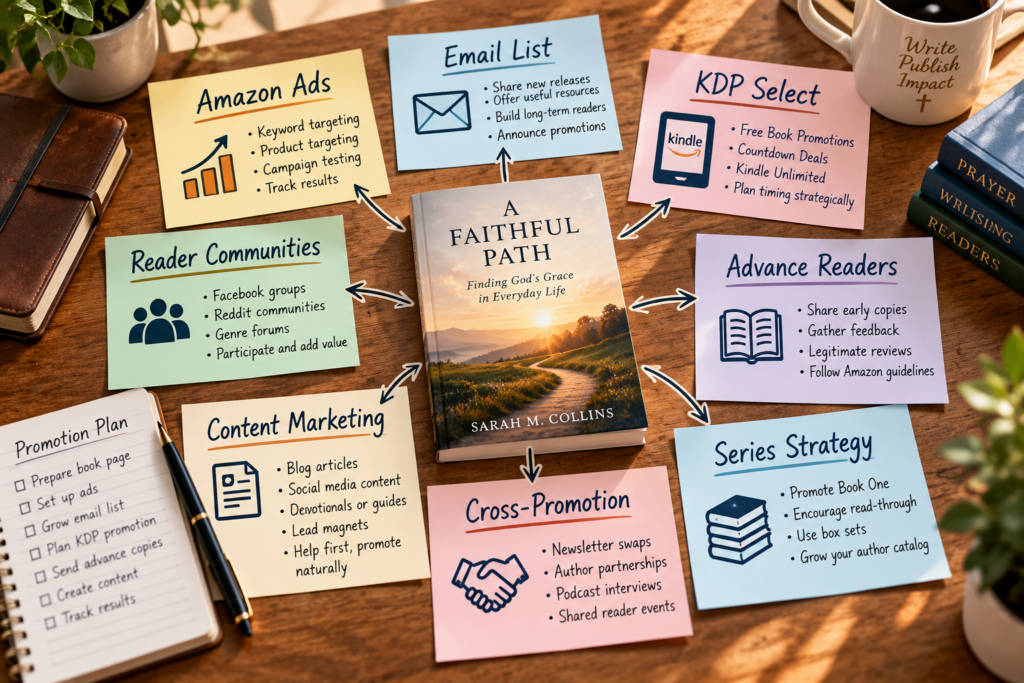
Publishing a book on Amazon is only the beginning.
Readers still have to discover it.
For Christian authors, that creates an important question:
Which book-promotion tools are actually available, and which ones make sense for my audience?
There is no single tactic that guarantees quick sales.
Amazon advertising, KDP Select promotions, email, reader communities, advance copies, author platforms, and cross-promotion all serve different purposes.
The stronger strategy is to understand what each tool can do, choose the ones that fit your book, and measure whether they are actually helping you reach the right readers.
Start With the Book Page Before Promoting Anything
Promotion sends people somewhere.
Usually, that somewhere is your Amazon book detail page.
Before spending money or sending readers to it, check:
- cover
- title
- subtitle
- description
- price
- categories
- author page
- A+ Content
- series information
- Kindle sample
Ask one simple question:
If my ideal reader arrives here, will they understand immediately why this book might be for them?
A promotion cannot compensate indefinitely for unclear positioning.
Traffic creates an opportunity.
The book page still has to make the case.
Amazon Sponsored Products Can Put Your Book in Front of Active Shoppers
Sponsored Products are Amazon’s primary advertising option for individual books.
These are cost-per-click ads. You establish a budget and targeting, and you pay when a shopper clicks the advertisement.
Amazon currently allows authors to use approaches including keyword targeting, product targeting, automatic targeting, and negative targeting. Ads may appear in shopping results and on relevant product pages. Amazon Ads
This makes Sponsored Products useful because the reader is already on Amazon.
They are not being interrupted while doing something unrelated.
They are browsing books.
Do Not Use Only Exact-Match Keywords
The old version of this article recommended exact-match keywords exclusively.
That is unnecessarily restrictive.
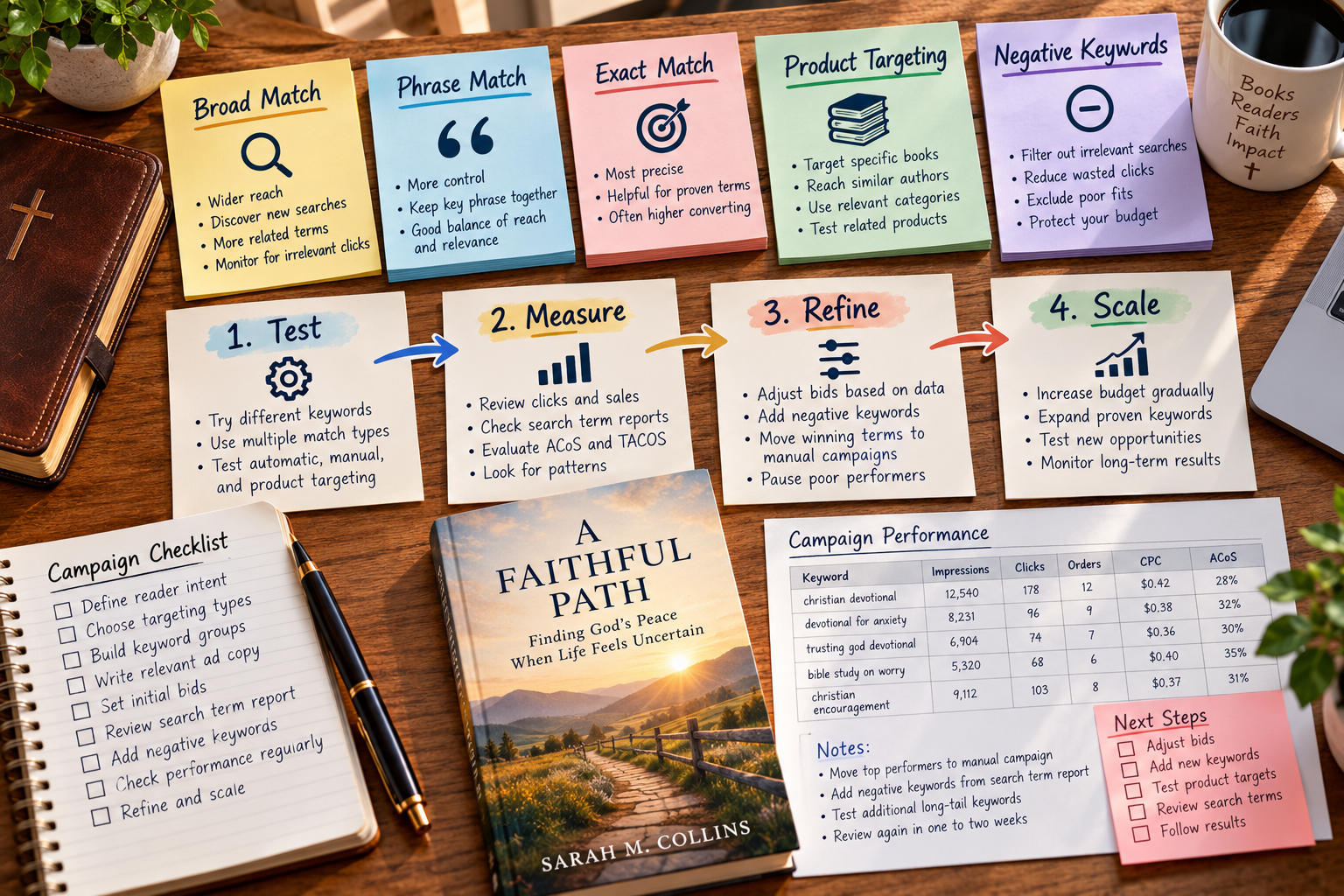
Different targeting types can answer different questions.
Broad or looser targeting
Can help you discover how readers search.
More specific targeting
Can focus spending around clearer reader intent.
Product targeting
Can reach readers viewing related books or genres.
Automatic targeting
Can reveal searches or product relationships you did not think of yourself.
Negative targeting
Can prevent irrelevant searches or products from consuming your budget.
Amazon itself encourages authors to understand different targeting options rather than relying on one approach exclusively. Amazon Ads
Build Advertising Around Reader Intent
Imagine you published a Christian devotional about grief.
Very broad targeting might include:
Christian books
More relevant targeting could include:
Christian devotional
More specific targeting could include:
Christian devotional for grief
or
devotional after losing a loved one
The smaller phrase does not automatically perform better.
But its intent is clearer.
You are trying to find the overlap between:
what the reader wants
and
what your book actually provides.
That principle matters more than following somebody else’s list of supposedly profitable keywords.
Do Not Follow Arbitrary Bidding Formulas
There is no universal rule that authors should bid:
- above Amazon’s recommendation
- below Amazon’s recommendation
- a particular percentage higher
- a fixed number of cents per click
Your bid depends on:
- competition
- royalty
- conversion
- objective
- budget
- book price
- campaign history
Amazon offers several bidding strategies, including fixed bids and dynamic approaches where bids can move based on the likelihood of conversion. Amazon Ads
Start with an amount you can afford to test.
Then use actual campaign results.
Email Remains One of an Author’s Most Valuable Assets
Amazon can change.
Social media algorithms can change.
An email list gives you a direct connection with readers who have voluntarily chosen to hear from you.
That makes email especially useful for:
- new releases
- temporary discounts
- series launches
- audiobook editions
- new devotionals
- special reader resources
The difference between effective email marketing and spam is relevance.
Do not send every subscriber every promotion simply because you can.
Tell readers why the book may matter to them.
For example:
If you have been walking through a season of grief, my new 30-day devotional was written specifically for that journey.
That communicates much more than:
My new book is available now.
Friends and Family Are Not a Marketing Strategy
The original article encouraged authors to contact friends, relatives, coworkers, and clients individually.
There is nothing inherently wrong with telling people you know about your book.
But Faith Author Hub should not teach authors to treat every personal relationship as a sales prospect.
A better principle is:
Tell relevant people naturally. Build your actual readership intentionally.
If your sister genuinely reads Christian historical fiction, she may care about your new novel.
Your former insurance agent probably does not need a personalized sales email simply because you know him.
The goal is readership, not obligation.
Build an Email List Before You Need One
One of the best long-term promotion strategies starts before the next book launches.
Offer readers something useful in exchange for joining your email list.
For a Christian nonfiction author, that might be:
- prayer guide
- Scripture reflection sheet
- short devotional
- reading plan
- discussion guide
- printable worksheet
For Christian fiction:
- bonus scene
- prequel story
- character letter
- reading guide
- series introduction
The free resource should naturally connect to the books you write.
Then the subscriber has a reason to remain interested in what you publish next.
KDP Select Gives Eligible Kindle Authors Promotional Tools
Authors enrolled in KDP Select gain access to specific promotional tools.
KDP Select is a free 90-day program for Kindle ebooks that also includes the title in Kindle Unlimited.
Eligible authors can choose promotional tools including:
- Kindle Countdown Deals
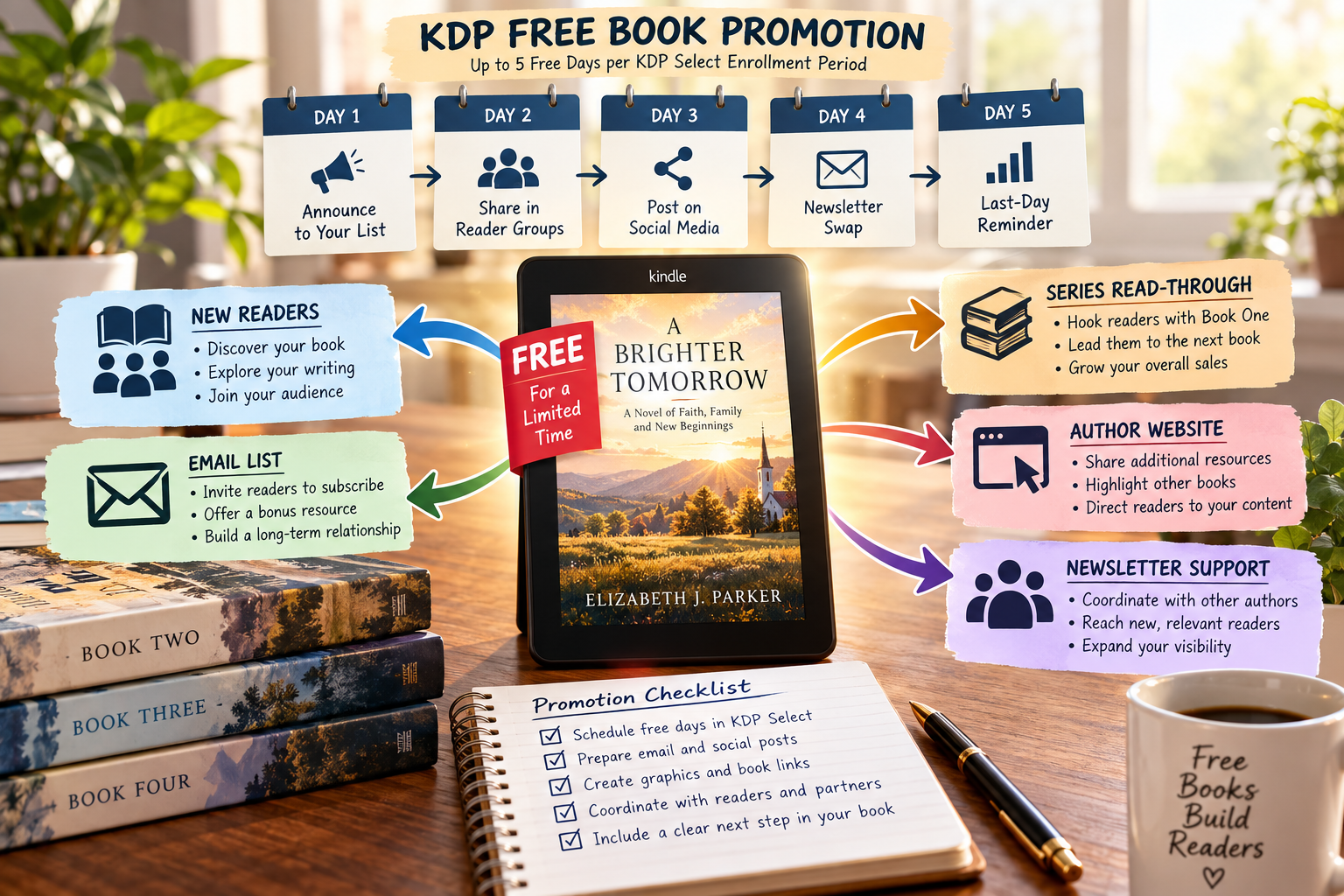
- Free Book Promotions
Free Book Promotions can make the Kindle ebook free for up to five days during an enrollment period.
Countdown Deals allow temporary paid discounts on eligible titles in supported marketplaces. Kindle Direct Publishing
These tools can be useful, but they require KDP Select exclusivity for the Kindle ebook.
That tradeoff should be deliberate.
Free Promotions and Countdown Deals Serve Different Purposes
Do not choose one simply because another author had success with it.
A Free Book Promotion might make sense when your goal is:
- maximum downloads
- introducing Book One of a series
- expanding awareness
- bringing readers into a larger catalog
A Countdown Deal may make more sense when you want:
- paid sales
- temporary urgency
- discounted entry into a series
- a structured promotional price
Neither guarantees read-through or future purchases.
The promotion creates access.
The book must create the relationship.
Advance Reader Copies Can Support a Launch
Advance reader copies, often called ARCs, allow selected readers to receive the book before or around publication.
These can help authors:
- gather reader feedback
- identify last-minute issues
- introduce the book to interested readers
- make legitimate review opportunities possible
But the wording matters.
Amazon permits authors to provide free or discounted copies, provided the copy is not conditioned on a review and the author does not attempt to influence what the reader says. Kindle Direct Publishing
So the principle is not:
Free book in exchange for a review.
It is:
Here is an advance copy. An honest review is welcome, but not required.
That distinction protects both the reader and the author.
Never Buy Reviews
Reviews are valuable because they represent independent reader experiences.
Paying for favorable reviews undermines that.
Likewise, do not:
- reimburse purchases in exchange for reviews
- give gift cards for reviews
- require positive ratings
- tell readers what to write
- pressure personal contacts to post praise
Build reviews through genuine readership.
It is slower.
It is also sustainable.
Reader Communities Can Help, but Lead With Participation
Facebook groups, Reddit communities, forums, Discord groups, church communities, and genre groups can expose authors to potential readers.
But they are communities first.
They are not free advertising inventory.
Before posting a book link:
- read the rules
- understand the culture
- participate genuinely
- contribute useful information
- use designated promotional threads when required
Some groups welcome author promotions.
Others prohibit them completely.
Respect the space.
A Christian author should be particularly cautious about entering a faith community primarily to extract customers.
Serve first.
Promote where appropriate.
Share Useful Content Instead of Constant Book Links
Content marketing gives potential readers a reason to discover your work before they are asked to buy anything.
Suppose your book is about prayer during difficult seasons.
You might publish:
- article on unanswered prayer
- short Scripture reflection
- prayer worksheet
- Pinterest pin
- newsletter reflection
- Facebook discussion
The book becomes the deeper resource connected to that content.
This is one reason a platform such as Faith Author Hub matters.
Searchable content can continue introducing readers to relevant ideas long after a launch campaign ends.
Cross-Promotion Can Work When Audiences Truly Overlap
Authors sometimes benefit from working together.
Possibilities include:
- newsletter swaps
- themed reader events
- multi-author giveaways
- podcast appearances
- interviews
- shared seasonal promotions
- curated reading lists
But audience fit matters.
Two books being Christian does not automatically mean they serve the same reader.
A scholarly theological reference book and a Christian romantic comedy share a broad faith category but very different buying audiences.
Look for meaningful overlap.
Series Promotion Changes the Economics
Authors with series have additional options.
Instead of asking whether advertising Book One is directly profitable by itself, ask whether readers continue into:
- Book Two
- Book Three
- Book Four
A lower-priced first book may make financial sense if enough readers continue through the series.
That same strategy makes little sense for a standalone book with no related catalog.
Promotion economics depend on what happens after the first sale.
Sponsored Brands Become Relevant as Your Catalog Grows
Amazon also offers Sponsored Brands to eligible authors with three or more qualifying titles under the same author name.
These ads can feature multiple books and help present the author’s wider catalog. Amazon Ads
That can be particularly useful for:
- Christian fiction series
- devotional collections
- Bible-study collections
- related nonfiction books
For an author with one book, Sponsored Products are usually the more straightforward starting point.
As the catalog grows, promotion can shift from:
Sell this book
toward:
Introduce this author and this body of work.
Book Promotion Services Can Provide Additional Reach
Third-party promotional newsletters and reader-discovery services can also play a role.
Some specialize in:
- discounted ebooks
- free ebooks
- specific genres
- new releases
Evaluate them based on:
- audience relevance
- cost
- submission requirements
- actual performance
- whether they fit your book
Do not assume a large email list means a large number of appropriate readers.
Audience fit matters more than headline subscriber counts.
Track What You Can Actually Measure
Promotion becomes much more useful once you stop judging it by activity alone.
Do not ask:
How many posts did I make?
Ask:
What happened afterward?
Depending on the channel, useful measurements can include:
- email opens
- email clicks
- landing-page visits
- ad impressions
- ad clicks
- advertising spend
- attributed Amazon sales
- Kindle Unlimited page reads
- book sales
- series read-through
- newsletter signups
You may not be able to attribute every sale perfectly.
That is normal.
Look for patterns rather than pretending the data is more precise than it is.
Avoid Fake Precision
The old article included rules such as:
Stop a keyword after 20 clicks.
Spend $5 every day.
Wait three weeks before requesting a review.
Those numbers may occasionally be useful examples.
They are not universal publishing laws.
A $5 advertising budget may generate useful data in one category and almost nothing in another.
Twenty clicks may be meaningful for one book and insufficient for another.
Promotion should respond to evidence.
Not arbitrary thresholds.
Christian Authors Should Protect Reader Trust
Christian publishing carries an additional responsibility.
Marketing should not manipulate faith.
Avoid statements such as:
God led you to this book.
This book will restore your marriage.
Buy this devotional and overcome anxiety.
You cannot know those outcomes.
Instead, describe what the book actually offers.
For example:
A 30-day devotional exploring Scripture, prayer, and trust during uncertain seasons.
That is strong marketing.
It is also truthful.
Build Promotion Around the Book’s Purpose
Different books need different promotional mixes.
A Christian romance novel may benefit from:
- Amazon Ads
- series promotion
- reader newsletters
- genre groups
- advance readers
A Bible study may benefit from:
- church connections
- downloadable study resources
- articles
- small-group outreach
A devotional may benefit from:
- search content
- seasonal promotion
- related lead magnets
Do not force every book through the same marketing formula.
Follow the reader.
Frequently Asked Questions
What is the best way to promote a KDP book?
There is no universal best method. Amazon Ads, email marketing, KDP Select promotions, reader communities, advance copies, content marketing, and partnerships can all be useful depending on the book and audience.
Should I run Amazon Ads as soon as I publish?
You can advertise during launch, but first make sure your book page is ready to convert interested shoppers. Amazon specifically positions Sponsored Products as useful during launch, post-launch growth, and series promotion. Amazon Ads
How much should a new author spend on Amazon Ads?
There is no required starting amount. Use a budget you can afford to treat as testing money, gather data, and adjust based on actual results.
Can I give readers free books and ask for reviews?
You can provide free or discounted copies, but Amazon prohibits requiring a review in exchange or trying to influence the review. Kindle Direct Publishing
Does KDP offer free book promotions?
Yes. Eligible Kindle ebooks enrolled in KDP Select can use a Free Book Promotion for up to five days during the applicable enrollment period. Kindle Direct Publishing
Should I use a Kindle Countdown Deal instead?
Possibly. Countdown Deals maintain a paid promotional price while Free Book Promotions reduce the ebook to zero. The better option depends on your objective.
Should I promote in Facebook groups?
Only when the group’s rules allow it and the promotion is relevant. Participate as a member rather than treating every group as advertising space.
What should I promote if I have several books?
Series entry points, related titles, or your broader author catalog may make more sense than promoting every title equally.
Promotion Is a System, Not a Trick
Successful book promotion is rarely one magic tactic.
It is a combination of:
a book readers actually want
a clear product page
the right audience
appropriate promotional channels
reasonable testing
measurement
continued improvement
Amazon Ads can help.
Email can help.
KDP Select promotions can help.
Advance readers can help.
Communities and partnerships can help.
But none of them replace understanding who the book was written for.
Find that reader first.
Then choose the promotional tools that give them the best chance to discover you.