How KDP Free Book Promotions Work and When They Make Sense
KDP Free Book Promotions let eligible KDP Select authors offer a Kindle ebook free for up to five days. Learn how the program works and when giving a book away can support a larger reader strategy.
Giving away a Kindle ebook for free can sound counterintuitive.
Why would an author spend months writing a book and then give it away?
Because sometimes the goal of a promotion is not immediate revenue.
A KDP Free Book Promotion can help introduce a book to new readers, bring attention to the first book in a series, support a launch campaign, or give an older title another opportunity to be discovered.
But free does not automatically mean effective.
The promotion works best when the author knows exactly what the free period is supposed to accomplish.
What Is a KDP Free Book Promotion?
A Free Book Promotion is available to eligible Kindle ebooks enrolled in KDP Select.
KDP Select is Amazon’s 90-day ebook exclusivity program.
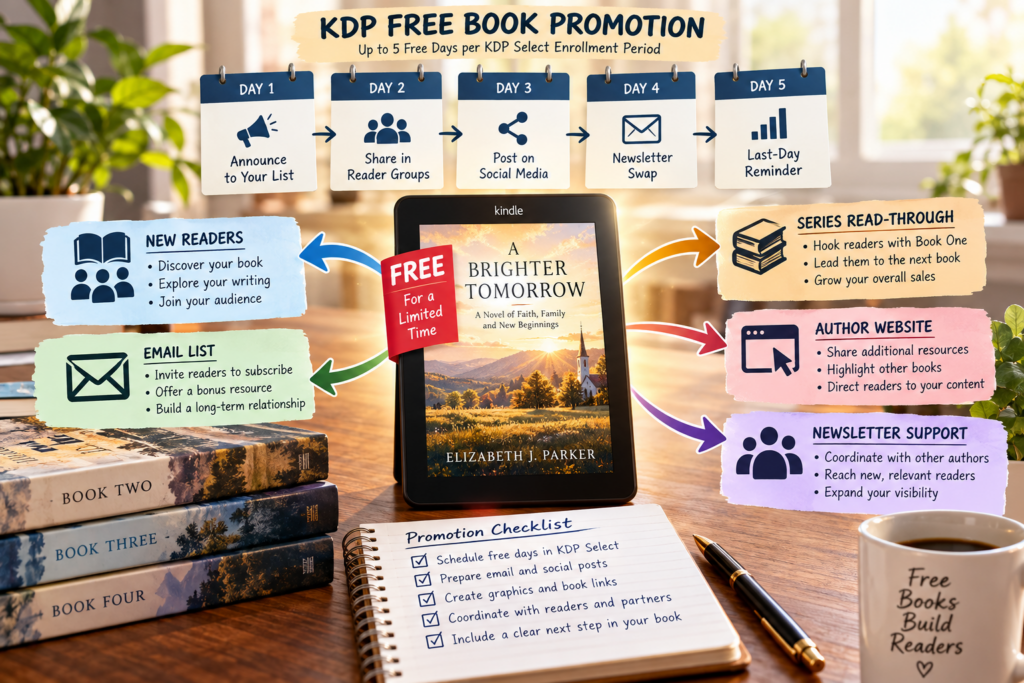
During a Free Book Promotion, the Kindle edition can be offered to readers at no charge for up to five days during the current KDP Select enrollment period.
Those five days can be used:
- all at once
- one day at a time
- in shorter multi-day promotions
Unused promotional days do not carry over into the next enrollment period.
Free Book Promotions Are for Kindle Ebooks Only
The promotion affects the Kindle ebook edition.
It does not make your:
- paperback
- hardcover
- audiobook
free.
Those formats can remain available at their normal prices.
That gives authors an opportunity to use the Kindle edition as an entry point without discounting every version of the book.
Your Ebook Must Be Enrolled in KDP Select
Free Book Promotions are a KDP Select benefit.
That means your Kindle ebook must follow KDP Select’s exclusivity requirements during the enrollment period.
The ebook generally cannot be distributed digitally through another retailer or platform during that term.
Print, audio, and other non-digital formats can still be distributed elsewhere.
This tradeoff should be considered before enrolling.
A free promotion may be useful, but it should not be the only reason you choose exclusivity.
Public-Domain Books Are Not Eligible for KDP Select
This matters for Christian authors publishing classic works.
A straightforward public-domain edition is not eligible for KDP Select.
That means it cannot use a KDP Free Book Promotion.
If you publish older Christian works, do not assume every Kindle title qualifies simply because it is available through KDP.
Original books and qualifying works where you control the required rights are different.
You Get Up to Five Free Days Per Enrollment Period
Each 90-day KDP Select enrollment period gives you access to up to five Free Book Promotion days.
You do not have to use all five.
A one-day promotion may make sense for one book.
A three-day promotion may make sense for another.
A full five-day promotion may support a larger campaign.
The number of days should follow the strategy.
Do not assume longer is always better.
You Must Choose Between Free Promotions and Countdown Deals
Within a KDP Select enrollment term, authors choose between the two promotional types:
- Free Book Promotion
- Kindle Countdown Deal
You cannot use both promotional types for the same ebook during the same enrollment period.
That makes the decision more important.
A free promotion and a discounted paid promotion accomplish different things.
When a Free Promotion Can Make Sense
A free promotion can be useful when your objective is reader acquisition rather than immediate royalties.
Possible goals include:
- introducing Book One of a series
- attracting readers to a new author
- bringing attention to an older title
- supporting a new release elsewhere in the series
- growing an email list
- encouraging readers to explore related books
- supporting a broader marketing campaign
The promotion should have a reason.
“Free because Amazon allows it” is not a strategy.
Series Authors Have a Natural Advantage
Series authors often have the clearest use case.
Suppose you publish a five-book Christian mystery series.
You make Book One free temporarily.
A new reader downloads it.
If they enjoy it, Books Two through Five remain available at their normal prices.
The free book becomes an entry point.
That can make more strategic sense than discounting a standalone title with nowhere for the reader to go afterward.
Christian Fiction Can Use Free Promotions as an Entry Point
Christian fiction authors can use a free period to introduce readers to:
- a series
- a recurring character
- a fictional world
- an author brand
For example, you might make the first book in a Christian historical romance series free while promoting a newly released fourth book.
The marketing message becomes:
Start the series free for a limited time.
That is much stronger than simply announcing:
My book is free.
The promotion now connects to a larger reading journey.
Devotionals Need a Different Goal
A devotional usually does not have the same series-read-through structure.
The goal may instead be audience growth.
A free devotional could support:
- newsletter growth
- a related Bible study
- a new devotional release
- a seasonal campaign
- ministry outreach
- related website content
For example, a devotional about grief might be promoted alongside:
- grief-related articles
- Scripture reflections
- Pinterest content
- email newsletters
- downloadable prayer resources
The free book becomes part of a larger content ecosystem.
Free Does Not Guarantee That Readers Will Read
This is one of the most important realities.
A free download is not the same as a reader.
People download books they never open.
They download books they intend to read later.
They collect free books simply because they are free.
So download count alone does not tell you whether the promotion succeeded.
The better question is:
What happened after the download?
Give Free Readers a Clear Next Step
The book should make it easy for an interested reader to continue the relationship.
Possible next steps include:
- join your email list
- read the next book in the series
- download a companion resource
- visit your website
- discover another related book
- subscribe to your newsletter
Do not overwhelm the reader with ten calls to action.
Choose one or two logical next steps.
A strong back matter section can make a substantial difference.
Build the Email List Connection Carefully
A free promotion can introduce readers to your broader platform.
Suppose your devotional includes a link to:
Free 7-Day Prayer Guide
The reader finishes the devotional, visits the landing page, and joins your email list.
Now the free download has created a direct relationship.
That may be more valuable than the original ebook sale would have been.
The free resource should genuinely complement the book.
Do not use a generic giveaway disconnected from the reader’s reason for downloading.
Coordinate the Promotion With Your Existing Audience
Do not assume Amazon will provide all the traffic.
Tell your existing audience when the promotion begins.
Possible channels include:
- author website
- reader groups
- launch team
- relevant communities
- partner newsletters
The promotion supplies the offer.
Your marketing helps people discover it.
Do Not Spam Reader Communities
Free does not give you permission to ignore community rules.
Before promoting in:
- Facebook groups
- Reddit communities
- forums
- church groups
- online reader communities
check the rules.
Some allow promotions only on certain days.
Some require designated threads.
Some prohibit self-promotion entirely.
Respect the community.
Free books can still be spam.
Cross-Promotion Can Expand Reach
Other authors may serve a similar readership.
That creates opportunities for:
- newsletter swaps
- themed promotions
- reader events
- joint giveaways
- curated reading lists
For example, several Christian historical fiction authors might coordinate promotions around a shared theme.
Each author introduces readers to relevant books without pretending every Christian book serves the same audience.
Fit matters.
Consider Paid Advertising Carefully
You can promote a free book through paid advertising.
But remember what you are buying.
You are paying to acquire readers, not direct revenue from the free download.
That means you need a clear downstream objective.
For example:
Free Book One → Reader enjoys it → Reader buys Book Two
or:
Free devotional → Reader joins email list → Reader discovers future books
Without a next step, paid advertising to a free book can become expensive very quickly.
Do Not Assume Free Downloads Improve Paid Ranking
The old version of this article overstated this.
Free and paid activity are not the same thing.
During a free promotion, the book participates in Amazon’s free rankings rather than generating ordinary paid sales.
A strong free promotion may introduce more people to the book.
Some of those readers may later purchase other books.
But authors should not assume that a large number of free downloads guarantees a lasting paid ranking boost afterward.
Treat any post-promotion lift as something to measure, not something promised.
Do Not Assume Free Promotions Automatically Generate Reviews
Free readers are not required to review.
Many will never finish the book.
Some will finish and never review.
A few may choose to leave an honest review.
That is normal.
Do not calculate promotion success using formulas such as:
500 downloads should produce 10 reviews.
Reader behavior is not that predictable.
And never condition access to the free book on leaving a review.
What Should You Measure?
Start with the objective.
If your goal is series discovery, measure:
- downloads
- later sales of Book Two
- later sales of Book Three
- Kindle Unlimited reading
- series activity
If your goal is email growth, measure:
- landing-page visits
- email signups
- subscriber engagement
If your goal is broader awareness, measure:
- website traffic
- social engagement
- later sales
- reader responses
Downloads matter.
They simply are not the whole story.
Compare Results With Your Normal Baseline
Before the promotion, record normal activity.
For example:
- average daily sales
- Kindle Unlimited page reads
- email subscribers
- series sales
- website visits
Then compare what happens during and after the campaign.
This gives you useful context.
Without a baseline, a spike may look impressive without telling you whether it actually changed anything meaningful.
Do Not Invent Universal Success Thresholds
The old article suggested specific ranking improvements and review percentages.
Those should be removed.
There is no universal number of:
- downloads
- reviews
- ranking positions
- post-promotion sales
that defines success.
A niche theological book and a Christian romance novel may behave very differently.
Judge the promotion against the purpose you established before it began.
Schedule the Promotion in Advance
Free Book Promotions must be scheduled before the desired start date.
The earliest available start is generally after the first day of the KDP Select enrollment period.
Do not wait until the morning you want the promotion to begin.
Plan ahead.
Prepare your:
- social posts
- website announcement
- promotional graphics
- reader outreach
before the free period starts.
Think About Timing Strategically, Not Superstitiously
You will find plenty of advice claiming:
- Tuesday is best
- weekends are best
- three days are always ideal
- five days are always better
- never use single days
Those rules are too simplistic.
Timing should depend on:
- your audience
- email schedule
- launch calendar
- series releases
- seasonal relevance
- other promotions
- available marketing support
A Christmas devotional has a different promotional calendar from a year-round Christian suspense novel.
Use logic rather than folklore.
Seasonal Christian Books Can Benefit From Planned Timing
Christian publishing has natural seasonal opportunities.
Examples include:
- Advent
- Christmas
- Lent
- Easter
- Mother’s Day
- Father’s Day
- graduation
- back-to-school
- Thanksgiving
- New Year
A free promotion connected to a genuine seasonal need can be more relevant than a random free period.
For example:
A short Advent devotional offered free in late November has a clear reason to exist.
The timing follows reader interest.
Avoid Manipulative Faith-Based Messaging
A free Christian book does not need spiritual pressure.
Avoid messages such as:
God wants you to download this today.
or:
This free book could be the answer God sent you.
Instead:
The Kindle edition is free through Friday for readers looking for a Scripture-based devotional on hope during difficult seasons.
That communicates the offer honestly.
Frequently Asked Questions
How many free promotion days does KDP Select provide?
Eligible Kindle ebooks can be offered free for up to five days during each 90-day KDP Select enrollment period.
Do I have to use all five days at once?
No. You can use the days together or divide them into shorter promotions during the same enrollment period.
Can I use a Free Book Promotion and Countdown Deal in the same KDP Select term?
No. You choose one promotional type for that enrollment period.
Can I use Free Book Promotions for paperbacks?
No. They apply to eligible Kindle ebooks.
Can I use Free Book Promotions for public-domain books?
Public-domain books are not eligible for KDP Select, so they cannot use this promotion.
Do unused free days roll over?
No. Unused promotion days do not carry into the next KDP Select enrollment period.
Do free downloads guarantee more paid sales afterward?
No. A promotion may introduce new readers, but later sales depend on reader engagement, book quality, series structure, marketing, and many other factors.
Will free readers automatically leave reviews?
No. Readers may choose to review the book, but there is no guaranteed review rate.
Should Book One in a series be free?
It can be a useful strategy because readers who enjoy Book One may continue into later paid books. Whether it makes sense depends on your series economics.
Make Free Part of a Larger Strategy
A KDP Free Book Promotion is not valuable simply because the price reaches zero.
Its value comes from what happens next.
A reader discovers your book.
They read it.
They enjoy it.
Then perhaps they:
- continue the series
- join your email list
- discover another book
- recommend your work
- become a long-term reader
That is the real objective.
Before scheduling a free promotion, decide exactly what you want the reader to do after downloading the book.
Then build the promotion around that next step.