KDP Hardcover vs Paperback: What Christian Authors Should Compare
Compare KDP hardcover and paperback publishing for Christian authors, including printing costs, royalties, trim sizes, page limits, distribution, pricing, gift appeal, and when offering both formats makes sense.
Amazon KDP gives independent authors more than one print option.
For many books, paperback is the obvious starting point.
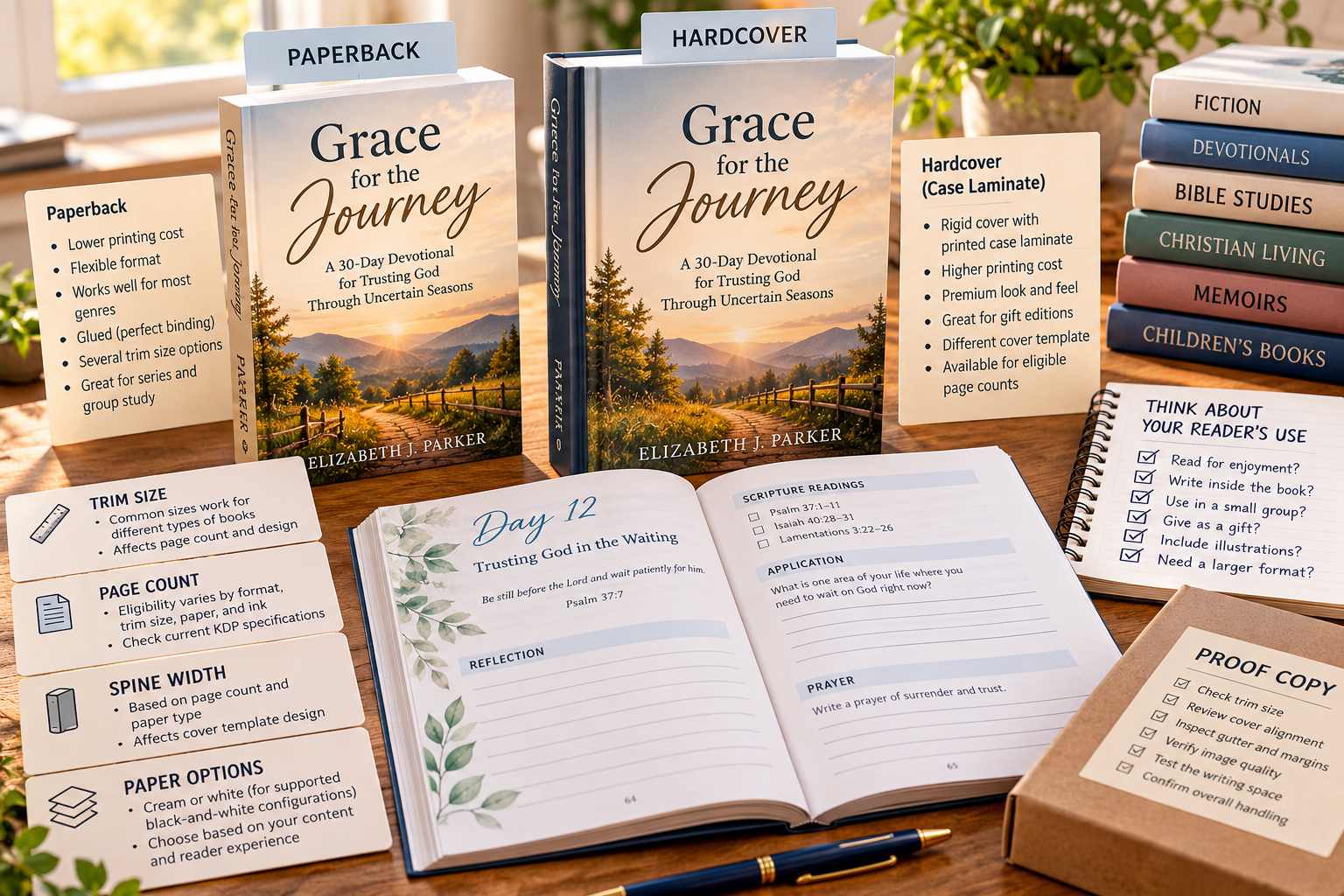
But hardcover can make sense too, especially for Christian devotionals, gift books, keepsake titles, Bible studies, memoirs, children’s books, and books intended to feel more permanent.
The important question is not:
Which format pays more?
It is:
Which format makes sense for this book, this reader, and this price point?
Hardcover and paperback use different printing costs, page limits, trim-size options, pricing expectations, and distribution possibilities.
Those differences matter more than the binding alone.
Hardcover Does Not Automatically Earn More Per Sale
A hardcover can have a higher list price than a paperback.
That does not automatically mean it earns more.
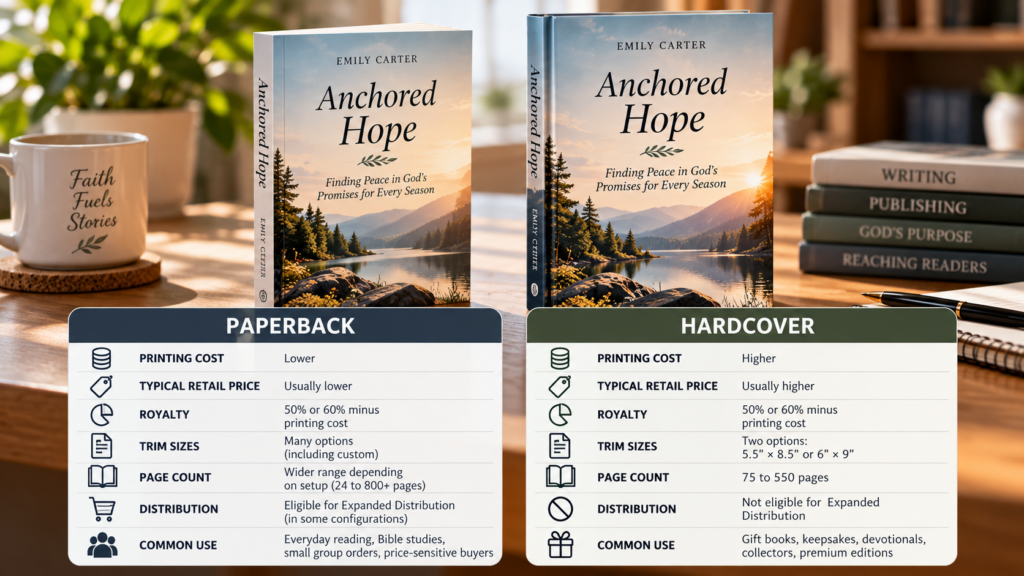
For both paperback and hardcover sold through Amazon, KDP currently uses either a 50% or 60% royalty rate depending on the list price and marketplace.
Then KDP subtracts the printing cost. Kindle Direct Publishing
The basic formula is:
Royalty rate × list price – printing cost = royalty
That means three things matter:
- list price
- royalty tier
- printing cost
Hardcovers cost more to manufacture than paperbacks.
For example, KDP’s current U.S. printing-cost table shows a 300-page black-ink regular-trim hardcover costing about $9.25 to print. Kindle Direct Publishing
A comparable paperback generally costs much less to manufacture. Kindle Direct Publishing
So a hardcover needs a sufficiently higher list price to create a larger royalty.
Sometimes it does.
Sometimes it does not.
Run the actual numbers for your book before deciding.
Use KDP’s Calculator Instead of Guessing
KDP provides a Printing Cost and Royalty Calculator specifically for paperbacks and hardcovers. Kindle Direct Publishing
Use it before finalizing pricing.
Enter:
- trim size
- page count
- ink type
- marketplace
- format
- list price
Then compare the estimated royalty for paperback and hardcover.
This is much more useful than relying on generic examples such as:
paperback earns $3
and
hardcover earns $6
Those numbers may not apply to your book at all.
Hardcover Printing Costs Are Higher
The biggest economic difference is manufacturing cost.
KDP calculates hardcover printing costs using:
fixed cost + page count × per-page cost
For a regular-trim black-ink hardcover on Amazon.com, current KDP pricing for books from 110 to 550 pages uses a fixed cost plus a per-page charge. Kindle Direct Publishing
Paperbacks use a lower cost structure. Kindle Direct Publishing
This matters especially for:
- long books
- color interiors
- image-heavy books
- low-price books
A higher manufacturing cost creates a higher minimum viable list price.
That is why hardcover pricing should be decided from the cost structure upward, not simply by adding a few dollars to the paperback price.
KDP Hardcover Trim Sizes Are Limited
KDP currently supports two hardcover trim sizes:
- 5.5″ × 8.5″
- 6″ × 9″
Both support black ink on white or cream paper and premium color on white paper. Kindle Direct Publishing
That makes hardcover a good fit for many:
- novels
- memoirs
- devotionals
- Christian nonfiction
- Bible-study books
But it may not suit books needing larger or unusual dimensions.
Paperback offers many more trim sizes and also allows custom sizes within KDP’s permitted range. Kindle Direct Publishing
If you are developing a workbook, children’s activity book, large-format devotional, cookbook, or other specialty product, check the trim options before deciding on hardcover.
Hardcover Page Count Is Also More Restricted
KDP hardcover currently supports 75 to 550 pages. Kindle Direct Publishing
Paperback can support much wider page-count ranges depending on ink, paper, and trim size.
For example, some black-and-white paperback configurations can run from 24 pages to more than 800 pages. Kindle Direct Publishing
So hardcover may not work for:
- very short gift books
- very long reference books
- some extensive workbooks
- certain specialty formats
Check your final page count before planning the hardcover edition.
KDP Hardcovers Use Case Laminate Covers
This is another important correction.
KDP does not currently offer dust jackets.
Its hardcover books are case laminate.
That means the cover artwork is printed directly onto the hardcover surface. Kindle Direct Publishing
The hardcover file includes:
- front cover
- back cover
- spine
There are no dust-jacket flaps.
That simplifies the production process but also limits certain premium-design approaches.
If you want a traditional jacketed hardcover, you would need a different printer or distribution service.
Paperback Offers More Distribution Flexibility
KDP hardcovers are not eligible for Expanded Distribution. Kindle Direct Publishing
Eligible paperbacks can participate in Expanded Distribution, which may make them available to distributors serving bookstores, online retailers, libraries, and academic institutions.
That does not guarantee those organizations will stock or order the book.
But the option exists for paperback.
For authors who care about broad bookstore or library availability, that can be a meaningful difference.
If hardcover wholesale distribution is important, compare other print services such as IngramSpark rather than assuming KDP hardcover will serve that role.
Hardcover Can Make Sense for Gift-Oriented Christian Books
Some Christian books naturally lend themselves to premium formats.
Examples include:
- devotional gift books
- prayer books
- family keepsakes
- Christian memoirs
- anniversary or memorial books
- premium Bible-study editions
- special-edition fiction
- collectible series
In those cases, readers may be willing to pay more because the book feels permanent or giftable.
A hardcover devotional purchased for a birthday, Christmas, graduation, baptism, or retirement can serve a different buying occasion from the paperback edition.
That is a product-positioning issue, not just a royalty issue.
Paperback Usually Offers the Lowest Purchase Barrier
Paperback still has a strong advantage.
It usually allows a lower retail price.
That matters when:
- the author is unknown
- the audience is price-sensitive
- the book is part of a series
- readers are buying multiple copies
- churches or small groups are ordering in quantity
- the book is intended for everyday use rather than gifting
For a Bible study that a church wants 30 copies of, paperback may be much easier to justify.
For a gift devotional, hardcover may make more sense.
The reader and buying occasion should drive the decision.
Some Books Benefit From Offering Both
You do not necessarily have to choose only one.
A paperback can serve the budget-conscious reader.
A hardcover can serve:
- gift buyers
- collectors
- loyal readers
- premium buyers
When both editions are available, readers can choose.
That is often more useful than trying to force one format to serve every audience.
Do Not Launch Hardcover First Just Because It Costs More
The old article recommended hardcover-first launches as a general strategy.
I would remove that.
There is no universal reason to assume delaying paperback will create more urgency or profit.
For some established authors or special editions, a hardcover-first release may make sense.
For most independent authors, especially those without a proven audience, restricting buyers to the more expensive format can reduce accessibility.
Choose release order based on:
- audience
- existing demand
- genre
- gift appeal
- launch strategy
- price sensitivity
Do not assume premium pricing automatically creates premium demand.
Christian Fiction May Use Hardcover Differently
A Christian fiction author may use hardcover for:
- collector editions
- signed editions
- series sets
- special launches
But the paperback may still be the primary reading format.
For an established series with loyal readers, hardcover can add another revenue tier.
For a debut novel, paperback may remain the easier entry point.
Again, audience behavior matters more than format prestige.
Devotionals May Be Strong Hardcover Candidates
Devotionals are particularly interesting because they often live on a nightstand, desk, or gift table.
Readers may interact with them repeatedly rather than read once and shelve them.
That can make durability and presentation more valuable.
If the devotional has:
- elegant interior design
- premium illustrations
- gift positioning
- daily reading structure
hardcover may strengthen the product.
But run the printing-cost math first.
A premium format only works if the retail price still makes sense to the intended reader.
Bible Studies and Workbooks Need a Different Calculation
A hardcover Bible study may sound premium.
But it may be impractical.
Readers often want Bible-study materials that:
- lie flat
- can be written in easily
- cost less in bulk
- can be replaced without concern
KDP hardcover does not provide spiral binding.
So a hardcover may look more premium while actually being less functional for some workbook uses.
Paperback may serve the study experience better.
Think about use, not appearance alone.
Color Books Can Become Expensive Quickly
KDP supports premium-color hardcover printing, but color carries a much higher per-page manufacturing cost. Kindle Direct Publishing
That can affect:
- children’s books
- illustrated devotionals
- photography books
- art books
- educational resources
A beautiful hardcover may require a retail price the audience will not accept.
Before committing, compare:
- printing cost
- minimum list price
- expected retail price
- likely buyer
Do that before investing heavily in design.
Order a Physical Proof Before Publishing
Always inspect the printed product.
A digital preview cannot fully show:
- cover feel
- spine appearance
- interior margins
- gutter behavior
- color reproduction
- binding
- physical weight
- perceived quality
A hardcover is often purchased specifically because it feels premium.
Make sure the finished product actually supports that expectation.
Paperback and Hardcover Metadata Should Usually Match
The old article suggested changing subtitles, descriptions, and keywords between paperback and hardcover.
I would not recommend that as a default.
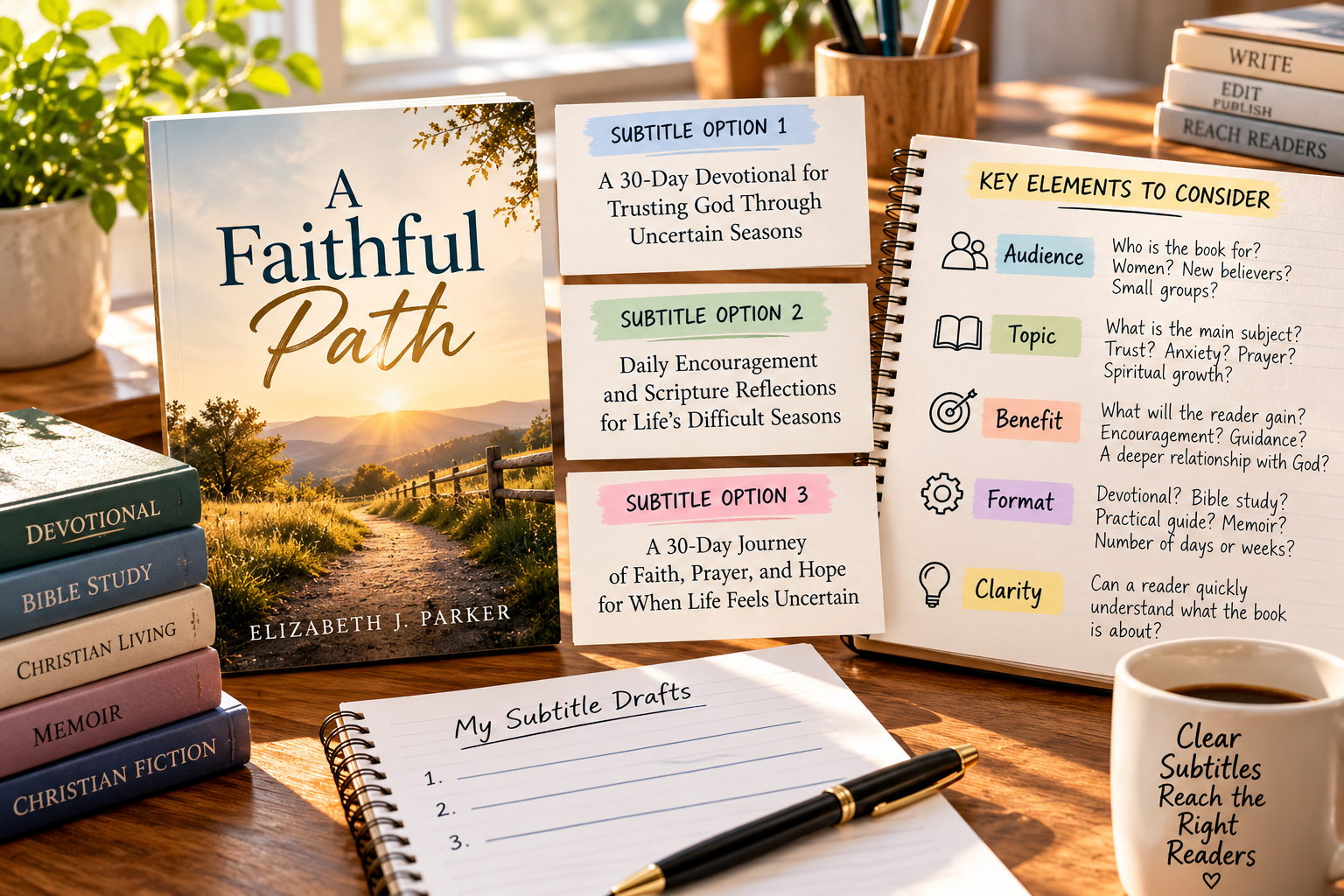
If paperback and hardcover are simply two formats of the same edition, consistent metadata helps Amazon recognize them as related formats.
Keep core metadata aligned:
- title
- subtitle
- author
- series
- edition
- description
The format itself is already different.
You generally do not need to invent a separate positioning statement for the hardcover unless it is truly a distinct edition.
Frequently Asked Questions
Does KDP hardcover pay more than paperback?
Not automatically. Both currently use a 50% or 60% royalty rate for Amazon sales depending on list price. Hardcover printing costs are higher, so the final royalty depends on price, page count, trim size, ink type, and marketplace. Kindle Direct Publishing
What hardcover sizes does KDP offer?
KDP currently supports 5.5″ × 8.5″ and 6″ × 9″ hardcover trim sizes. Kindle Direct Publishing
What is the KDP hardcover page limit?
KDP currently supports hardcovers from 75 to 550 pages. Kindle Direct Publishing
Does KDP offer dust jackets?
No. KDP currently produces case-laminate hardcovers with artwork printed directly onto the cover. Kindle Direct Publishing
Can KDP hardcovers use Expanded Distribution?
No. KDP states that hardcover books are not eligible for Expanded Distribution. Kindle Direct Publishing
Should I offer both hardcover and paperback?
Often, yes. Paperback can serve price-conscious readers while hardcover serves gift buyers, collectors, or readers who prefer a premium physical edition.
Which Christian books are strongest candidates for hardcover?
Devotionals, gift books, memoirs, premium Bible-study resources, children’s books, and collectible fiction editions may benefit from hardcover when the reader sees enough value to justify the higher price.
Compare the Book, Not Just the Binding
Hardcover is not automatically more profitable.
Paperback is not automatically the better choice.
The right format depends on:
- printing cost
- list price
- royalty
- audience
- intended use
- trim size
- page count
- color requirements
- distribution goals
- gift appeal
Run both formats through KDP’s calculator.
Then think about the reader.
If hardcover creates enough additional value to justify its price, offer it.
If paperback better serves the way the book will actually be bought and used, choose paperback.
And when both formats serve different buyers, there is nothing wrong with offering both.